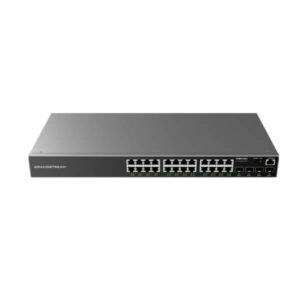
FortiSwitch 224E-POE in Dubai, UAE
A practical managed access switch for offices, branches and distributed business networks that need 24 Gigabit copper access ports, four Gigabit SFP uplinks and a controlled PoE+ budget for selected powered endpoints. FourTeck.com helps business buyers confirm the correct model, port plan, PoE demand, uplink optics, FortiGate management approach and delivery requirement before quotation.
Request QuoteCheck UAE Availability
Quick Product Information
Fortinet
FS-224E-POE
Managed Layer 2/3 PoE+ access switch
24 x Gigabit Ethernet RJ45
4 x Gigabit SFP
12 x 802.3af/802.3at ports, 180 W total budget
1RU rack mount
FortiGate switch-controller compatible; dedicated management and console ports
Branch offices, SMB networks and distributed access environments
Contact FourTeck.com for current options
Vendor datasheet lists limited lifetime warranty; entitlement should be verified for the supplied unit
Share port, PoE, uplink, quantity and deployment details for quotation
Buyer Snapshot: Is This the Right Fit?
This model makes the most sense when a buyer needs a conventional Gigabit access layer with a moderate number of powered devices rather than PoE on every copper port. Its 24 RJ45 interfaces provide room for ordinary wired endpoints, while 12 PoE+ ports and a 180 W shared budget can support compatible devices when their combined power draw is properly planned. Four Gigabit SFP interfaces provide fiber uplink flexibility for cabinet-to-cabinet or switch-to-core connections where the design remains within Gigabit requirements.
Mixed wired and powered endpoints in office, branch and distributed access networks.
Combines switching and selected PoE+ delivery without requiring a full-PoE design.
Count powered devices, calculate peak wattage and confirm which endpoints need 802.3af or 802.3at.
1RU cabinets where Gigabit copper access and Gigabit fiber uplinks match the network design.
Confirm FortiGate, FortiOS, FortiSwitchOS and topology compatibility for the intended FortiLink design.
Model review, quote preparation, accessory planning, UAE delivery coordination and warranty guidance.
Product Overview
The Fortinet FS-224E-POE sits in the secure access switching category and is intended for organizations that need to connect ordinary wired devices and a smaller group of PoE-powered endpoints from the same rack-mounted platform. The hardware provides 24 Gigabit Ethernet RJ45 interfaces for access connectivity and four Gigabit SFP interfaces that can be used for fiber uplinks according to the network design. Twelve of the copper ports support IEEE 802.3af and 802.3at power delivery, with a combined PoE budget of 180 W. That distinction matters in procurement: it is not a full-PoE switch across all 24 copper ports, so accurate powered-device counting is essential before purchase.
In a practical business environment, the switch can sit at the access layer for desktops, printers, IP phones, wireless access points, cameras and other Ethernet equipment, provided the powered endpoints fit the available PoE ports and power budget. The four SFP ports give network designers a cleaner way to uplink from a floor cabinet or branch rack using compatible fiber optics where copper distance, electrical isolation or structured backbone design makes fiber preferable. Buyers should also note that these uplinks are Gigabit SFP rather than the faster 10 Gigabit SFP+ interfaces found on newer or higher-tier access models, so backbone expectations should be reviewed against present and future traffic.
The model is FortiGate switch-controller compatible and can participate in Fortinet-managed access designs when the selected FortiGate, software releases and topology support the intended implementation. This can be useful for organizations already standardizing on Fortinet security because switching administration can be aligned more closely with the broader network-security architecture. It can also operate in deployments where buyers need conventional switching functionality with VLANs, link aggregation, spanning-tree control, access rules and basic Layer 3 capabilities.
For UAE procurement teams, the key decision is whether this established platform still matches the project rather than simply whether the model code is available. A new branch may benefit from a newer generation with faster uplinks or a different PoE profile, while an existing estate may specifically require FS-224E-POE for consistency, replacement or spare-unit planning. FourTeck.com can help compare those considerations, confirm the requested hardware code, review optics and cabling, discuss support expectations and prepare a quotation based on quantity and destination.
Key Business Benefits
A switch should be evaluated by what it enables in the real network, not only by the number of ports on the front panel. The following benefits explain where this platform can add practical value and where buyers should plan carefully.
◆ Balanced Access-Port Density
Twenty-four Gigabit copper ports provide a familiar access-layer size for a small office, branch cabinet or departmental floor. Buyers can connect a mix of workstations, printers, phones and infrastructure devices without moving immediately to a 48-port design. This helps keep rack planning and port allocation easier to understand while still leaving room for organized patching and structured growth.
◆ PoE+ Where It Is Needed
Twelve PoE+ ports can reduce the need for separate power adapters or injectors for supported devices. The business advantage is cleaner installation and centralized power delivery for selected endpoints. Because the total budget is 180 W, the buyer can plan around actual device draw rather than assuming every powered port can operate at its individual maximum simultaneously.
◆ Fiber Uplink Flexibility
Four Gigabit SFP interfaces support fiber-based uplink designs using compatible transceivers. This is useful for linking a network closet to another cabinet, aggregation point or protected equipment room where copper distance limits or building topology make fiber a better fit. Optic type, fiber mode, connector style and distance must still be matched correctly.
◆ Fortinet-Managed Network Alignment
Organizations already using compatible FortiGate appliances can evaluate FortiLink-based management so access switching becomes part of a more unified operational model. Centralized visibility can simplify day-to-day administration, especially in branches where firewall and switching changes need to be coordinated. Software and topology compatibility should always be validated before final design.
◆ Predictable Rack Deployment
The 1RU format fits standard rack and cabinet planning and keeps the access layer easy to document. Its compact depth can be useful where cabinet space is limited, while the built-in AC power design keeps installation straightforward. Buyers should still check rack depth, airflow, ambient temperature, power availability and cable management before deployment.
◆ Room for Segmentation and Control
Support for VLANs, link aggregation, spanning-tree instances, ACL resources and host or route entries gives network administrators tools to organize traffic and protect access-layer design. These capabilities can help separate voice, user, guest, camera or management traffic according to the organization’s architecture rather than running every endpoint in a single flat network.
Product Highlights for Procurement Teams
A practical port count for office floors, branch racks and mixed endpoint networks. Buyers can map each physical port to a documented user, phone, printer, wireless device or infrastructure connection.
Designed for projects where only part of the access layer needs power. The most important planning step is to total the maximum expected draw of all powered devices and leave sensible operating headroom.
Useful for fiber uplinks, inter-cabinet connectivity or separation from copper runs. Transceivers are selected separately and must match distance, fiber type and the equipment at the far end.
The vendor-rated duplex switching capacity aligns with the port design of this access platform. Real application performance still depends on traffic patterns, configuration, endpoints and uplink utilization.
Relevant for organizations building or maintaining a Fortinet-oriented branch architecture. Confirm the planned FortiGate model, software versions and supported topology before relying on a particular management feature.
Established hardware can be valuable for standardization or replacement, but buyers should ask about current availability, support eligibility, software compatibility and suitable newer alternatives before committing to a long rollout.
The buying decision should therefore combine the vendor specifications with the actual project brief. Port count alone is not enough. The project owner should confirm how many endpoints require power, whether the uplink requirement is still 1 Gigabit, whether the organization intends to manage the switch through FortiGate, whether there is a need for future multigigabit wireless access points, and whether a newer FortiSwitch family may provide a better long-term fit. FourTeck.com can help structure that comparison without assuming that the oldest, newest or most expensive model is automatically the correct choice.
Technical Specifications
| Specification | Details |
|---|---|
| Brand / Model | Fortinet / FS-224E-POE |
| Product Type | Layer 2/3 FortiGate switch-controller compatible PoE+ switch |
| Network Interfaces | 24 x Gigabit Ethernet RJ45 + 4 x Gigabit SFP |
| Dedicated Management | 1 x 10/100 management port |
| Console | 1 x RJ45 serial console port |
| PoE Ports | 12 ports supporting IEEE 802.3af / 802.3at |
| PoE Power Budget | 180 W total |
| Switching Capacity | 56 Gbps duplex |
| Packet Forwarding | 83 Mpps duplex |
| Network Latency | Less than 1 microsecond, vendor rated |
| MAC Address Storage | 16 K |
| VLANs Supported | 4 K |
| Link Aggregation | Group size 8; total groups up to number of ports |
| Packet Buffer | 1.5 MB |
| Memory / Flash | 512 MB DDR3 / 128 MB flash |
| ACL / Spanning Tree | 512 ACL entries / 32 spanning-tree instances |
| Route Entries | 64 IPv4 / 64 IPv6 |
| Host Entries | 512 IPv4 / 512 IPv6 |
| Form Factor | 1RU rack mount |
| Dimensions | 44 x 230 x 330 mm |
| Weight | 2.44 kg |
| Power Input | 100–240 V AC, 50/60 Hz; built-in AC power supply |
| Redundant Power Option | Optional FRPS-740, subject to compatibility and availability |
| Power Consumption | 220.18 W average / 223.57 W maximum in vendor data |
| Operating Temperature | 0°C to 50°C |
| Storage Temperature | -20°C to 70°C |
| Humidity / Airflow | 10% to 90% non-condensing / side-to-back airflow |
| Noise Level | 30.6 dBA in vendor data |
| Certifications | FCC, CE, RCM, VCCI, BSMI, UL, CB, RoHS2 |
| Vendor Warranty Reference | Fortinet datasheet lists limited lifetime warranty; exact supplied-unit entitlement and conditions must be confirmed |
The specification table gives the hardware baseline, but the right configuration is determined by the network around it. Begin with a port map: list every user device, printer, phone, camera, access point, uplink and management connection. Then identify which endpoints require PoE and record their maximum power draw. A 180 W shared budget can be sufficient for a modest powered-device estate, but a design that approaches the limit with no margin may be difficult to expand and more sensitive to endpoint changes.
Next, review uplink expectations. The four SFP interfaces are Gigabit, so an office that expects high aggregation traffic, dense Wi-Fi or fast east-west traffic may benefit from a newer switch with 10 Gigabit uplinks. Also confirm the correct optic type for multimode or single-mode fiber, distance and connector format. Finally, verify management expectations: if the switch will be controlled through FortiGate, check the relevant FortiOS and FortiSwitchOS support matrix rather than assuming every release combination behaves identically.
Configuration and Buyer Guidance
A successful purchase begins with the requirement, not with the model code. Before requesting a quotation, document what the switch must support on day one and what is likely to change during the next refresh cycle. The following questions help procurement and technical teams avoid ordering a unit that is physically compatible but operationally constrained.
Count active ports and reserve capacity for future desks, printers, access points and infrastructure devices.
Separate ordinary Ethernet devices from powered endpoints and make sure no more than the available PoE ports are required.
Use endpoint maximum draw for planning, total it across powered devices and retain reasonable headroom under the 180 W budget.
Confirm whether four 1G SFP interfaces meet aggregation, server, firewall and backbone traffic expectations.
Share the FortiGate model, software release and intended topology so management compatibility can be reviewed.
Confirm SFP optics, fiber patch leads, copper patching, rack hardware, labeling, UPS capacity and any external redundant power requirement.
When contacting FourTeck.com, provide the model code, quantity, delivery location, number of powered devices, approximate wattage per device, uplink media, existing FortiGate model, preferred management approach and any deadline tied to a migration or replacement. For a multi-site project, include a per-site port schedule rather than one combined number. This lets the quotation process identify whether the requested model fits every location or whether different sites need different port density, PoE capacity or uplink performance.
Ideal Business Use Cases
The strongest use cases are environments where a 24-port Gigabit access layer remains appropriate and only part of the connected estate requires PoE. It is less suited to projects that need every port powered, multigigabit access for modern high-capacity wireless, or high-speed 10G uplinks at the access edge.
Branch Office Access
A branch can use the copper ports for staff PCs, printers and local infrastructure while reserving PoE+ ports for phones or wireless access points. SFP uplinks can connect the access layer to a fiber handoff or another network cabinet. The design should account for the branch firewall, uplink capacity and future headcount rather than filling every port immediately.
IP Telephony with Mixed Data Devices
Where a business has a limited number of PoE phones alongside non-powered desktops and printers, the partial-PoE layout can be economical and tidy. Buyers must count phones carefully and include any additional powered devices in the same 180 W budget. Voice VLAN design and quality-of-service policy should be coordinated with the wider network configuration.
Small Wireless Edge
A site with a modest number of compatible access points can power them directly from selected ports, helping avoid separate local power supplies. The access point power class and uplink demand should be checked, especially when replacing older wireless equipment with newer models that may require more power or benefit from faster-than-Gigabit access links.
Existing Fortinet Branch Standard
Organizations that already operate compatible FortiGate-managed switching may use this model for estate consistency, replacement or a standardized branch template. Before adding units to an established design, confirm software support, configuration templates, firmware policy and whether the lifecycle of the platform aligns with the remaining life of the branch standard.
Camera or IoT Segment with Controlled Scale
Selected compatible PoE cameras or other powered endpoints can be connected when the total quantity and wattage fit the switch. For surveillance, the buyer should also consider continuous traffic to the recorder, retention architecture and whether uplink bandwidth remains adequate when multiple video streams are active simultaneously.
Replacement and Spare Strategy
A business maintaining an existing 224E generation may need the same model to minimize configuration change, cabinet redesign or spare-part complexity. In that case, current supply condition, serial-number status, support eligibility and firmware compatibility become as important as the original hardware specification. These items should be documented before procurement approval.
FortiSwitch 224E-POE PoE+ Power Planning
Power over Ethernet is one of the most useful capabilities of this switch, but it is also the area most likely to cause a sizing mistake. The model offers 12 PoE-capable ports supporting 802.3af and 802.3at with a combined 180 W power budget. The correct interpretation is not that every powered port can automatically consume its theoretical maximum at the same time. The shared power pool must support the total demand of all connected powered devices, so the buyer should build a simple PoE worksheet before ordering.
Start by listing every device that will draw power from the switch and record its maximum input requirement from the endpoint datasheet. Use the maximum planning value rather than an idle measurement, because an access point, phone or camera may draw more power during startup, radio activity, illumination or feature use. Add the figures together and leave operational margin for device replacement, firmware changes and small expansions. If the design is already close to the 180 W ceiling, a higher-PoE model may be more suitable than relying on perfect power behavior every day.
Port count is equally important. A project with thirteen low-power phones may draw less than 180 W but still exceed the number of PoE ports. Conversely, six higher-draw devices may fit the port count but consume a significant part of the available budget. This is why quantity and wattage must be checked together. Fortinet documentation also provides controls for PoE behavior and priority in supported software environments, which can help administrators determine which endpoints retain power when budgets are constrained. Feature availability should be confirmed against the chosen FortiSwitchOS and management mode.
For business continuity, consider what happens during maintenance or power events. If powered phones or access points are operationally important, include the switch and any upstream network equipment in the UPS calculation. Also review whether redundant power accessories are appropriate for the site. FourTeck.com can use the endpoint list and proposed cabinet design to help buyers determine whether this PoE profile is sufficient or whether a full-PoE or higher-budget alternative deserves consideration.
FortiSwitch 224E-POE Uplink and Traffic Design
The four Gigabit SFP interfaces make the switch flexible for fiber-connected access designs, but their speed should be evaluated in the context of the whole site. A branch with ordinary productivity traffic may find Gigabit uplinks entirely appropriate, especially when traffic is distributed across multiple uplinks or when the WAN connection is significantly slower. A dense wireless environment, local server traffic, surveillance aggregation or large file-transfer workload can place different pressure on the uplink and may justify a newer platform with faster SFP+ interfaces.
Fiber selection is a separate design task. An SFP slot does not determine the distance or cable type on its own. The chosen transceiver must match the fiber plant, optical wavelength, distance, connector format and transceiver at the opposite end. Multimode and single-mode requirements should not be mixed casually, and existing building fiber should be identified before the optics are quoted. For sites using copper uplinks instead, the access-port plan should account for those connections and their distance limitations.
The switch supports link aggregation groups, which can be useful for resilience or combined logical links where both ends are configured correctly. Aggregation is not a substitute for proper traffic engineering, and the benefit depends on hashing behavior and the number of traffic flows. Similarly, VLAN support lets administrators separate logical networks for voice, users, guest access, cameras or management, but segmentation must be coordinated with the upstream firewall, router or core switch so routing and policy behavior remain consistent.
Before a quote, share the current core switch or firewall model, uplink medium, distance, available fiber strands and expected traffic patterns. If the goal is to replace an older access switch without changing the backbone, those details help preserve compatibility. If the project is a new deployment, they help determine whether staying with Gigabit uplinks is a deliberate choice or an accidental bottleneck. FourTeck.com can then quote compatible optics separately and flag situations where a different FortiSwitch family may better support growth.
FortiSwitch 224E-POE Management and Network Control
Management strategy affects how easy the access layer is to operate after installation. This model is FortiGate switch-controller compatible, making it relevant to organizations that want the switching layer to align with a compatible Fortinet security architecture. In a FortiLink design, the switch can be administered through the FortiGate environment when the FortiGate model, FortiOS release, FortiSwitchOS release and topology support the required features. That can reduce the number of separate interfaces an administrator must use and can make branch templates easier to standardize.
Centralized management is valuable only when the design is documented. The buyer should know which FortiGate will control the switch, how the FortiLink connection will be formed, whether uplinks are direct or pass through other switching layers, what VLANs are required and how firmware updates will be handled. A replacement project should also confirm that the incoming switch can run a software release compatible with the existing controller. These checks are especially important when mixing equipment generations.
At the switching level, the platform provides resources for VLANs, link aggregation, spanning tree, access-control lists, MAC addresses, host entries and route entries. These features give administrators practical tools for organizing the access layer, reducing loops, grouping links and applying local control. The precise feature set visible in the interface can vary with software version and operating mode, so project requirements such as a specific routing function, authentication workflow or management feature should be checked against current Fortinet documentation rather than inferred from the hardware label.
For procurement, this means the quotation request should include a short management statement: standalone switching, FortiGate-managed switching or migration from another controller. FourTeck.com can then discuss compatibility, support expectations and related components more accurately. That reduces the risk of receiving the correct physical switch but discovering later that the planned controller, firmware policy or network topology needs adjustment.
What Should You Know Before Choosing This Switch?
The answers below focus on the practical questions that usually decide whether this switch belongs in a project. They cover sizing, PoE, uplinks, management, replacement planning and quotation preparation so both technical and procurement teams can evaluate the requirement using the same information.
Is this a good fit for a 24-port branch network?
Yes, when the site needs up to 24 Gigabit copper access connections and the traffic design remains comfortable with Gigabit uplinks. It is especially relevant where only some endpoints require PoE. Leave spare access ports for growth and account separately for uplinks, management links and any devices that may be added during the expected life of the branch.
Can I power twelve devices from it automatically?
You can connect up to twelve compatible PoE endpoints to the PoE-capable ports, but the total draw must also stay within the 180 W shared budget. A port-count check alone is not enough. Add the maximum power requirement of each phone, camera or access point and leave headroom for startup behavior, future device replacement and configuration changes.
What should I check before using the SFP ports?
Confirm fiber type, distance, connector format, wavelength and the transceiver used at the far end. The switch provides Gigabit SFP interfaces, so the optic must be compatible with 1G operation and the installed fiber plant. If the project expects higher backbone speed, compare a model with SFP+ uplinks before buying optics for this platform.
Can it be managed through an existing FortiGate?
It is FortiGate switch-controller compatible, but a production design should still verify the exact FortiGate model, FortiOS release, FortiSwitchOS release and intended FortiLink topology. This is particularly important when adding an older switch generation to a currently supported firewall environment. Share those details with FourTeck.com before quotation if FortiGate management is required.
Should I use it for modern Wi-Fi access points?
It can power compatible 802.3af or 802.3at access points, but the complete wireless requirement should be checked. Newer APs may need more power, multigigabit copper access or faster aggregation than this switch provides. Review the AP model, maximum power draw, Ethernet speed and expected traffic before treating the switch as a long-term wireless edge platform.
What if I am replacing an existing FS-224E-POE?
Match the hardware code, configuration method, firmware compatibility and uplink optics first. Also confirm support eligibility and current supply condition for the replacement unit. A like-for-like replacement can simplify migration, but a failure event is also a good point to evaluate whether a newer model would improve uplink speed, PoE capacity or lifecycle planning.
Which accessories may be required?
Common project items include compatible SFP transceivers, fiber patch cords, copper patch leads, rack mounting hardware, cable-management components, labels, UPS capacity and possibly an external redundant-power option where supported. The exact list depends on the cabinet and topology. Include existing optic models and rack details in the request so accessories can be quoted deliberately.
How much growth should I reserve?
Reserve both ports and power. A switch with free RJ45 interfaces can still be constrained if all PoE ports or most of the 180 W budget are already allocated. Also consider future uplink demand. If planned growth includes more cameras, phones, high-performance APs or local servers, compare the next port or PoE tier before standardizing the site.
What should I send to FourTeck.com for an accurate quote?
Send the requested model code, quantity, delivery location, required date, endpoint count, number and type of PoE devices, uplink media and distance, FortiGate model if applicable, and any support or installation expectations. For replacements, add the existing switch serial family, firmware context and optic types. This information helps separate required items from optional accessories.
Common Business Requirements This Switch Can Support
For a branch that needs mixed powered and non-powered ports
A suitable option when a branch has ordinary workstations and printers plus a smaller number of phones, access points or other compatible powered devices. The buyer should map the twelve PoE ports to endpoints and total their maximum wattage before ordering.
For sites with an existing Gigabit fiber backbone
Four GE SFP interfaces can fit a building or branch design already standardized on 1G fiber uplinks. Confirm transceiver compatibility and distance. Teams planning a backbone upgrade should check whether a newer SFP+ model would avoid another access-switch replacement later.
For organizations maintaining Fortinet-managed branches
The model can fit an established FortiGate switch-controller architecture when software and topology support are confirmed. It can be attractive for standardized branch designs, but buyers should verify current lifecycle and support considerations before extending an older platform across many new sites.
For replacement projects that need minimal physical change
A like-for-like unit can reduce rack, patching and optic changes when replacing the same generation. Before ordering, compare the installed configuration, software compatibility, power accessories and support requirements so the replacement does not introduce an avoidable operational difference.
For procurement teams comparing partial PoE with full PoE
This model makes sense when only selected ports require power. If most or all endpoints will need PoE, compare a full-PoE model with a larger budget. The right choice depends on device count, maximum draw, expansion and the cost of supplementary injectors or a second switch.
For projects that need a documented quote and accessory plan
Share port maps, PoE loads, fiber details, rack location and management requirements so the hardware quote can include the items that make the switch deployable. This is particularly important for multi-site rollouts where small differences in fiber or power design can change the bill of materials.
What Buyers Should Check Before Purchase
Before approving a purchase order, buyers should separate model identification from project suitability. A quotation that lists only FS-224E-POE and quantity may not reveal whether the network needs extra optics, a larger PoE budget, different uplink speed, newer lifecycle coverage or a particular controller configuration. Procurement should therefore validate the technical bill of materials and the commercial terms together.
Configuration Fit
Confirm 24 copper ports are enough after reserving growth. Verify that no more than twelve powered devices are expected and that their combined maximum draw stays comfortably inside the 180 W budget. If the site is close to either limit at launch, a higher-capacity model can be a better long-term decision.
Compatibility Check
Review FortiGate and software compatibility for managed designs, plus SFP type, fiber mode, distance and far-end equipment for uplinks. A transceiver that fits physically is not automatically correct. Existing configuration templates should also be reviewed when replacing an older switch in a standardized estate.
Availability and Warranty
Ask for current supply status, condition, serial-number expectations and the support or warranty entitlement applicable to the offered unit. Fortinet’s datasheet references a limited lifetime warranty, but procurement should confirm the actual terms that apply to the specific supply channel and product lifecycle.
Quote Preparation
Provide quantity, destination, required date, port and PoE schedule, uplink details, controller information, support expectation and installation scope. For project supply, include site-by-site quantities and any need for staged delivery. Clear requirements reduce later variation orders and missing-accessory delays.
Also consider long-term operating cost. A partial-PoE switch can be efficient when only a few devices need power, but it may create extra cost if future expansion requires injectors, a second switch or a premature platform refresh. Likewise, a 1G uplink design may be adequate for current applications but restrictive if a wireless upgrade, local storage system or high-resolution surveillance project is planned. Compare the cost of the requested unit with the cost of keeping the access layer suitable for the expected life of the site.
Finally, distinguish replacement urgency from standardization strategy. An urgent failure replacement may justify matching the installed model to restore service quickly, while a new multi-site rollout deserves a broader comparison with current FortiSwitch families. FourTeck.com can help review both situations and prepare alternatives where the requested model may not be the most practical choice for a fresh deployment.
UAE Availability and Service Support
FourTeck.com supports business inquiries for Fortinet switching hardware in Dubai and across the UAE. Assistance can include model review, configuration discussion, quote preparation, supplier availability checks, accessory matching, delivery coordination and warranty guidance. Because this is an established switch generation, current availability may vary by source, quantity, product condition and lifecycle position. Buyers should request a current confirmation rather than assume that an online listing represents FourTeck inventory.
For a straightforward purchase, share the exact model code, quantity and delivery location. For a project quotation, add the number of powered endpoints, their maximum power requirements, preferred uplink media, SFP requirements, rack details and whether the switch will be managed through FortiGate. If the order is replacing existing equipment, include the current switch model, management mode and optic type. These details allow the sales and technical discussion to focus on deployment readiness rather than only hardware quantity.
Support expectations should also be stated before purchase. The vendor datasheet lists a limited lifetime warranty for the model family, but actual entitlement, registration, lifecycle conditions and service options should be confirmed for the specific unit being supplied. If the project needs a FortiCare service level, hardware replacement objective or deployment assistance, request those items explicitly so they can be evaluated separately from the hardware.
Business Coverage Across the UAE
Businesses in Dubai, Abu Dhabi, Sharjah and Ajman can contact FourTeck.com for availability checks, configuration guidance and quotation support for branch upgrades, office networks, replacement units and larger project requirements. The team can review whether the requested switch matches the required port density, powered-device count, fiber uplink design and management approach, then coordinate the commercial proposal around quantity and destination. For multi-location deployments, buyers can provide a site schedule so each location is assessed individually instead of assuming every office needs the same PoE profile or uplink accessories.
Regional Availability for GCC and Africa Projects
FourTeck.com also supports business technology inquiries for selected GCC and Africa markets through regional inquiry channels. Organizations planning multi-country projects can request help with model consistency, site-by-site bill of materials, related Fortinet equipment, accessory planning and commercial coordination. Regional availability is not uniform: supplier position, shipping options, warranty handling, local import requirements and support expectations can differ by destination.
For GCC requirements involving Saudi Arabia, Qatar, Oman, Kuwait or Bahrain, provide the destination city, quantity per site, required timeline and whether the switch is part of a broader Fortinet deployment. For Africa projects, including Kenya and Uganda, share the same technical details plus any project documentation that affects shipment or installation planning. A consolidated requirement helps determine whether one model should be standardized across all sites or whether local power, uplink and device-density differences require separate variants.
Regional platforms can be used where relevant: FourTeck Kuwait, FourTeck Kenya, FourTeck Uganda and FourTeck Africa. Availability, delivery methods and warranty processes should be confirmed for each country before procurement approval.
Other Fortinet Options Buyers May Consider
A buyer should compare nearby FortiSwitch options when the project is not strictly tied to this model. The most useful comparison is based on PoE density, uplink speed, port count and lifecycle rather than on model numbering alone.
FortiSwitch 224E
Consider the non-PoE sibling when the site needs the same general 24-port Gigabit access profile but powers no endpoints from the switch.
FortiSwitch 248E-POE
A 48-port direction for larger access layers that need more copper density and a greater number of powered endpoints than a 24-port design.
FortiSwitch 248E-FPOE
Useful to compare when the project needs PoE across a much denser 48-port access layer and a significantly larger overall power budget.
Current FortiSwitch F/G Series
For a new rollout, compare newer generations that may offer faster uplinks, different PoE choices or improved alignment with current wireless and campus designs.
FortiGate Security Gateway
If the goal includes FortiGate-managed switching, the firewall or gateway model is part of the design and should be checked for controller capacity and software compatibility.
FourTeck.com can help buyers compare these directions according to the actual project. A replacement order may favor exact model continuity, while a greenfield office could benefit from a newer access platform. A high-camera-count site may need more PoE, and a wireless-heavy site may need faster uplinks or multigigabit access. The related model decision should be tied to the workload rather than a simple price comparison.
Why Business Buyers Contact FourTeck.com
Business networking purchases often involve more than choosing a chassis. The switch must fit the installed cabling, powered-device load, firewall design, rack, software environment and procurement process. FourTeck.com focuses on helping buyers organize those details before a quote is finalized.
Current model availability can be checked against quantity and destination rather than assumed from an old listing.
Port density, PoE load, uplink optics and management approach can be reviewed before purchase.
Business quotations can reflect quantity, accessories, delivery needs and project scope.
Delivery requirements are discussed according to actual location and supplier status.
Support and warranty expectations can be reviewed for the offered unit and supply route.
If the requested model is not ideal for a new rollout, suitable FortiSwitch alternatives can be discussed.
This approach is useful for SMB buyers who do not have a dedicated network architect as well as enterprise procurement teams that already have a detailed bill of materials. In both cases, the objective is to reduce avoidable mismatches: too few powered ports, insufficient PoE budget, incorrect optics, unsuitable uplink speed, unsupported controller combinations or missing rack and support items. FourTeck.com can work from a short requirement or a formal project list and help move the request toward a clearer purchasing decision.
Frequently Asked Questions
What is the FS-224E-POE used for?
It is a managed business access switch for connecting Gigabit Ethernet endpoints and supplying PoE+ power to selected compatible devices. Typical roles include branch or office connectivity for workstations, printers, IP phones, wireless access points and other network equipment. The design is most appropriate when 24 copper access ports, up to twelve PoE devices and Gigabit SFP uplinks match the site requirement.
Does every RJ45 port provide PoE?
No. The official Fortinet specification lists 24 Gigabit RJ45 ports in total, with PoE+ available on 12 ports. The combined PoE power budget is 180 W. A buyer should therefore check both the number of powered devices and their total maximum wattage. If most access ports need power, a full-PoE model may be more suitable.
Is it available for business buyers in Dubai or the UAE?
FourTeck.com can check current supply options for UAE requirements. Availability can vary because the model is an established generation and supplier status changes over time. Contact sales with the exact model code, quantity, destination and required timeline. The quotation process can also address accessories, support expectations and delivery coordination rather than assuming a public listing represents current FourTeck stock.
Can FourTeck.com help size the PoE requirement?
Yes. Share the make and model of each powered endpoint, quantity per type and whether future additions are planned. The calculation should use maximum endpoint power, not only typical draw. FourTeck.com can help compare that requirement with the twelve PoE ports and 180 W shared budget, then discuss a higher-PoE alternative when the proposed load is too close to the platform limit.
What optics do the SFP uplink ports need?
The correct optic depends on the fiber type, required distance, wavelength, connector format and equipment at the opposite end. The switch provides Gigabit SFP interfaces, so optics should be selected for compatible 1G operation. Do not choose an SFP only by connector appearance. Include the existing fiber and far-end switch or firewall details in the quotation request.
Can the switch be integrated with FortiGate?
The model is FortiGate switch-controller compatible and can be considered for FortiLink-managed designs. Actual deployment should verify the FortiGate model, FortiOS version, FortiSwitchOS version and topology. That check matters when an older access-switch generation is being introduced into a newer firewall environment or when a specific management feature is required.
What warranty applies to this model?
Fortinet’s secure access datasheet lists a limited lifetime warranty for the model family, but the exact entitlement for a purchased unit depends on applicable vendor terms, product lifecycle, supply condition and channel. Buyers should ask the quotation to state the warranty or support position clearly. FortiCare or other service requirements should be identified separately when they are part of the project.
Is this model suitable for a new network rollout?
It can be, if its Gigabit access, Gigabit SFP uplinks and partial-PoE design match the expected life of the site. For a fresh rollout, also compare current FortiSwitch generations, especially when the business expects Wi-Fi upgrades, higher PoE demand or faster backbone links. A replacement project and a greenfield project can lead to different recommendations even when the same port count is required.
Can businesses request project or bulk supply?
Yes. For project quantities, provide a site-by-site schedule with model, quantity, required date, PoE endpoint count, uplink requirements and destination. If sites have different cabling or device profiles, keep those differences visible rather than combining them into one total. FourTeck.com can then structure the quotation and discuss alternatives where one switch model does not fit every location equally well.
How do I request a quote?
Use the FourTeck.com contact page and send the exact model code FS-224E-POE, required quantity, delivery location and preferred timeline. Add PoE device details, SFP or fiber requirements, FortiGate model and any installation or support expectations if applicable. The more complete the requirement, the easier it is to identify necessary accessories and avoid quoting equipment that does not match the deployment.
Need Help Choosing the Right Fortinet Switch?
FourTeck.com can help review current availability, model suitability, PoE loading, Gigabit fiber uplinks, FortiGate compatibility, accessories, warranty expectations and delivery requirements for your business. Share your site details and receive a quotation built around the actual network requirement.