Fortinet FortiSwitch 424E-POE in Dubai, UAE
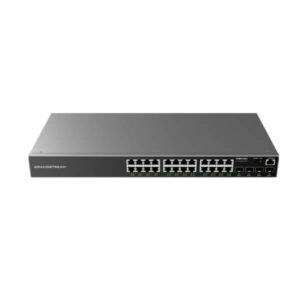
Build a cleaner wired access layer for phones, wireless access points, cameras, workstations, printers, controllers, and other Ethernet devices while keeping higher-speed uplink capacity available for the rest of the network. This 24-port managed switch combines Gigabit copper access, PoE+ delivery, four 10 Gigabit SFP+ uplinks, Layer 2/3 capability, and FortiGate controller compatibility in a 1 RU rack platform. It is a practical choice for organizations that want more control over segmentation, powered endpoints, uplink planning, and Fortinet-centered network operations without moving to a larger 48-port chassis.
Request QuoteCheck UAE Availability
Quick Product Information
Fortinet
FS-424E-POE
Managed Layer 2/3 PoE+ Ethernet switch
24 x Gigabit Ethernet RJ45
24 ports, IEEE 802.3af/at, 250 W budget
4 x 10GE SFP+; SFP+ slots support 1GE SFP
1 RU rack mount
Standalone or FortiGate-managed depending on design
Campus access, branches, offices, powered endpoint networks
Contact FourTeck.com for current UAE options
Confirm applicable Fortinet warranty and support entitlement
Share port, PoE, uplink, optic, and support requirements
Fast Decision Snapshot for IT and Procurement Teams
This model is most useful when a project needs twenty-four copper access ports, widespread PoE+ availability, and a stronger uplink plan than a basic access switch with only 1 Gigabit SFP connectivity. The decision should not be made from port count alone. Buyers should compare the planned PoE draw, rack and power design, current FortiGate environment, optical transceivers, support coverage, and expected growth over the life of the network.
Business access layers that combine standard Gigabit endpoints with PoE-powered devices.
One managed platform can carry data and power while providing 10G uplink choices.
Total PoE wattage, optic type, cable runs, FortiLink design, and support term.
Office floors, branch racks, campus closets, IP telephony, cameras, and wireless edge networks.
The 250 W PoE budget must be planned against endpoint demand rather than assuming every port can draw maximum PoE+ power at the same time.
Quote review can include switch quantity, optics, support, related Fortinet products, and delivery requirements.
Product Overview
A modern access switch has to do more than provide empty Ethernet sockets. It sits between users and the rest of the business network, often powering the very devices that keep daily operations running. In this model, twenty-four Gigabit RJ45 interfaces can connect workstations, phones, access points, surveillance cameras, printers, room systems, access-control devices, and other compatible endpoints. PoE support reduces the number of local power adapters needed at the edge, while the four 10 Gigabit SFP+ interfaces provide a useful path toward a firewall, distribution switch, core switch, server environment, or redundant upstream design.
The switch is designed as a Layer 2/3 FortiGate switch-controller-compatible platform, which makes it particularly relevant for businesses already operating Fortinet security infrastructure. In a properly planned FortiLink architecture, switching and security operations can be brought closer together, helping administrators manage VLANs, port policies, connected devices, and other access-layer functions from a broader Fortinet environment. It can also be used in other supported management modes, but the exact feature set and software requirements should be checked against the intended firmware release and network topology.
For a UAE business, the most important buying question is often whether the model is correctly sized for the site rather than whether it simply has enough physical ports. A 24-port switch may look suitable on paper, yet the actual project can be constrained by PoE power, uplink bandwidth, optic distance, rack depth, cooling, VLAN design, or future expansion. A deployment with many low-power desk phones has a different power profile from one with high-demand access points and cameras. Similarly, a branch using one 10G uplink has a different resilience requirement from a campus closet using multiple aggregated or redundant paths.
FourTeck.com can help procurement teams translate the technical requirement into a cleaner bill of materials. Share the number and type of endpoints, expected PoE draw, preferred FortiGate management method, uplink media, rack environment, support expectations, project quantity, and destination. That information makes it easier to confirm whether this switch is the right fit, whether a full-PoE variant is more appropriate, and which accessories or support services should be included in the quotation.
Key Business Benefits
◆ One Cable for Data and Power
PoE+ can simplify desk, ceiling, wall, and camera deployments by carrying network data and compatible endpoint power over the Ethernet connection. This can reduce reliance on separate adapters and make central power planning easier, particularly when the network rack is protected by UPS infrastructure.
◆ Faster Uplink Headroom
Four 10GE SFP+ slots give network designers more flexibility than an access switch limited to 1G uplinks. The additional uplink capacity can be useful for aggregation, firewall connectivity, server-room links, resilient paths, and traffic growth from multiple edge devices.
◆ Better Segmentation Control
Support for thousands of VLANs and managed switching functions allows IT teams to separate departments, voice traffic, cameras, wireless infrastructure, guests, building systems, and other device classes according to the wider network policy.
◆ Fortinet Ecosystem Alignment
FortiGate controller compatibility can reduce operational fragmentation for organizations already using Fortinet. A properly designed FortiLink deployment can help administrators manage access switching as part of a broader secure networking architecture rather than as an isolated device.
◆ Rack-Friendly Enterprise Format
The 1 RU format fits standard network rack deployments and supports structured cabinet planning. Buyers should still confirm depth, airflow, power connections, cable management, and service clearance, especially where cabinets are shallow or already densely populated.
◆ Useful Growth Path
A switch with 10G uplinks and Layer 3 capability gives businesses more room to evolve than a basic unmanaged or low-uplink platform. It can support a structured access layer today while preserving options for future network redesign, additional segmentation, or higher upstream capacity.
The value of these benefits depends on design quality. PoE does not remove the need to calculate power, 10G ports do not remove the need to choose correct optics, and centralized management does not remove the need to validate software compatibility. The best outcome comes from matching the hardware to the endpoint mix, business continuity target, security architecture, and expected network growth.
Product Highlights That Matter in a Real Deployment
Buyers should pay close attention to the difference between physical PoE port count and usable PoE power. Although all twenty-four copper ports are PoE-capable, the total 250 W budget is shared across connected powered devices. A high-density access point or surveillance project may therefore be better served by a higher-power model if the calculated load leaves too little margin. The same caution applies to optics: SFP and SFP+ modules vary by speed, wavelength, fiber type, reach, connector, and vendor compatibility. The quotation should include the exact transceiver and patching requirements rather than treating “10G uplink” as a complete specification.
The model remains present in current FortiSwitchOS support material, but firmware planning still matters. Organizations migrating from significantly older FortiSwitchOS releases should follow Fortinet’s documented upgrade path instead of jumping directly between distant versions. For FortiGate-managed deployments, validate the FortiOS and FortiSwitchOS pairing as part of the change plan.
Technical Specifications
| Specification | Details |
|---|---|
| Brand | Fortinet |
| Model / SKU | FS-424E-POE |
| Product Type | Layer 2/3 managed PoE+ switch, FortiGate switch-controller compatible |
| Network Interfaces | 24 x GE RJ45 plus 4 x 10GE SFP+; SFP+ interfaces are compatible with 1GE SFP |
| PoE Ports | 24 x IEEE 802.3af/at |
| PoE Power Budget | 250 W |
| Switching Capacity | 128 Gbps duplex |
| Forwarding Performance | 204 Mpps in published Secure Access documentation |
| MAC Address Storage | 16K |
| Network Latency | < 1 microsecond in vendor family specifications |
| VLANs Supported | 4K |
| Link Aggregation Group Size | Up to 8 ports per LAG in published family specifications |
| Packet Buffer | 2 MB |
| Memory / Flash | 1 GB DDR4 / 256 MB flash |
| Management / Console | Dedicated management interface and RJ45 serial console |
| Form Factor | 1 RU rack mount |
| Dimensions | Approximately 44 x 410 x 440 mm in published Secure Access specifications |
| Weight | Approximately 5.25 kg |
| Power Input | 100–240 V AC, 50/60 Hz |
| Power Design | Built-in AC with redundant AC power design in published product specifications |
| Operating Temperature | 0°C to 45°C in published product specifications |
| Management Options | Standalone and Fortinet-managed options; exact capabilities depend on software and design |
| Support / Warranty | Fortinet terms apply; confirm entitlement and FortiCare requirement for the quoted unit |
Choosing the correct configuration starts with endpoint inventory. List every device that will connect to the switch and mark whether it needs PoE, its maximum power requirement, its expected traffic level, and whether it belongs in a dedicated VLAN. Add a practical power margin instead of planning the PoE budget at exactly 100 percent. Next, decide how many uplinks are required, whether those links are copper DAC or optical fiber, what distance they must cover, and whether redundancy or aggregation is part of the design.
The management model matters just as much. A standalone switch may fit an isolated use case, while an organization with FortiGate infrastructure may prefer FortiLink-based control. The selected FortiGate model, FortiOS release, FortiSwitchOS release, and topology must be compatible. If the network is replacing an older 424-series unit, capture the existing VLANs, trunks, link aggregation, spanning-tree design, PoE priorities, management IPs, and cabling before migration. This reduces unexpected downtime and avoids treating a hardware replacement as a simple unplug-and-reconnect task.
Configuration and Buyer Guidance
A good switch quotation should describe the whole access-layer requirement, not just one hardware SKU. Begin with the number of active ports today and the growth expected during the project life. If twenty-three ports are already required at day one, a 24-port platform leaves almost no physical expansion room. In that case, a second switch, a 48-port model, or a different access-layer design may be more sensible. Port density should always be considered alongside rack space, uplink architecture, and redundancy.
How many powered devices?
Count phones, access points, cameras, terminals, and controllers. Record each device’s maximum PoE requirement and calculate the combined worst-case load.
What uplinks are required?
Confirm 1G or 10G, fiber or DAC, distance, connector type, single-mode or multimode fiber, and whether multiple links will be aggregated or used redundantly.
How will it be managed?
Share the FortiGate model and software version if FortiLink is planned. If the switch will be standalone or cloud managed, confirm the intended management platform and licensing.
What resilience is needed?
Consider redundant upstream paths, power feeds, UPS protection, switch pairs, link aggregation, and acceptable downtime. Hardware capability should be matched to a tested recovery design.
Compatibility with the rest of the environment should also be documented. This includes FortiGate and FortiSwitchOS versions, optic compatibility, rack depth, power sockets, PDU capacity, patch panels, cable category, fiber plant, endpoint VLANs, voice configuration, camera or wireless controller requirements, and any change-window constraints. Support needs belong in the same conversation. Confirm whether the project requires FortiCare, what term is expected, and who will own firmware updates, troubleshooting, replacement coordination, and configuration changes after handover.
Before requesting a quotation from FourTeck.com, send a short network brief: site count, quantity of switches, endpoint types, PoE wattage estimate, uplink speed and media, existing FortiGate model, firmware preference, rack environment, desired support term, delivery location, and whether installation or migration assistance is required. This gives the sales and technical team enough context to recommend a usable bill of materials rather than a hardware-only quote that later needs extra optics, cables, licenses, or support services.
Ideal Business Use Cases
Office Access Layer
Connect employee desktops, IP phones, printers, meeting-room systems, and wireless access points from one managed rack switch. VLAN separation can help keep voice, users, wireless infrastructure, guests, and building devices in distinct logical networks.
Branch Network Standardization
Organizations operating repeatable branch designs can use a consistent 24-port PoE access layer where the endpoint count and power budget fit. FortiGate integration may simplify operations when branches already follow a Fortinet security architecture.
Wireless Access Point Connectivity
The switch can power compatible wireless access points while using higher-speed uplinks for aggregate traffic. The final fit depends on how many APs are deployed and how much PoE each unit needs under maximum operating conditions.
IP Telephony
A phone-heavy office can benefit from PoE delivery and VLAN-based separation for voice services. Teams should confirm the phone power class, DHCP and voice VLAN design, QoS policy, and any call-server requirements before rollout.
Surveillance and Building Devices
PoE cameras, access-control terminals, and selected building systems can share the platform when their combined wattage stays within budget. Camera retention and video traffic should be considered when sizing upstream bandwidth.
Campus Wiring Closet
The combination of 24 edge ports and four 10G uplinks can suit a campus access closet that needs controlled aggregation toward distribution or firewall infrastructure without moving to a larger access switch.
These use cases are not interchangeable. A desk-phone network may consume modest PoE power but need careful voice QoS. A modern access-point deployment can require substantially more PoE and uplink bandwidth. A camera network may have moderate individual power draw yet generate sustained upstream traffic around the clock. A branch office may be less demanding technically but more dependent on remote management and fast recovery because no network engineer is permanently onsite. The switch should therefore be chosen against the operating profile of the site, not simply the list of device categories it can connect.
For project planning, consider how the network will behave during maintenance or failure. What happens to phones and access points if the switch reboots? Is there another path for critical devices? Is the rack protected by a suitable UPS? Are both power feeds used where appropriate? Have uplinks been physically separated? Does the business have spare optics or a replacement strategy? Practical continuity questions often matter more to users than headline switching figures once the system is in production.
FortiSwitch 424E-POE PoE Planning and Endpoint Power
PoE is one of the strongest reasons to select this switch, but it is also the area where poor planning most often creates surprises. The device offers twenty-four IEEE 802.3af/at-capable ports and a 250 W PoE budget. That means every access port can participate in a PoE design, but the available power is shared across the whole switch. A simple project with low-power IP phones may fit comfortably. A project combining cameras, wireless access points, room systems, and other higher-draw equipment can approach the total budget far more quickly.
The correct calculation starts with the maximum supported or configured draw of each powered device, not its average everyday consumption. List every endpoint, group identical models, multiply quantity by their maximum expected wattage, then include a planning margin. This prevents a deployment from working during normal operation but failing when several devices simultaneously request higher power, reboot, or activate optional functions. If the result is too close to the 250 W ceiling, compare the higher-power 424E-FPOE variant or another FortiSwitch model rather than accepting a fragile design.
Power priority also deserves consideration. Networks with voice, wireless, security cameras, and noncritical IoT devices may not value every endpoint equally during a constrained power event. FortiSwitchOS provides PoE configuration controls, but the exact operational behavior should be designed and tested according to the software release in use. The best practice is to define critical endpoint classes, document their switch ports, and verify recovery behavior during maintenance.
FortiSwitch 424E-POE 10G Uplinks and Network Growth
Access switches concentrate traffic from many edge devices into a much smaller number of upstream links. Four 10GE SFP+ interfaces provide useful design headroom for this role. They can be used for fiber connectivity, compatible direct-attach options, link aggregation, redundant paths, or different upstream destinations depending on the wider topology and supported configuration. Because the SFP+ interfaces can also accept 1GE SFP modules, the platform can fit transitional environments where some links remain at Gigabit speed while the network is upgraded over time.
The optical choice is part of the switch design, not an accessory decision to leave until installation day. A short multimode run within a building requires a different transceiver from a longer single-mode path between buildings. The connector type, fiber core, patch panel, installed cable plant, distance, and target speed all matter. If a project uses DAC cables in a rack or adjacent cabinet, cable length and compatibility still need confirmation. Mixing assumptions can delay commissioning even when the switch itself is correct.
Uplink capacity should also be related to actual traffic. A camera-heavy network may create sustained streams toward recording infrastructure. Wi-Fi access points can aggregate traffic from many users. Server or storage access may produce bursts that are invisible in a simple endpoint count. Voice traffic is usually lighter but sensitive to congestion and latency. The availability of four higher-speed interfaces gives architects several options, but the chosen arrangement should be built around traffic flows, resilience, and the capabilities of the upstream firewall or distribution switch.
When asking FourTeck.com for a quotation, include the number of uplinks, expected speed, fiber type, distance, connector, preferred optic or DAC type, and the device on the far end. This allows the quote to cover the complete path rather than supplying a switch with unused SFP+ cages and no compatible transceivers.
FortiSwitch 424E-POE Management, Segmentation and FortiGate Integration
A managed switch earns its value when administrators use it to create predictable network behavior. This platform supports substantial VLAN scale and FortiGate switch-controller compatibility, allowing it to fit segmented networks where users, phones, cameras, access points, guest traffic, infrastructure, and building systems should not all share the same broadcast domain. The logical design can be mapped to business policy so that access decisions are intentional rather than determined by whichever port is convenient.
For organizations already using FortiGate, FortiLink can be an important operational advantage. In a compatible design, the firewall and switch participate in a coordinated management model, helping the network team work with wired access as part of a broader Fortinet environment. That can make VLAN deployment, port visibility, device onboarding, monitoring, and policy alignment easier to operate across multiple Fortinet components. However, compatibility is version-sensitive. The FortiGate model, FortiOS release, switch firmware, management topology, and any advanced feature requirements should be verified before change approval.
Software lifecycle planning deserves the same discipline as hardware selection. Current FortiSwitchOS release information continues to list this model, but older installations may need staged upgrades. Fortinet specifically documents a two-step path for some 424E-family devices when moving from older 6.0.x or 6.2.x releases to later 7.x releases. This is a reminder that network firmware should never be treated as a generic file update. Backup configuration, read release notes, validate the supported path, check FortiGate compatibility, schedule a maintenance window, and prepare console access before starting.
Questions Business Buyers Ask Before Choosing This Switch
The questions below focus on the practical decisions that determine whether this platform will work in a live network. They cover port density, power, uplinks, Fortinet management, accessories, migration, support, and quote preparation so technical and commercial teams can reach the same conclusion before an order is placed.
Is a 24-port model enough for our office or branch?
It is enough only when the planned live connections and near-term growth fit comfortably within twenty-four access ports. Count workstations, phones, access points, printers, cameras, controllers, and spare positions. If the design already consumes nearly every port, consider a second switch or a higher-density model so routine changes do not immediately force another hardware purchase.
Can all 24 ports power PoE+ devices at maximum load?
All twenty-four copper ports are PoE-capable, but the switch has a shared 250 W PoE budget. That means the total endpoint draw matters more than the number of PoE ports. Add the maximum wattage of every powered device and retain a margin. If the calculated requirement is high, compare a full-PoE model before ordering.
What should we check for 10G uplinks?
Confirm the far-end device, required speed, distance, fiber type, connector, transceiver standard, and whether the path uses SFP+, 1GE SFP, or a compatible direct-attach cable. Four empty uplink slots do not guarantee that the installed fiber plant or upstream device will match. Include optics and patching in the bill of materials.
Can it be managed through our existing FortiGate?
The model is FortiGate switch-controller compatible and can participate in FortiLink designs when the FortiGate, FortiOS release, FortiSwitchOS release, and topology are supported together. Share those details before purchase. A model family match is not a substitute for checking the current compatibility matrix and the features required by your deployment.
Is this suitable for Wi-Fi access points and cameras together?
Yes, when the combined PoE demand and traffic profile fit the switch design. Modern access points may consume more power and create bursty aggregate traffic, while cameras can produce continuous video streams. Calculate power and upstream bandwidth separately. Also decide whether wireless and surveillance traffic should use dedicated VLANs and policies.
What should we verify when replacing an older switch?
Record existing VLANs, trunks, uplinks, link aggregation, spanning-tree behavior, port descriptions, PoE priorities, management IPs, and endpoint mappings. Also document current firmware and controller versions. Replacement hardware should be introduced through a migration plan so the new device preserves required network behavior instead of creating an avoidable outage.
Which accessories may be required beyond the switch?
Common project items include SFP or SFP+ optics, DAC cables, fiber patch cords, copper patch leads, rack hardware, cable managers, PDUs, UPS capacity, console access, and support services. The exact list depends on site design. Ask for a complete bill of materials rather than assuming that uplink modules or project cabling are included.
Do we need a separate management license?
The answer depends on how the switch will be managed. FortiGate-managed switching and cloud-managed or standalone approaches have different licensing and service considerations. Define the desired management model first, then confirm any FortiCare, cloud-management, or advanced switching requirements against current Fortinet ordering guidance before the quote is finalized.
What details should we send for an accurate quotation?
Send switch quantity, site count, endpoint list, active port count, PoE wattage estimate, uplink speed and distance, fiber or DAC requirement, FortiGate model, firmware details, support term, rack and power environment, delivery destination, and whether installation is required. This information allows FourTeck.com to review the whole deployment rather than price one isolated SKU.
Business Requirements to Match Before You Buy
For a branch that needs phones and Wi-Fi
A suitable option when the port count and total PoE load fit within the platform’s limits. Confirm AP power class, phone quantity, voice VLAN policy, uplink speed, and remote management before rollout.
For a network closet moving to 10G uplinks
The four SFP+ interfaces provide a clear upgrade path, but the project must match transceivers, fiber type, distance, and far-end ports. Confirm whether links are standalone, aggregated, or redundant.
For businesses standardizing on Fortinet
This model fits Fortinet-centered access designs when software and topology are compatible. Share the FortiGate model and intended FortiLink architecture so management capability is checked before purchase.
For mixed cameras, phones, and access points
A mixed PoE environment can work well if total wattage remains within budget. Calculate peak power by device class and make sure continuous video or wireless traffic has adequate upstream capacity.
For a replacement of older 424-series hardware
Buyers replacing earlier hardware should check firmware paths, port mappings, controller compatibility, rack depth, and existing optics rather than assuming a direct swap will preserve every configuration detail.
For multi-site procurement
Before ordering repeatedly across sites, define a standard bill of materials covering switch, optics, patching, support, firmware baseline, labeling, and deployment documentation so each branch follows the same design.
What Buyers Should Check Before Purchase
The wrong switch is often purchased for the right project because one key detail is missed. A procurement team may compare model names and prices while the network team is thinking about wattage, fiber, controller versions, or rack constraints. Bringing those details together before the quote reduces the risk of missing accessories, selecting the wrong PoE level, or discovering that the chosen management approach needs additional planning.
Configuration Fit
Confirm active ports, spare capacity, PoE device count, total wattage, VLAN needs, uplink speed, and expected growth. If the 250 W budget is tight, request a comparison with a higher-power variant.
Compatibility Check
Validate FortiGate and FortiSwitchOS versions, FortiLink topology, optics, fiber plant, cable category, rack depth, power feeds, UPS design, and upstream switch or firewall interfaces.
Availability and Warranty
Ask for current supplier availability, lead-time guidance, warranty handling, support entitlement, and FortiCare term for the exact quoted SKU. Do not assume historical stock or support conditions still apply.
Quote Preparation
State quantity, delivery destination, project timeline, desired support term, installation scope, optic requirements, and whether the order is a new build, expansion, or replacement.
Long-term operating cost should also be part of selection. Hardware price is only one component. Consider support renewals, spare optics, power consumption, UPS sizing, rack capacity, future port growth, and the staff time needed to manage the environment. A lower-cost switch can become expensive if it forces a second purchase soon after deployment or requires unplanned changes to the rest of the network.
For bulk or project supply, agree on the configuration standard before ordering the full quantity. One validated pilot site can reveal issues with optics, cable lengths, firmware, rack placement, endpoint power, or VLAN templates. Once those details are documented, procurement can request a repeatable bundle for the remaining locations. FourTeck.com can help buyers review model fit, related Fortinet options, accessories, support terms, and delivery requirements so the quotation reflects the real deployment rather than an incomplete hardware list.
UAE Availability and Service Support
FourTeck.com supports business inquiries for Fortinet switching projects in Dubai and across the UAE. Support can begin at the specification stage, where the team reviews whether the requested switch, PoE budget, uplink design, accessories, and management method match the actual requirement. This is useful for procurement teams that receive a model number from an engineer but still need to confirm what else belongs in the bill of materials.
Availability may vary by supplier status, project quantity, support bundle, and the exact hardware requirement. For that reason, the page does not assume live stock or a guaranteed delivery date. Buyers should request current confirmation when the project is ready to proceed. The quotation can also account for optics, patching, related Fortinet equipment, FortiCare requirements, and any installation or configuration scope agreed with the team.
Warranty and support expectations should be clarified before purchase. Ask which Fortinet warranty terms apply to the quoted hardware, whether registration is required, what support entitlement is included or optional, and how replacement handling will be coordinated if a hardware issue occurs. For operational networks, the support plan should match the business impact of downtime rather than being selected only on initial cost.
Dubai, Abu Dhabi, Sharjah and Ajman Coverage
Businesses in Dubai, Abu Dhabi, Sharjah, Ajman, and other UAE locations can contact FourTeck.com for product availability checks, configuration guidance, quotation assistance, and delivery coordination. The requirement can be handled as a single-switch request, a branch refresh, a campus access project, or a multi-site standardization exercise. Share the delivery location together with technical details so the commercial proposal reflects both the network design and the logistics requirement.
For project work, buyers can also provide a site schedule and quantity breakdown. This helps separate hardware required immediately from equipment planned for later phases. Where multiple locations use the same design, standardizing optics, support terms, firmware baseline, labeling, and documentation can simplify future operations and reduce configuration differences between sites.
GCC and Africa Availability
FourTeck.com also supports business technology inquiries for selected GCC and Africa markets through its regional channels. Organizations with projects in Saudi Arabia, Qatar, Oman, Kuwait, Bahrain, Kenya, Uganda, and other supported locations can request model guidance, quotation assistance, and delivery planning based on the destination and supplier situation. Availability, freight, warranty handling, taxes, support terms, and service scope can differ by country, so regional requirements should be quoted separately rather than assumed to match a UAE transaction.
Multi-country projects benefit from a standardized technical bill of materials combined with country-specific commercial handling. The technical portion can define the switch model, optics, patching, support term, firmware baseline, rack requirements, and deployment template. The commercial portion can then account for destination, delivery method, local lead time, and any region-specific support considerations. This reduces the risk of different branches receiving similar-looking but operationally inconsistent equipment.
Other Fortinet Options Buyers May Consider
The right alternative depends on why this model is being considered. Some buyers need the same 24-port scale but more PoE power. Others need a newer multi-gigabit access design for modern wireless infrastructure, or a smaller switch for compact branches. Comparing requirement first and model second usually produces a better result than choosing the closest part number.
FortiSwitch FS-124G-FPOE
Consider for multi-gigabit access and higher-power PoE requirements where newer wireless or powered endpoints need more edge capability.
FortiSwitch FS-110G-FPOE
Useful for smaller sites that need a compact Fortinet access switch with multi-gigabit capability and PoE.
FortiSwitch Product Range
Browse broader Fortinet switching options when port density, PoE budget, environmental requirements, or uplink design differs from this 24-port platform.
Fortinet Product Hub
Useful when the project also needs a FortiGate firewall, wireless, management, or other Fortinet components alongside the switch.
If the current project is mainly limited by PoE capacity, compare the switch against a full-PoE variant before changing families. If the limitation is access speed for high-performance wireless or workstations, a newer multi-gigabit model may be more appropriate. If the requirement is industrial, outdoor, or environmentally challenging, a FortiSwitch Rugged platform should be reviewed instead of forcing a conventional campus switch into an unsuitable enclosure. FourTeck.com can help map these different requirements to a model and accessories list.
Why Business Buyers Contact FourTeck.com
Network procurement is easiest when product sourcing and technical context are discussed together. FourTeck.com supports buyers who already know the exact SKU as well as teams that only know the business requirement. The goal is to reduce avoidable purchasing mistakes such as ordering a switch with insufficient PoE headroom, forgetting uplink optics, choosing the wrong transceiver distance, overlooking support coverage, or assuming a FortiGate and FortiSwitch software combination will work without validation.
Hardware and related project items can be reviewed as one requirement.
Port count, PoE load, uplinks, optics, and management design can be checked before ordering.
Commercial proposals can reflect quantity, support term, accessories, and delivery destination.
Delivery requirements can be reviewed once current supplier availability is confirmed.
Buyers can clarify applicable warranty and support expectations for the quoted unit.
Older hardware can be reviewed against current options when direct replacement is uncertain.
This approach is particularly useful for procurement teams supporting multiple departments. Finance may need a clear commercial scope, IT operations may need compatibility and support, security teams may care about segmentation and FortiGate integration, and project managers may be concerned with delivery timing and rollout sequence. A complete requirement gives all of those stakeholders a common reference.
FourTeck.com does not need the customer to have every technical detail ready before making contact. A simple endpoint count, current firewall model, approximate site size, powered-device list, and business goal are enough to start. The remaining questions can be identified during the quotation process so the final order is based on a usable deployment plan rather than an incomplete assumption.
Frequently Asked Questions
What is the FS-424E-POE mainly used for?
It is used as a managed business access switch for connecting wired devices and powering compatible PoE endpoints such as IP phones, wireless access points, cameras, and other network devices. Its four 10GE SFP+ uplinks make it suitable for structured connections toward firewalls, distribution switches, or aggregation infrastructure. Final suitability depends on the port count, PoE load, topology, and management design.
How much PoE power does this switch provide?
The published PoE power budget is 250 W across twenty-four IEEE 802.3af/at-capable access ports. That budget is shared, so buyers should add the maximum expected draw of all powered devices and leave operating margin. If a project has many high-power access points, cameras, or other PoE+ devices, a higher-power switch variant may be more appropriate.
Does it support 10 Gigabit uplinks?
Yes. The switch provides four 10GE SFP+ uplink interfaces, and the SFP+ slots can also support 1GE SFP modules. Buyers still need to select compatible transceivers or direct-attach cables for the intended distance, fiber type, connector, and far-end equipment. Those optics are part of the network design and should be confirmed in the quotation.
Can FourTeck.com help with FortiGate compatibility?
Yes. Share the FortiGate model, FortiOS version, current switch firmware if applicable, and intended FortiLink topology. The team can use those details to help review the requirement. Software compatibility should be validated against current Fortinet documentation before deployment because supported combinations and feature behavior depend on release versions.
Is the switch available for UAE business orders?
FourTeck.com can support UAE inquiries and quotation requests for this model. Current availability is not assumed because supplier status, order quantity, support bundle, and project timing can change. Contact the team with the required quantity and delivery location to confirm the latest option, expected lead-time guidance, and any related accessories or support items.
What should be included in a complete switch quote?
A complete quote may include the switch, required SFP or SFP+ optics, DAC cables, fiber or copper patching, rack accessories, FortiCare or management services where needed, and any agreed installation scope. The exact bill of materials depends on the site. Providing endpoint, uplink, rack, and support details helps avoid missing items at deployment time.
Can businesses request multiple units for a rollout?
Yes. For a multi-site or bulk requirement, provide the total quantity, site breakdown, deployment phases, standard optic requirements, support term, and delivery destinations. It is often useful to validate one standard configuration before ordering every location. That approach can reveal cable, firmware, power, or rack issues early and create a repeatable deployment template.
What warranty guidance is available?
Warranty and support conditions should be confirmed for the exact quoted hardware and region. Fortinet publishes warranty terms and offers FortiCare service options, but entitlement can depend on product status, registration, support purchase, and applicable policy. FourTeck.com can help buyers clarify what is included in the proposal and what additional support term should be considered.
How do I request a quotation from FourTeck.com?
Use the FourTeck.com contact page and include the SKU, quantity, delivery location, endpoint count, PoE device list, required uplink speed, optic distance, FortiGate model, support term, and any installation requirement. If some details are unknown, send what is available. The team can identify the missing information needed to prepare a more accurate proposal.
Need Help Finalizing Your Fortinet Switch Requirement?
Send FourTeck.com your port count, powered-device list, estimated PoE wattage, uplink media and distance, FortiGate details, support expectations, quantity, and delivery location. The team can help review model fit, accessories, availability, warranty guidance, and quotation requirements before you place the order.