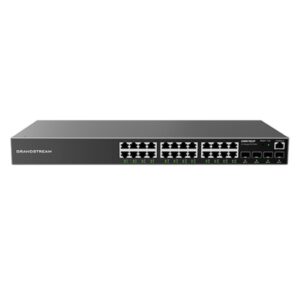
Fortinet FortiSwitch 624F in Dubai, UAE
Built for modern campus networks that need more than ordinary 1 Gigabit edge connectivity, the FortiSwitch 624F combines 24 multi-gigabit copper access ports, four high-speed SFP28 uplinks, Layer 2/3 switching, FortiGate controller compatibility, and MACsec support in a compact 1RU platform. It is especially relevant for organizations introducing faster wireless access points, high-bandwidth workstations, secure building networks, or distribution designs where the access layer should not become the bottleneck.
Quick Product Information
Fortinet
FS-624F
Layer 2/3 multi-gigabit campus switch
24 × 1GE/2.5GE/5GE RJ45
4 × 1GE/10GE/25GE SFP/SFP+/SFP28
Not included on FS-624F; consider FS-624F-FPOE where PoE is required
Standalone or FortiGate/FortiLink managed; other management options depend on selected deployment
MACsec plus FortiSwitch access-control and visibility features according to software and deployment mode
1RU rack mount
Dual hot-swappable 350W AC power supplies
Subject to current supplier status and order quantity
Share port, uplink, FortiGate, optics, cabling and support requirements for quotation
Buyer Snapshot: Is This the Right Campus Switch?
Busy network buyers can use the points below as a first filter. The model is positioned above ordinary Gigabit access switching because every copper access port can operate at multi-gigabit rates and the uplink side can reach 25GE. That combination is useful when edge devices are capable of more bandwidth than a 1GE switch can provide, but buyers should confirm whether they also need PoE, which is not present on this specific non-PoE model.
Campus access, aggregation, high-density wireless backhaul, secure office networks, and multi-gigabit edge devices.
Higher access and uplink bandwidth without moving every connected device to fiber.
PoE requirement, FortiGate integration, SFP28 optics or DACs, rack power, cabling category, and support contract.
1RU wiring closets, campus distribution designs, and network refresh projects where 2.5GE/5GE edge speeds are needed.
Software feature availability can depend on FortiSwitchOS release, management mode, licenses, and connected FortiGate model.
Product selection, model comparison, optics matching, quote preparation, delivery coordination and warranty guidance.
Product Overview
Modern office and campus networks increasingly connect devices that can exceed the limits of a traditional 1GE access layer. High-performance wireless access points, advanced workstations, media systems, engineering devices, storage endpoints, and densely used collaborative environments can all place more pressure on access switching. The FortiSwitch 624F addresses that shift by providing 24 copper ports that can negotiate at 1GE, 2.5GE, or 5GE, allowing an organization to reuse copper connectivity where appropriate while supporting faster edge equipment. On the uplink side, four SFP/SFP+/SFP28 interfaces support high-speed aggregation up to 25GE, giving network architects more headroom between the wiring closet and upstream switching or security infrastructure.
The switch is part of Fortinet’s campus switching family and can operate as a standalone Layer 2/3 device or be integrated through FortiLink with a compatible FortiGate. That distinction matters in real projects. A business that already uses FortiGate may prefer centralized visibility and policy coordination, while another organization may deploy the switch in a more conventional standalone architecture. Buyers should therefore treat management mode as a design choice, not simply a specification line. The correct approach depends on the existing firewall, desired operational model, network segmentation requirements, and whether the organization plans to standardize wired and wireless access around the Fortinet ecosystem.
Security at the access layer is another reason buyers consider this platform. MACsec support can protect Ethernet links at Layer 2 where link encryption is required by the network design. The wider FortiSwitch feature set also includes access-control, segmentation, visibility, authentication and management capabilities, although the exact functions available to a specific deployment can depend on FortiSwitchOS version, FortiGate integration, licensing and topology. Rather than assuming every feature is active by default, procurement teams should map the required controls to the proposed configuration before purchase.
For UAE organizations, the practical value of the model often comes down to three questions: does the network need multi-gigabit access now, will it need higher-speed uplinks during the service life of the switch, and does the environment require power delivery to endpoints? If PoE is needed for access points, cameras, phones or other powered devices, the FS-624F itself is not the correct variant and the FPOE version should be evaluated instead. FourTeck.com can help buyers in Dubai and across the UAE review these details, align the switch with current infrastructure, and prepare a quotation that includes the hardware, compatible optics or cables, support options and related network components.
Key Business Benefits
◆ Multi-Gig Access Without a Full Fiber Edge
Twenty-four RJ45 interfaces supporting 1GE, 2.5GE and 5GE let businesses introduce faster edge connectivity while retaining copper where the cabling plant and device support it. This is useful during staged refresh projects because legacy 1GE devices can coexist with newer multi-gig endpoints instead of forcing a one-time replacement of every connected system.
◆ 25GE Uplink Headroom
The four SFP28 uplink interfaces provide a path to 25GE aggregation, helping the wiring closet avoid becoming constrained as access-side traffic increases. For buyers planning high-density wireless or applications that create large east-west flows, faster uplinks can improve architecture flexibility and reduce the need to replace the entire access switch simply to gain more upstream capacity.
◆ Strong Switching Performance
Fortinet specifies 440 Gbps of duplex switching capacity and 654 Mpps forwarding performance for the platform. These figures support the intended campus role, but practical design should still consider traffic patterns, uplink architecture, oversubscription targets, routing requirements and the capabilities of neighboring devices instead of relying on one headline number.
◆ Secure Link Design with MACsec
MACsec can add Ethernet link protection where organizations need encryption between compatible network devices. This can be relevant for regulated environments, inter-building links, sensitive departments or designs where network teams want security controls below the IP layer. Buyers should confirm interoperability, key management and exact deployment requirements with the overall network design.
◆ Centralized Fortinet Integration
When deployed through FortiLink with a suitable FortiGate, the switch can become part of a more unified operational model for wired access, segmentation, device visibility and policy. For IT teams already using Fortinet security infrastructure, this can reduce the number of separate management workflows and help align network access with the security architecture.
◆ Redundant Power Design
Dual hot-swappable AC power supplies give infrastructure teams more flexibility when designing rack power resiliency. The switch should still be connected to an appropriate UPS, PDU strategy and electrical circuit plan, but redundant power inputs can reduce exposure to a single internal PSU failure and can simplify maintenance in business-critical closets.
◆ Better Lifecycle Planning for Faster Endpoints
A switch refresh is often expected to remain in service longer than the wireless access points, laptops or other edge devices connected to it. Providing multi-gig copper and high-speed uplinks gives buyers more room to upgrade endpoints over time, which can help prevent the access layer from becoming obsolete too early in the lifecycle.
Product Highlights
Each access port can support 1GE, 2.5GE or 5GE, allowing mixed endpoint generations on the same switch.
SFP/SFP+/SFP28 interfaces support up to 25GE, useful for aggregation, distribution and high-bandwidth inter-switch links.
Supports campus switching functions and routing features according to the software release, configuration and license requirements.
Can be centrally managed with a compatible FortiGate, helping consolidate security and network access operations.
Supports link-layer encryption for designs that require protected Ethernet connections between compatible endpoints.
Fits standard enterprise rack environments and uses front-to-back airflow, which should be considered in hot/cold aisle planning.
A critical buyer note is that FS-624F is the non-PoE model. Organizations connecting powered access points, phones, cameras or other PoE endpoints should not assume power delivery is available because the same 600-series family also contains FPOE variants. If endpoint power is part of the requirement, compare the FS-624F-FPOE before finalizing the bill of materials. Optics are another planning point: SFP28 transceivers, SFP+ optics, direct-attach cables and fiber types should be matched to the required distance and upstream device. FourTeck.com can help assemble these items into a complete quote rather than pricing the switch chassis in isolation.
Technical Specifications
| Specification | Fortinet FortiSwitch 624F |
|---|---|
| Model / SKU | FS-624F |
| Product Type | Layer 2/3 FortiGate switch-controller-compatible campus switch |
| Copper Access Interfaces | 24 × 1GE/2.5GE/5GE RJ45 |
| Fiber / Uplink Interfaces | 4 × 1GE/10GE/25GE SFP/SFP+/SFP28 |
| Dedicated Management Port | 1 × 10/100/1000 |
| Serial Console | 1 × RJ45 console port |
| PoE | Not provided on FS-624F |
| Switching Capacity | 440 Gbps duplex |
| Forwarding Rate | 654 Mpps duplex |
| Network Latency | Less than 1 µs |
| MAC Address Storage | 64K |
| VLANs Supported | 4K |
| Link Aggregation Group Size | 28 |
| Packet Buffer | 8 MB |
| Memory | 4 GB DDR4 |
| Flash / Drive | 32 MB flash and 32 GB SSD |
| Spanning Tree Instances | 64 |
| Route Entries IPv4 / IPv6 | 330K / 112K |
| Host Entries IPv4 / IPv6 | 16K / 5K |
| Form Factor | 1RU rack mount |
| Dimensions | 44 × 442 × 440 mm (H × D × W) |
| Weight | 6.925 kg |
| Power Input | 100–240V AC, 50/60 Hz |
| Maximum Power Consumption | 240W |
| Power Supplies | 2 × 350W; dual hot-swappable AC redundant power |
| Heat Dissipation | 423 BTU/h |
| Operating Temperature | 0°C to 45°C |
| Humidity | 5% to 95% RH, non-condensing |
| Airflow | Front to back |
| Noise Level | 54.88 dBA |
| Compliance | FCC, CE, RCM, VCCI, BSMI, UL, CB, RoHS2 |
| Warranty | Fortinet limited lifetime warranty according to the applicable Fortinet warranty policy |
Choosing the correct configuration involves more than confirming port count. A 24-port switch may be physically sufficient but still be wrong if the project requires PoE, 100GE uplinks, a larger port density, a different routing scale or a different airflow and rack design. Buyers should also check whether existing copper cabling can reliably support 2.5GE or 5GE at the required distances, whether the upstream switch accepts the planned 10GE or 25GE optics, and whether the FortiGate model has the appropriate FortiLink scale for the number of managed switches. For resilient designs, decide whether uplinks will be aggregated, whether multiple closets will use redundant paths, and how UPS and PDU feeds will be arranged. FourTeck.com can review these points before a formal quote is requested.
Configuration and Buyer Guidance
A good campus switch purchase starts with the network design, not only with the model number. Before quotation, map the switch to the users, devices, applications and uplinks that will depend on it. The 624F provides substantial access bandwidth, but the value of that capability depends on the rest of the infrastructure being able to use it. A 5GE port connected through cabling that cannot sustain the required speed, for example, will not deliver the expected improvement. Likewise, a 25GE uplink only helps when the upstream device, transceiver, fiber and topology are designed for that speed.
How many devices will connect?
Count current wired endpoints and allow space for growth, spare ports, temporary project devices and future access-point expansion. If 24 access ports are insufficient, the 648F family may be more appropriate.
Do endpoints require PoE?
FS-624F does not deliver PoE. If the switch must power access points, cameras, phones or sensors, evaluate a PoE-capable FortiSwitch variant and calculate the total power budget.
What uplink speed is realistic?
Confirm whether the distribution layer is ready for 10GE or 25GE, which optical standard is required, link distance, fiber type and whether direct-attach copper is suitable for short rack links.
Will FortiGate manage the switch?
If FortiLink management is planned, share the FortiGate model, software version, HA design and number of switches. Management scale and supported functions can vary by FortiGate and release.
Is secure link encryption required?
Where MACsec is part of the requirement, confirm peer-device support, key exchange design and which links need encryption. Do not assume every endpoint can participate automatically.
What support coverage is expected?
FortiCare options, replacement expectations, project support and maintenance responsibilities should be agreed before order. Hardware warranty and service contracts are separate concepts.
When contacting FourTeck.com, provide the required quantity, planned deployment role, number of connected devices, expected port speeds, PoE requirement, FortiGate model if present, desired uplink type and distance, preferred support term, delivery location and whether installation or configuration assistance is needed. This information helps the quotation reflect the complete requirement rather than only the switch chassis.
Ideal Business Use Cases
High-Density Wireless Campus
Organizations upgrading to access points with multi-gigabit Ethernet backhaul can use the copper ports at 2.5GE or 5GE while keeping higher-speed fiber uplinks toward distribution. This helps reduce the mismatch between faster wireless capability and an older 1GE wired edge. Because this model does not provide PoE, the APs need separate power or the FPOE variant should be selected instead.
Corporate Floors and Department Networks
Engineering, media, analytics and other departments may have workstations or appliances that can use more than 1GE. A multi-gigabit access switch allows these endpoints to connect over suitable copper cabling without requiring an all-fiber desktop architecture. VLANs, link aggregation and access controls can be incorporated according to the wider network design.
Campus Distribution and Aggregation
The 25GE-capable SFP28 ports can be useful for connecting to higher-level switching or security infrastructure. Depending on topology, the switch may serve as a high-performance access or lower-tier aggregation device. Network architects should compare route scale, uplink count and redundancy requirements with larger FortiSwitch models before assigning it a central distribution role.
Secure Building or Inter-Closet Links
MACsec support can fit environments where link-layer encryption is desired on compatible Ethernet connections. This can be relevant for sensitive departments, regulated organizations or campus links that cross shared pathways. The security design should specify exactly which links are encrypted, how keys are handled and how MACsec interacts with the rest of the segmentation and firewall policy.
Fortinet-Centered Secure LAN
Companies already using FortiGate can integrate FortiSwitch through FortiLink to simplify network and security operations. This can support centralized VLAN configuration, device visibility, access policies and switch monitoring within the Fortinet architecture. The actual scale and functions should be checked against the FortiGate model and software version.
Network Refresh With Gradual Endpoint Migration
A mixed-speed environment is common during refresh projects. Older 1GE endpoints can continue operating while selected new devices use 2.5GE or 5GE. This lets IT teams phase endpoint replacement and cabling validation instead of requiring every device to move to the same speed at once. Capacity planning should still reserve enough uplink bandwidth for the expected aggregate load.
Other valid scenarios can include educational campuses, healthcare offices, hospitality networks, business parks and multi-floor commercial buildings where multi-gigabit access is genuinely required. The model should not be selected simply because it is faster than an existing switch; it should be selected because the connected devices, uplink design, security policy and management plan can take advantage of its capabilities.
Fortinet FortiSwitch 624F Multi-Gigabit Performance
The defining capability of the 624F is not simply that it has 24 RJ45 ports; it is that those ports can operate across 1GE, 2.5GE and 5GE. This gives network designers a practical middle ground between traditional Gigabit Ethernet and moving every access connection to 10 Gigabit fiber or copper. For many modern wireless access points, creative workstations, high-throughput appliances and specialist endpoints, 2.5GE or 5GE can provide meaningful extra capacity while retaining familiar RJ45 connectivity.
That flexibility can simplify migration. An office may currently have a mix of ordinary user devices at 1GE and selected access points or workstations capable of faster speeds. The switch can accommodate both classes, so the network does not have to be rebuilt around the fastest device on day one. This is especially useful when endpoint refresh cycles occur at different times across departments. The same physical access layer can serve today’s Gigabit clients and tomorrow’s multi-gigabit clients, provided the cabling supports the target rates.
The access side must be considered together with the uplink side. Four SFP28 interfaces capable of 25GE give the design room to aggregate more traffic toward distribution or core switching. An organization may use one or more uplinks depending on redundancy, topology and capacity requirements. Link aggregation, spanning tree design, MCLAG architecture and FortiLink topology should be planned rather than assumed. The goal is to avoid replacing a 1GE access bottleneck only to create a new bottleneck at the uplink.
Fortinet FortiSwitch 624F Security and FortiLink Integration
A campus switch is part of the security boundary because it decides how users, devices and network segments connect to business resources. The 624F can be integrated with a compatible FortiGate through FortiLink, allowing the switch to participate in a more unified Fortinet architecture. In that model, administrators can manage switching functions through the FortiGate environment and coordinate access-layer behavior with broader security policy. This can be attractive to organizations that want fewer separate consoles and a clearer operational relationship between the LAN edge and the firewall.
Fortinet documents a range of FortiLink-related capabilities across the campus family, including centralized VLAN configuration, switch discovery, health monitoring, link aggregation configuration, device detection, 802.1X options, DHCP snooping, host quarantine, NAC-related visibility and policy controls. The exact feature set available in a specific project should be validated against the FortiSwitchOS and FortiOS versions, FortiGate model, licenses and topology. Some advanced routing or specialized capabilities may have additional requirements, so a design review is important when the switch will do more than straightforward access switching.
MACsec adds another dimension. It can protect Ethernet frames at Layer 2 on supported links, helping reduce exposure where traffic must be encrypted over the physical network segment. This is different from application encryption or IPsec VPN protection. Buyers should identify whether the peer switch, router or endpoint also supports the required MACsec implementation and how the keys will be managed. In many deployments, MACsec is applied selectively to sensitive uplinks or inter-building connections rather than every ordinary client port.
Fortinet FortiSwitch 624F Resilience, Power and Rack Deployment
Performance specifications are only one part of a switch deployment. The physical design of the rack, power system and cooling environment can have an equally important effect on reliability. The 624F is a 1RU rack-mount unit measuring approximately 44 × 442 × 440 mm and weighing about 6.925 kg. It uses front-to-back airflow, so rack placement should align with the data-room cooling strategy. In a densely populated cabinet, mixing devices with opposing airflow patterns can create avoidable thermal problems even when every individual device is operating within its rated temperature range.
Fortinet specifies dual 350W hot-swappable AC power supplies for the non-PoE model and a maximum power consumption of 240W. Redundant PSUs provide useful hardware resilience, but true power-path resilience requires more than two power modules. For critical sites, the two inputs should be considered alongside separate PDU feeds, UPS architecture and circuit diversity where available. A switch can have redundant internal supplies and still experience a complete outage if both feeds depend on the same upstream power source.
The operating environment is rated from 0°C to 45°C with 5% to 95% non-condensing relative humidity. This is appropriate for controlled business racks and data rooms, not for unconditioned outdoor or industrial spaces. If a project involves heat, dust, vibration or unusual environmental exposure, a ruggedized model may be more suitable. Noise is another practical point: the published level is 54.88 dBA, so placing the switch in an open office or quiet meeting room may be undesirable compared with a dedicated communications closet.
Finally, plan rack accessories, cable management and optics before installation day. SFP28 ports require the correct transceivers or DACs, and multi-gig copper links should use cabling appropriate to the intended speed and distance. FourTeck.com can help combine the switch with related networking components so the installation team receives a more complete bill of materials.
Common Buyer Questions Before Selecting This Switch
The answers below focus on practical fit, configuration, compatibility and deployment. They are useful for network managers and procurement teams who need to decide whether this model matches the requirement before asking for a formal quotation.
Is this switch suitable for a Wi-Fi 6 or Wi-Fi 6E refresh?
Yes, where access points use 2.5GE or 5GE Ethernet backhaul, the multi-gigabit RJ45 ports can prevent the wired edge from limiting those links. However, FS-624F does not provide PoE, so the access points need separate power or the PoE-capable FS-624F-FPOE should be considered. Confirm the AP’s actual Ethernet speed and power requirement before selecting the variant.
Can I connect ordinary 1GE devices and faster devices at the same time?
Yes. The 24 copper interfaces support multiple negotiated speeds, so a conventional 1GE endpoint can share the switch with devices capable of 2.5GE or 5GE. This is useful for phased upgrades. The actual negotiated rate still depends on the endpoint network interface, cable quality, length and configuration, so multi-gig performance should be validated as part of deployment.
Should I use 10GE or 25GE uplinks?
Choose the uplink speed according to expected aggregate traffic, the capability of the upstream switch or firewall, redundancy design and available optics. A 10GE link can be sufficient for lighter loads, while 25GE gives more headroom for dense multi-gig access. The decision should include oversubscription targets and future endpoint growth rather than using the fastest option without a capacity plan.
Do I need a FortiGate to use the switch?
No. FortiSwitch campus models can operate in standalone deployments, while FortiLink integration with a compatible FortiGate provides a centralized Fortinet management approach. Buyers who already use FortiGate should consider whether unified control, device visibility and coordinated policy are useful operational goals. Share the FortiGate model and software release so compatibility and scale can be checked.
What optics or cables do I need for the uplinks?
The answer depends on link speed, distance, fiber type and the upstream device. Short same-rack links may use supported direct-attach cables, while longer runs require suitable SFP+ or SFP28 optics and matching fiber. Do not order transceivers only by connector appearance. Provide the required distance, speed and remote device model so compatible parts can be included in the bill of materials.
Will existing copper cabling support 5GE?
Possibly, but it should be confirmed rather than assumed. Supported speed depends on cable category, installation quality, distance, patching and electromagnetic conditions. In an upgrade project, test representative links before committing to a network-wide target speed. Where the cabling cannot sustain 5GE reliably, endpoints may negotiate at a lower supported rate until the physical layer is improved.
Is the 24-port model large enough for future growth?
Count today’s active ports, planned access points, spare capacity, growth and temporary project connections. A design that uses all 24 access ports on day one leaves little operational flexibility. If port density is expected to rise, compare the FortiSwitch 648F family or plan multiple switches. Uplink and management scale should be evaluated at the same time, not after the hardware is purchased.
What should I check before replacing an older Gigabit switch?
Document VLANs, trunks, link aggregation, spanning-tree behavior, management IPs, authentication, monitoring, port descriptions, uplink optics, cable types and connected PoE devices. A faster replacement can still create downtime if configuration details are missed. Because this specific model has no PoE, verifying endpoint power requirements is one of the most important replacement checks.
What information should I send FourTeck.com for an accurate quote?
Send the required quantity, deployment role, port count, endpoint speeds, PoE requirement, FortiGate model if applicable, uplink speed and distance, preferred optics or DAC type if known, support term, delivery location and expected project timeline. Also mention whether configuration or installation guidance is required. These details help avoid missing accessories and make the proposed configuration more useful.
Business Requirements to Match Before You Buy
For businesses that need multi-gig wired access
This model is suitable when selected endpoints genuinely need 2.5GE or 5GE. Buyers should confirm NIC capability and cable quality so the faster ports deliver practical value instead of operating permanently at 1GE.
For teams modernizing wireless infrastructure
The switch can provide multi-gig backhaul for suitable access points, but it does not supply PoE. Projects that need switch-powered APs should compare the FPOE variant and calculate both port power class and total PoE budget.
For projects that need faster distribution uplinks
Four SFP28 ports support high-speed uplink design. Buyers should match the optics, fiber, remote port type and required redundancy, then decide whether 10GE or 25GE is the better fit for actual traffic.
For Fortinet-centered network operations
Organizations using FortiGate can evaluate FortiLink for centralized control. Before ordering for a larger site, confirm the firewall’s switch-management scale, software compatibility and HA topology.
For secure links using MACsec
A suitable option when link-layer encryption is a defined requirement, provided the connected peer supports the same technology and the key-management method is planned. MACsec should be part of the network security design, not treated as a checkbox alone.
For phased replacement of older access switches
Mixed 1GE, 2.5GE and 5GE support can simplify migration, but buyers replacing a legacy switch should audit VLANs, trunks, powered devices, monitoring and uplink transceivers before the change window.
What Buyers Should Check Before Purchase
A strong purchase decision should eliminate surprises before the hardware arrives. For this switch, the most common risks are choosing the non-PoE model for a PoE deployment, ordering incompatible optics, assuming existing cabling can run at the target multi-gig speed, or overlooking how the switch will be managed. Buyers should also compare the expected network growth with the available 24 access ports and four high-speed uplinks. A small difference in model selection can affect rack design, power budget, licensing, implementation effort and long-term expansion.
Configuration Fit
Confirm port count, endpoint speeds, required uplink bandwidth, VLAN and routing needs, redundancy, management mode and expected future growth. If the project needs more access ports or larger uplinks, compare the next model before final approval.
Compatibility Check
Verify copper cabling, SFP+/SFP28 optics, fiber type, remote switch ports, FortiGate model, FortiSwitchOS/FortiOS releases, monitoring tools and any authentication infrastructure. Compatibility should be confirmed end to end.
Power and Rack Planning
The switch uses dual AC PSUs and front-to-back airflow. Plan UPS/PDU feeds, rack depth, cable management and cooling. If powered endpoints are required, remember that FS-624F itself has no PoE output.
Support and Warranty
Review the applicable Fortinet limited lifetime hardware warranty and decide whether FortiCare or another support level is required for technical assistance and replacement expectations. Support terms should match business criticality.
Accessories and Add-Ons
Budget for SFP28/SFP+ optics, DAC cables, fiber patch leads, copper patching, rack accessories, UPS/PDU capacity, support contracts and any licenses needed for the planned management model or advanced features.
Quote Preparation
Provide quantity, delivery location, required date, existing network details, uplink design, FortiGate information, power requirements and support preference. This gives FourTeck.com enough context to propose the correct bill of materials.
Long-term cost should include more than hardware acquisition. Consider optics, power, support, spare strategy, implementation, change management and the expected lifespan of the cabling plant. A network refresh that keeps existing copper may reduce disruption, but only if that cabling supports the planned multi-gig speeds reliably. For large rollouts, staging, labeling, standardized firmware, pre-configuration and documented port templates can also reduce deployment effort. FourTeck.com can help procurement teams compare the FS-624F with PoE or higher-density alternatives before the purchase request is finalized.
UAE Availability and Service Support
FourTeck.com supports business inquiries for Fortinet switching solutions in Dubai and across the UAE. Product availability can change according to supplier status, required quantity, support term and project timing, so the most reliable approach is to request a current quotation rather than assume stock from a generic catalog listing. The team can help confirm the requested model, compare the non-PoE and FPOE variants, and review whether the proposed configuration includes the optics, cables and support services needed for installation.
Configuration assistance can be especially useful for projects involving FortiGate integration. Share the firewall model, FortiOS release, HA design and number of managed switches so FortiLink compatibility and scale can be considered. If the deployment is standalone, provide the routing, VLAN, authentication and monitoring requirements instead. For uplink planning, FourTeck.com can help identify suitable SFP+/SFP28 transceiver options or direct-attach cables based on speed, distance and remote equipment.
Delivery coordination is available as part of the procurement process, subject to quotation terms and product availability. Warranty guidance can also be provided so buyers understand the difference between the vendor’s hardware warranty and optional support services. For organizations buying multiple units, project planning may include phased supply, matching accessories and configuration consistency. Use the contact form to share the required quantity, deployment location and technical requirements so the sales team can respond with current options.
Dubai, Abu Dhabi, Sharjah and Ajman Coverage
Businesses in Dubai, Abu Dhabi, Sharjah, Ajman and other UAE locations can contact FourTeck.com for switch availability, configuration guidance, quote assistance and delivery coordination. Multi-site organizations should include the number of locations, quantity per site, preferred rollout schedule and whether each site uses the same FortiGate, VLAN and uplink design. This helps determine whether a standard bill of materials can be repeated across the project or whether different accessories and switch variants are required. FourTeck.com can also help buyers compare suitable FortiSwitch alternatives where the required port count, PoE budget or uplink speed differs by site.
GCC and Africa Availability
FourTeck.com also supports business technology inquiries across selected GCC and Africa markets through regional inquiry channels. Organizations in Saudi Arabia, Qatar, Oman, Kuwait and Bahrain, as well as buyers in Kenya, Uganda and other Africa-region markets, can share their project requirements for product sourcing and configuration review. Availability, delivery arrangements, warranty handling and support options can vary by country, supplier route and order size, so these should be confirmed within the quotation rather than assumed from another market.
Regional projects benefit from a consistent technical brief. If a company is deploying the same campus design in several countries, provide a common network standard covering switch role, port speed, PoE needs, optics, FortiGate integration, support term and rack requirements. Country-specific power cords, logistics and support handling can then be reviewed separately. For regional inquiries, buyers may also use FourTeck Kenya, FourTeck Uganda, FourTeck Africa, or FourTeck Kuwait where relevant.
A multi-country quote should include destination, quantity, required date and whether central staging or local installation is planned. FourTeck.com can help align the product selection across the regional project while keeping country-specific supply and support conditions visible to procurement teams.
Related Models for Business Requirements
The correct alternative depends on why the 624F is being considered. If the requirement is multi-gig access plus endpoint power, choose a PoE-capable variant rather than adding external injectors across a large deployment. If the issue is port density, a larger 600-series model may reduce the number of switches required. For higher-speed campus core roles, buyers should evaluate models designed around larger uplink and backbone capacity.
FortiSwitch 624F-FPOE
Best for the same 24-port multi-gig access requirement when switch-powered devices are part of the design. The PoE budget and endpoint power classes should be calculated before ordering.
FortiSwitch 648F
A higher-density non-PoE option for environments that need more access interfaces and additional high-speed uplinks while remaining in the 600-series campus family.
FortiSwitch 648F-FPOE
Suitable where higher access-port density and PoE are both required. Compare total powered-device load, rack power and cooling with the non-PoE alternatives.
FortiSwitch T1024F-FPOE
A different performance tier with higher-speed access and 100GE uplink capability for projects that need substantially more backbone capacity than a 600-series access design.
FortiGate Security Integration
If centralized FortiLink management is planned, the connected FortiGate should be sized for the wider security and switch-management requirement.
Wireless Access Infrastructure
For campus projects driven by faster access points, evaluate the AP Ethernet speed, power class, user density and uplink requirement together with the switch.
Why Buyers Choose FourTeck.com
Business network procurement is easier when the supplier discussion includes the design around the product, not only the chassis model. FourTeck.com supports SMB, enterprise and project buyers who need help translating a technical requirement into a workable bill of materials. For a campus switch, that can include checking whether the requested model has the correct port density, whether PoE is necessary, which uplink optics are required, and whether the proposed switch fits the existing FortiGate environment.
Help with single-unit requirements, multi-switch deployments and structured project inquiries.
Review of port speed, PoE, uplinks, optics, FortiGate integration and related infrastructure.
Prepare a clearer request by including quantity, accessories, support options and delivery requirements.
Coordinate supply requirements according to quoted availability and project location.
Clarify vendor hardware warranty and optional service-contract considerations before order.
Compare PoE, port-density and higher-speed alternatives when the first selected model does not fit.
This approach is particularly valuable when a switch is part of a broader wireless, firewall or campus-refresh project. Missing optics, incorrect power assumptions or an unsuitable management design can delay deployment even if the hardware itself is correct. FourTeck.com can help buyers review these dependencies before the purchase order is issued. To explore other technology categories, visit FourTeck.com or use the business contact page for a project discussion.
Frequently Asked Questions
What is the FortiSwitch 624F mainly used for?
It is designed for enterprise campus switching where organizations need multi-gigabit copper access, high-speed fiber uplinks and secure Layer 2/3 functionality. Typical uses include wiring closets supporting faster wireless access points, high-bandwidth endpoints, departmental networks and lower-tier aggregation. The best role depends on the overall topology, uplink requirements, management design and whether PoE is needed.
Does the FS-624F provide Power over Ethernet?
No. The FS-624F is the non-PoE version. If the switch needs to power wireless access points, IP phones, cameras or other powered devices, evaluate the FS-624F-FPOE or another PoE-capable FortiSwitch. Always calculate the required PoE budget from the connected devices rather than selecting a PoE model only by port count.
How many uplink ports are available?
The switch provides four SFP/SFP+/SFP28 interfaces capable of high-speed uplink connectivity, including up to 25GE. The required optic or DAC is selected according to speed, distance, fiber type and the remote device. Buyers should confirm the full link specification before ordering transceivers so both ends of the connection are compatible.
Can FourTeck.com help with FortiGate integration?
Yes. Share the FortiGate model, FortiOS version, HA design, number of switches and desired FortiLink topology. FourTeck.com can help review whether the proposed switching design fits the existing environment and can include related optics, cables and support options in the quotation. Final feature compatibility should be validated against the applicable vendor documentation.
Is the switch available for business orders in the UAE?
FourTeck.com accepts product inquiries for Dubai and UAE business requirements. Actual availability can vary by supplier status, quantity, support selection and project timing. Contact the sales team with the required quantity and delivery location to receive current quotation guidance rather than relying on a static availability statement.
What warranty applies to the hardware?
Fortinet lists limited lifetime warranty coverage for this campus switch family subject to its warranty policy and terms. Buyers should also consider whether an optional FortiCare support contract is needed for technical support, replacement expectations or service-level requirements. FourTeck.com can provide warranty and support-option guidance during quotation.
What rack and power details should be prepared?
Plan one rack unit of space, suitable rack depth, front-to-back airflow, dual AC power feeds where resilience is required, UPS/PDU capacity and cable management. The non-PoE switch has a published maximum power consumption of 240W and uses dual 350W hot-swappable AC power supplies. Room cooling and airflow should also match the wider rack environment.
Can businesses request multiple units for a project rollout?
Yes. For multi-unit projects, provide quantities by site, preferred delivery schedule, standard configuration, optics, support term and whether staging or installation guidance is required. Standardizing the bill of materials can simplify deployment, while site-specific differences such as PoE, cabling or uplink distance should be identified before the order is finalized.
How do I request a quotation from FourTeck.com?
Use the FourTeck.com contact page and include the model, quantity, delivery location, required date, FortiGate details if applicable, PoE requirement, uplink speed, cable or optic distance and preferred support term. The more complete the technical brief, the easier it is to prepare a useful quotation with the required accessories and suitable alternatives.
Need Help Choosing the Right Fortinet Campus Switch?
FourTeck.com can help you review port speed, PoE requirements, FortiGate integration, optics, rack planning, support options, UAE availability and delivery requirements before you place an order.