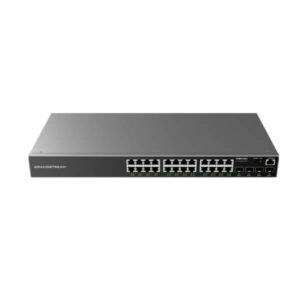
Fortinet FortiSwitch 648F-FPoE in Dubai, UAE
Designed for dense enterprise access layers, the FortiSwitch 648F-FPoE combines 48 multigigabit copper interfaces with eight 25GbE SFP28 uplinks and a published maximum 1800W PoE output limit. It is intended for environments where modern wireless access points, IP phones, cameras, access-control devices and other powered endpoints need more bandwidth and power than a conventional Gigabit access switch can comfortably provide. FourTeck.com helps business buyers review the correct port mix, PoE budget, uplink optics, FortiGate management approach, rack and power requirements before quotation.
Request QuoteCheck UAE AvailabilityAsk for Configuration Support
Quick Product Information
Fortinet
FS-648F-FPOE
Managed Layer 2/3 multigigabit PoE switch
32 × up to 2.5GbE + 16 × up to 5GbE RJ45
8 × 25GbE SFP28
802.3bt-compatible, up to 1800W published system limit
720 Gbps
Up to 1,071 Mpps
Standalone, FortiLink/FortiGate-oriented and licensed cloud options depending on deployment
1RU rack-mount platform
Redundant power supply architecture; verify input circuit and PSU requirements
Share device count, PoE load, uplink type, fibre distance and quantity with FourTeck
Buyer Snapshot: Is This the Right Switch for the Project?
This platform is aimed at buyers who need significantly more than basic 1GbE access. A fast purchasing decision should start with endpoint speed, PoE power, uplink design and the way the switch will be managed. The cards below summarize the strongest fit signals and the main checks to complete before a quotation.
Dense enterprise access networks, high-capacity Wi-Fi, converged voice/video/security deployments and sites needing multigigabit edge connectivity.
One access platform can provide higher copper speeds, large shared PoE capacity and multiple 25GbE uplinks for aggregation headroom.
Calculate endpoint wattage, identify which ports need 2.5GbE or 5GbE, confirm SFP28 optics and verify rack power circuits.
Decide whether the switch will run standalone, under FortiGate/FortiLink control or with a supported cloud-management licensing approach.
Use the eight SFP28 interfaces and 48 access ports as part of a wider capacity plan rather than sizing only for today’s connected devices.
Configuration review, optics and cable guidance, PoE budget checks, quote support, delivery coordination and warranty guidance for UAE buyers.
Product Overview
Enterprise access networks are changing because the devices at the edge are changing. A modern wireless access point can require more than one gigabit of wired bandwidth. Video endpoints, security systems, collaboration devices and building systems can increase both traffic and power demand. A switch selected only by port count can therefore become a bottleneck even when it appears to have enough physical interfaces. The Fortinet 600F family addresses this class of requirement with multigigabit copper connectivity and high-speed SFP28 uplinks, while the FPoE version adds substantial powered-device capacity.
The 648F-FPoE provides a differentiated port profile: the first 32 copper interfaces support links up to 2.5Gbps, while another 16 copper interfaces support links up to 5Gbps. This is useful when a network contains a mix of ordinary Gigabit devices, higher-performance access points and other multigigabit endpoints. Eight SFP28 interfaces provide up to 25Gbps per uplink interface, giving network architects flexibility for aggregation, inter-switch connectivity and faster paths toward the core. Fortinet positions the 600F series as high-end access switching, and its architecture can provide up to 200Gbps of aggregate uplink bandwidth when those high-speed interfaces are used as designed.
The FPoE model is particularly relevant to organizations converging network access and device power. Fortinet publishes an 1800W maximum PoE output limit and identifies the switch as 802.3bt-compatible. That does not remove the need for engineering: each endpoint has a power requirement, and the available system budget must be considered together with redundancy objectives, AC input, cable quality and the number of devices expected to draw power simultaneously. For buyers deploying many access points, cameras, phones or operational-technology endpoints, this planning step is often as important as the data-port count.
Management is another reason organizations consider this platform. It can participate in Fortinet-oriented network architectures using FortiLink with FortiGate, while standalone and licensed cloud-management approaches are also available depending on the intended deployment and software requirements. In Dubai and wider UAE projects, FourTeck.com can help buyers translate the vendor specification into a bill of materials that includes the switch, suitable optics, fibre patching, copper cabling, rack power considerations, support options and related network components. The goal is not simply to source a switch with 48 ports; it is to confirm that the model fits the actual access-layer design and operating model.
Key Business Benefits
◆ Multigigabit Access Without Replacing Every Cable Run
2.5GbE and 5GbE copper links give organizations a practical path beyond ordinary Gigabit access where existing structured cabling and endpoint capability support those speeds. That can help high-performance wireless access points and local devices move more traffic without requiring fibre to every desk or ceiling location.
◆ High PoE Capacity for Converged Edge Devices
A published maximum 1800W PoE output limit gives project designers substantial shared power headroom. This is valuable when one access switch must power a dense mix of Wi-Fi, voice, surveillance, access-control or smart-building devices. Correct endpoint wattage calculations remain essential, especially for high-power 802.3bt equipment.
◆ 25GbE Uplinks Reduce Access-Layer Bottlenecks
Eight SFP28 interfaces allow a network architect to build faster uplink paths than traditional 10GbE-only access designs. This becomes important when dozens of multigigabit endpoints can generate significant aggregate traffic toward core switches, firewalls, servers or campus distribution layers.
◆ Fortinet-Oriented Operational Consistency
Organizations already using FortiGate can incorporate FortiSwitch through FortiLink for centralized switch visibility and policy-aligned administration. This can reduce the number of separate interfaces an IT team must operate and can help network and security policies stay connected to the same broader environment.
◆ Capacity for Segmented Enterprise Networks
The platform supports up to 4,000 VLAN entries and 64,000 MAC addresses according to Fortinet’s published specification matrix. That gives larger campus and enterprise designs room to organize users, wireless networks, voice, cameras, management, guest services and other logical segments without treating the switch as a simple unmanaged edge device.
◆ Redundant Power Architecture for Better Continuity Planning
The platform is designed with redundant power supplies. In a business network, power redundancy can be a useful building block for continuity, but it should be paired with correct AC circuits, UPS design and PoE load planning. A dual-PSU chassis alone does not replace a complete resilient-power design.
Taken together, these benefits make the switch most compelling where network density, access speed, powered-device demand and operational control all matter at the same time. A smaller office with basic Gigabit endpoints may not need this level of capacity. A large wireless, campus, healthcare, education, hospitality or enterprise environment can justify it when the access layer is expected to remain useful through several growth cycles.
Product Highlights That Matter in a Real Network
Thirty-two ports are suited to links up to 2.5GbE and sixteen support links up to 5GbE, giving architects two access-speed tiers in the same chassis.
High-speed uplinks can support 25GbE connectivity where compatible optics, fibre and peer equipment are selected.
The FPoE model is built for powered edge devices, with a vendor-published maximum system PoE output limit of 1800W.
The hardware switching figure matches the needs of a dense access platform with multigigabit edge ports and multiple high-speed uplinks.
Fortinet documents MACsec hardware support on the 600F high-speed uplink architecture. Confirm software mode and license requirements for the intended design.
Local administration, FortiGate/FortiLink integration and supported cloud-management licensing let organizations choose an operating model that matches the network team.
Before purchase, confirm more than the headline port count. SFP28 transceivers are normally selected separately, fibre type and distance must match the link, PoE endpoint classes must be calculated, and the switch’s software feature set should be checked against the planned FortiSwitchOS release. Buyers replacing older access switches should also review rack depth, power circuits, cable category, link aggregation design and whether current FortiGate infrastructure supports the required FortiLink scale.
Technical Specifications
| Specification | FortiSwitch FS-648F-FPOE | Buyer Note |
|---|---|---|
| Product class | Managed Layer 2/3 campus access switch | Feature availability can vary by management mode, software release and license. |
| Ports 1–32 | 32 × RJ45, up to 2.5GbE | Also supports lower negotiated Ethernet rates with compatible endpoints. |
| Ports 33–48 | 16 × RJ45, up to 5GbE | Useful for higher-bandwidth access points and multigigabit devices. |
| Uplink ports | 8 × SFP28, up to 25GbE | Check transceiver, fibre, peer interface and distance compatibility. |
| PoE standard | 802.3af/at/bt family support on FPoE access ports | Confirm per-device class and actual power draw. |
| Maximum PoE output limit | Up to 1800W published system limit | Actual design depends on PSUs, AC input, redundancy target and endpoint load. |
| Switching capacity | 720 Gbps | Vendor published hardware figure. |
| Packet forwarding | Up to 1,071 Mpps | Performance can vary by traffic pattern and configuration. |
| MAC address storage | 64,000 entries | Relevant for large Layer 2 domains and endpoint scale. |
| VLAN entries | Up to 4,000 | Useful for segmented campus and enterprise environments. |
| Management interface | 1 × dedicated 10/100/1000 RJ45 management port; RJ45 console; USB | Supports local setup and maintenance workflows. |
| Security/segmentation | 802.1X, VLAN controls, ACL-related capabilities, Fortinet integration; MACsec hardware support on high-speed architecture | Verify exact features against FortiSwitchOS version and management mode. |
| Routing | Layer 3 functions supported; software/licensing and management mode dependent | Document required protocols before ordering. |
| Power supplies | Redundant PSU architecture | QSG rates each PSU at 100–127VAC, 12A max or 200–240VAC, 6A max, 50–60Hz. |
| Operating temperature | 0°C to 45°C published ambient guidance | Maintain rack airflow and verify current datasheet environmental limits. |
| Form factor | 1RU rack mount | Plan rack space, front-to-back airflow and power cabling. |
| Availability / warranty | Supplier, region and support-plan dependent | Contact FourTeck for current UAE options and applicable manufacturer/support terms. |
When comparing this switch with another 48-port model, focus on the complete architecture rather than the number of copper interfaces alone. The combination of multigigabit port tiers, an 1800W PoE ceiling, eight SFP28 ports and Fortinet management integration can be more important than a small difference in headline price. A buyer deploying only low-power Gigabit endpoints may be able to use a simpler platform. A buyer planning Wi-Fi 6E/7-class access, dense camera networks or multiple high-bandwidth floor uplinks should examine the 648F-FPoE more closely because its access and uplink design is intended for demanding environments.
Configuration and Buyer Guidance
A correct quote starts with the network requirement, not only the model name. For a switch of this class, FourTeck recommends documenting the endpoint mix, power requirement, uplink topology, management method and growth plan before deciding whether one unit or a wider switching design is appropriate.
How many devices will connect?
Count access points, phones, cameras, workstations, building devices, printers, controllers and any reserved ports. Add sensible growth rather than filling every access port on day one.
What power does each endpoint need?
Create a PoE worksheet showing device model, expected watts, peak class and quantity. The 1800W total ceiling is shared across powered endpoints and must be reconciled with the desired PSU redundancy.
Which links require 2.5G or 5G?
Place higher-performance devices deliberately. The 32-port and 16-port copper groups have different maximum link rates, so the port map should reflect actual endpoint capability.
How will the switch uplink?
Specify whether each SFP28 connection will operate at 25GbE or a supported lower rate, the fibre standard, distance, connector type, peer switch model and whether aggregation or redundancy is required.
How will it be managed?
State whether the design uses FortiGate/FortiLink, standalone FortiSwitch management or a supported cloud option. The answer can affect licensing, operational workflow and feature availability.
What supporting infrastructure is needed?
Check rack depth, PDU outlets, UPS capacity, AC circuit rating, earthing, Cat6/Cat6A cabling, fibre patching, SFP28 optics, cable management and environmental airflow.
For an accurate FourTeck quotation, share a device schedule, network diagram if available, current FortiGate model, intended uplink speeds, fibre distances, preferred support term, quantity and delivery destination. For replacement projects, also provide the existing switch model and identify any functions the old platform performs today, including VLAN gateways, link aggregation, spanning-tree roles, 802.1X, voice VLANs or monitoring. This reduces the risk of replacing hardware successfully while accidentally losing an operational feature that users depend on.
Ideal Business Use Cases
High-Density Enterprise Wi-Fi
Modern access points can generate more than 1Gbps of wired traffic and may require substantial PoE. The switch’s multigigabit copper ports and high shared PoE budget make it relevant for floor-by-floor or building-wide wireless access layers. Design teams should still check each AP’s negotiated Ethernet rate, PoE class, cabling and expected aggregate uplink load.
Converged Voice, Video and Security Networks
Organizations often connect phones, surveillance cameras, access-control systems and user devices through the same structured cabling while separating them with VLANs and policy. High port density and PoE capacity can simplify that physical design, while logical segmentation keeps services organized and easier to troubleshoot.
Campus Access With Fast Fibre Aggregation
A large office, education campus, healthcare building or hospitality site may need many active users on each floor plus faster uplinks toward a central core. Eight 25GbE SFP28 ports give architects room for resilient distribution links, multiple aggregation paths or high-bandwidth connections to compatible infrastructure.
Fortinet Security Fabric Environments
Businesses already operating FortiGate can use FortiLink-oriented management to bring switching into a more unified administration model. This is useful where network access decisions, segmentation and security operations are designed together rather than managed as unrelated technology silos.
Large Branch or Regional Office Standardization
A standard enterprise access switch can simplify documentation, configuration templates, spares planning and IT training across repeated office designs. The 648F-FPoE is most appropriate for the larger branch type where multigigabit endpoints, high PoE consumption and faster uplinks justify the platform.
Access Layer for Smart Buildings
Building networks increasingly connect cameras, door controllers, sensors, intercoms, wireless devices and operational systems. A high-PoE access switch can reduce local power adapters and simplify cabling, but device criticality, UPS runtime, segmentation and physical security should be designed alongside the switch.
The platform can also support other enterprise switching roles, but it should not automatically be treated as a core switch simply because it has high-speed uplinks. Core, aggregation and access roles have different resilience, routing, scale and topology requirements. FourTeck can help evaluate the intended role against the wider network design before procurement.
Fortinet FortiSwitch 648F-FPoE Multigigabit Access Performance
The most important performance characteristic is not one number; it is the way the port architecture matches real endpoint traffic. Thirty-two RJ45 ports provide links up to 2.5GbE and sixteen provide links up to 5GbE. In practice, this lets a network designer place different endpoint classes on the switch without building separate access layers for ordinary devices and higher-bandwidth wireless equipment. A typical enterprise floor may have many phones and user ports operating at 1GbE, several access points using 2.5GbE or 5GbE, and a smaller number of infrastructure devices that need higher sustained throughput. The mixed port profile makes that arrangement possible in one 1RU chassis.
Fortinet publishes a switching capacity of 720Gbps and forwarding performance up to 1,071 million packets per second. These are laboratory hardware figures and should not be interpreted as guaranteed application throughput, but they demonstrate that the switching silicon is designed for a high-density multigigabit access role. Real business performance also depends on packet size, VLAN architecture, security features, routing mode, uplink design and the capacity of connected systems.
The eight SFP28 interfaces are particularly important. If dozens of access ports are active simultaneously, a single 10GbE uplink can become an artificial bottleneck. SFP28 enables 25GbE-class links to compatible distribution or core switches, with multiple interfaces available for aggregation and resilience designs. Buyers should include optics in the initial bill of materials and verify that the selected transceivers are supported by the switch, match the fibre type and distance, and are compatible with the peer device. FourTeck can review these parameters so that a high-performance switch is not deployed with an undersized or incompatible uplink path.
Fortinet FortiSwitch 648F-FPoE Power over Ethernet Planning
A large PoE figure is valuable only when it is translated into a device-level power plan. Fortinet identifies this model as an 802.3bt-compatible FPoE switch with a maximum published system output limit of 1800W. That makes it capable of supporting a dense population of powered endpoints, but the project should still document what each device consumes, whether it uses 802.3af, 802.3at or 802.3bt, and how much headroom is required for startup peaks, future additions and redundancy objectives.
For example, an enterprise Wi-Fi rollout may include access points that use different power profiles depending on radio configuration. Security cameras can vary significantly between fixed indoor models and devices with heaters, infrared illumination, PTZ mechanisms or auxiliary accessories. Door systems, intercoms and collaboration endpoints can add more load. If a design simply multiplies the number of ports by an assumed wattage, it may either oversize the project unnecessarily or create a risk that the available budget is exhausted when devices draw their actual peak requirement.
Power engineering must also consider the upstream electrical environment. Fortinet’s current quick-start documentation identifies redundant power supplies and specifies the input rating per PSU. Buyers should check the rack PDU, circuit capacity, UPS output, cable routing and whether both power supplies will connect to independent protected sources. A resilient switch connected to a single unprotected circuit still has a single power dependency. FourTeck can help buyers create a PoE device schedule and align it with rack power and UPS planning so the switch’s substantial power capability is used responsibly rather than treated as an isolated specification.
Fortinet FortiSwitch 648F-FPoE Management, Segmentation and Resilience
Enterprise switching becomes operationally valuable when administrators can see connected devices, apply consistent segmentation and recover from common network changes without visiting every switch individually. The 600F platform supports Fortinet’s FortiLink approach, allowing a compatible FortiGate to act as the switch controller within an integrated network and security architecture. This can give IT teams centralized VLAN configuration, connected-device visibility, switch monitoring and coordinated access-policy workflows. The exact experience depends on the FortiGate model, FortiOS/FortiSwitchOS versions, scale and chosen topology.
The switch also supports conventional enterprise switching functions such as 802.1Q VLANs, link aggregation, spanning tree, LLDP and 802.1X-oriented access control. Fortinet’s recent software releases continue to expand features available to the 600F models, including capabilities such as VXLAN/BGP EVPN support and additional ACL and multicast functions in specific FortiSwitchOS versions. Buyers should not assume every feature is available in every management mode or base license. If a project depends on a specific routing protocol, advanced feature, dynamic access control or overlay design, include that requirement in the technical validation before purchase.
Resilience also extends beyond software. The hardware uses redundant power supplies, while the eight high-speed uplink ports can support designs with multiple physical paths. The best topology depends on the rest of the network: a dual-homed access layer, MC-LAG design, FortiLink topology or conventional LACP arrangement all have different prerequisites. FourTeck can help review the intended failure scenarios—loss of an uplink, switch, PSU, upstream device or power circuit—so that the switching design supports the business continuity objective rather than relying on a single feature label.
Questions Business Buyers Ask Before Choosing This Switch
The answers below are designed for technical teams and procurement buyers who need to determine fit before requesting pricing. They focus on deployment scale, PoE engineering, uplinks, compatibility, replacement planning and the information needed for a useful quotation.
Who is this switch best suited for?
It is best suited to medium-to-large enterprise access deployments where many endpoints need multigigabit data, PoE power or both. Typical examples include high-density wireless floors, education buildings, healthcare sites, hotels, large offices and smart-building networks. Smaller offices using standard Gigabit desktops and a few low-power devices may not need this level of port speed, uplink capacity or PoE headroom.
How do I know whether the 1800W PoE budget is enough?
Add the expected peak power draw of every powered endpoint, then include reasonable headroom for startup behavior and future additions. Separate low-power phones from higher-demand access points, cameras and building devices instead of using one average wattage. The vendor’s 1800W figure is a maximum system output limit; the final usable design must also consider PSU configuration, AC input, desired redundancy and per-port device classes.
Which devices should use the 5GbE ports?
Reserve the 16 ports capable of up to 5GbE for endpoints that can actually benefit from that rate, such as selected high-performance wireless access points or multigigabit infrastructure devices. Standard Gigabit devices can operate on lower negotiated rates, but placing them on the fastest ports without a reason can reduce future flexibility. A planned port map keeps 5GbE capacity available for the endpoints that need it most.
Can it work with my existing FortiGate?
The switch is designed to support FortiLink-based management with compatible FortiGate platforms, but the exact number of managed switches, supported topologies and features depends on the FortiGate model and software versions. Before replacing or adding an access switch, provide the current FortiGate model, FortiOS version, FortiLink topology and managed-switch count so compatibility and scale can be checked against current Fortinet documentation.
What optics and fibre are needed for the SFP28 uplinks?
That depends on the required link speed, distance, fibre type and peer device. An SFP28 port does not define the complete optical link. Buyers should identify whether the path is short-range multimode, longer-distance single-mode, direct attach or another supported medium, then select Fortinet-supported transceivers and matching fibre. Include the remote switch model and distance in the quote request so both ends of each uplink can be validated.
What should I check when replacing an older 48-port PoE switch?
Do not compare only port count. Record existing VLANs, link aggregation, uplink optics, spanning-tree behavior, voice VLANs, 802.1X policy, PoE device load and any local Layer 3 functions. Also check rack depth, airflow and power circuits. A successful hardware replacement should preserve required network behavior while improving capacity, rather than introducing hidden changes in cabling, optics, licensing or management workflow.
Does the switch require additional licenses?
Basic switching hardware and advanced or cloud-managed capabilities should be treated separately during procurement. Fortinet offers advanced-feature and cloud-management licensing for relevant FortiSwitch families, and some functions can depend on software mode or licensing. If the project requires cloud administration, advanced routing, overlay networking or a specific enterprise feature, state that explicitly so FourTeck can identify any additional license or support line items before the quote is approved.
Can the switch support future network growth?
It offers substantial physical headroom through 48 access interfaces and eight high-speed uplinks, but growth depends on how much capacity remains after the initial deployment. Keep spare access ports, PoE wattage and uplink bandwidth rather than designing to 100% utilization on day one. Also consider whether future wireless generations, additional cameras or new building devices will increase power demand even if the total endpoint count changes only slightly.
What information should I send FourTeck for an accurate quotation?
Send the required quantity, UAE delivery location, endpoint count, list of powered-device models, approximate PoE wattage, desired copper speeds, uplink speed and fibre distance, existing FortiGate or core switch model, management preference, support term and project timeline. If available, include a network diagram. These details help FourTeck quote the correct switch, optics, accessories and support options instead of treating the request as hardware-only procurement.
Business Requirements to Match Before You Buy
For businesses expanding Wi-Fi capacity
A suitable option when new access points can use 2.5GbE or 5GbE links and require PoE power. Buyers should match AP Ethernet capability, power class, cable category and aggregate uplink traffic.
For dense powered-device networks
Relevant when many phones, cameras, wireless units or building devices share one access layer. The key check is total and per-device PoE demand, not simply whether every port is marked PoE.
For sites needing faster floor uplinks
Eight SFP28 interfaces provide flexibility for high-capacity fibre paths. Before ordering, confirm link distance, compatible transceivers, peer port speed and whether aggregation or redundant paths are required.
For FortiGate-managed access layers
Organizations standardizing on Fortinet can evaluate FortiLink for centralized switch administration. The FortiGate model, software versions and intended topology should be reviewed before finalizing the deployment.
For buyers replacing older Gigabit PoE
A replacement project should confirm existing VLANs, uplinks, PoE load, authentication, rack power and optical standards. Higher hardware capability does not remove the need to preserve operational compatibility.
For multi-site standardization
The platform can fit a standardized large-site design when branches have similar high-density requirements. Procurement teams should separate large-site and small-site templates so they do not overspecify every location.
What Buyers Should Check Before Purchase
High-capacity switching purchases often go wrong because the discussion stops at model, quantity and unit price. A better procurement process verifies the technical dependencies that can affect installation cost and project timing. For this model, the most important dependencies are port-speed mapping, PoE engineering, optics, software mode, licenses, rack power and the upstream network.
Configuration Fit
Confirm how many endpoints need ordinary Gigabit, 2.5GbE and 5GbE. Map higher-speed devices to the correct ports and leave spare capacity for future APs or other infrastructure.
PoE Engineering
Build a device-level wattage schedule. Include peak draw, future additions, PSU redundancy goals and UPS capacity instead of assuming the maximum chassis budget will always be available exactly as a project requires.
Optics and Cabling
Specify SFP28 optics, fibre type, connector, distance and peer equipment. For copper access, verify the structured cabling can support the intended multigigabit speed at the installed length.
Software and Licensing
Document required Layer 3, overlay, cloud-management and advanced access-control functions. Check them against the intended FortiSwitchOS release, FortiGate mode and any required advanced-feature license.
Availability and Warranty
Ask for current supplier availability, applicable manufacturer warranty terms, FortiCare options and regional support conditions for the exact SKU. Do not assume a term based on another FortiSwitch model.
Quote Preparation
Provide quantity, delivery destination, existing FortiGate/core model, optics, endpoint schedule, support term and project dates. For multi-site orders, include site quantities so the bill of materials can be standardized sensibly.
Long-term cost should also include optics, support, power, UPS capacity, rack space and operational management—not only the initial switch. If a different FortiSwitch model can meet the requirement with lower power, fewer ports or simpler uplinks, FourTeck can help compare alternatives by function. Conversely, undersizing a high-density access layer may create an earlier replacement cost. A clear technical brief gives procurement and IT teams a common basis for evaluating the quotation.
UAE Availability and Service Support
FourTeck.com supports business inquiries for enterprise switching projects in Dubai and across the UAE. For the FS-648F-FPOE, support begins with confirming the exact hardware SKU and the intended deployment rather than assuming that every inquiry requires the same accessories or service package. Availability can change based on supplier status, quantity, support term and project timing, so buyers should request a current quotation rather than rely on a static stock statement.
Configuration support can include a review of access-port requirements, expected PoE load, SFP28 uplinks, transceiver selection, FortiGate integration, rack power, cabling and compatible support options. This is especially useful for projects where the switch will power a large number of devices or where the 25GbE interfaces are central to the network design. FourTeck can also help coordinate related items such as optics, patch cords, rack accessories, UPS infrastructure, firewalls and wireless access points when they form part of the same requirement.
Delivery coordination is based on the confirmed order, destination and supplier availability. Warranty guidance is likewise tied to the exact model, region and support arrangement. Buyers should ask what manufacturer terms and optional FortiCare services apply to the proposed supply. For a more accurate quote, send the switch quantity, destination, required support term, endpoint list, PoE budget and uplink information through the FourTeck contact page.
Dubai, Abu Dhabi, Sharjah and Ajman Coverage
Businesses in Dubai, Abu Dhabi, Sharjah, Ajman and other UAE locations can contact FourTeck.com for enterprise switch sourcing, configuration review and quotation assistance. The same technical information is useful regardless of destination: required quantity, deployment role, endpoint count, PoE demand, uplink design, rack environment and support expectations. For single-site purchases, FourTeck can help identify the necessary switch and accessory lines. For multi-site projects, buyers can provide a site schedule so the network can be standardized by branch type while still allowing larger sites to use higher-capacity switching where justified. Delivery options and timing are confirmed against current supplier and logistics conditions rather than assumed in advance.
GCC and Africa Regional Availability
FourTeck also supports business technology inquiries for selected GCC and Africa markets through its regional channels. Buyers in Saudi Arabia, Qatar, Oman, Kuwait and Bahrain, as well as organizations with project requirements in Kenya, Uganda and other Africa-region locations, can submit the model, quantity and technical requirement for review. Availability, commercial terms, support coverage, warranty handling and delivery options can vary by country, supplier route and project size, so each regional request should be validated independently.
For cross-border or multi-country deployments, standardization is often more important than sourcing one unit at a time. Share a site list showing the number of switches per location, expected endpoint and PoE profile, local rack power, uplink technology and whether the same FortiGate/FortiLink architecture will be used everywhere. FourTeck can then help structure the inquiry around consistent hardware, optics and support where practical, while identifying places where local regulations, power conditions or supply routes may require adjustments.
Regional buyers can use FourTeck.com as the main UAE business site, or visit the relevant regional platforms for Kenya, Uganda, Africa and Kuwait. Exact fulfilment details are confirmed during quotation.
Other Fortinet Switching Options Buyers May Consider
Not every project needs the largest port count or PoE budget. Buyers should compare adjacent FortiSwitch models by access-speed requirement, PoE demand, uplink design and deployment scale. The options below are useful functional reference points; current availability and exact feature details should be confirmed before ordering.
FortiSwitch 624F-FPOE
A 24-port multigigabit FPoE option with 25GbE SFP28 uplinks and a lower published PoE ceiling. Consider it where high-speed access is needed but 48 copper ports would be excessive.
FortiSwitch 648F
The non-PoE version preserves the high-density multigigabit copper and SFP28 profile for environments where endpoint power is supplied separately or is not required.
FortiSwitch M426E-FPOE
A lower-density enterprise access option with a mix of Gigabit and multigigabit PoE ports. It can fit sites where the full 600F access profile is unnecessary.
FortiSwitch T1024F-FPOE
A different high-performance profile with 24 multigigabit/10GbE copper interfaces and 100GbE uplink capability. Suitable when fewer copper ports but higher per-port and uplink speeds are the priority.
FourTeck can also help align the access switch with FortiGate security, business wireless infrastructure and the wider campus design. If an exact model is unavailable, the replacement should be selected by function—port speeds, PoE load, uplink count, management, software features and resilience—rather than by choosing the nearest model number.
Why Business Buyers Choose FourTeck.com
FourTeck works with procurement teams that need the correct model, accessories and support lines rather than a product name alone.
Port planning, PoE budget, uplinks, optics and management requirements can be reviewed before commercial approval.
Buyers can request hardware-only or project-oriented quotations based on actual quantities and required supporting components.
Delivery details are coordinated after supplier availability, order quantity and destination are confirmed.
Applicable manufacturer terms, FortiCare options and regional support expectations can be clarified for the proposed supply.
Project teams can discuss multi-site and selected regional requirements with consistent technical information.
For a high-capacity switch, good procurement reduces the gap between the bill of materials and the real network. A unit can be technically correct but still arrive without the required optics, with an underestimated PoE load, or with a management approach that does not fit the existing security architecture. FourTeck’s role is to help buyers identify those dependencies before the quote is finalized. This is useful for SMB IT teams, enterprise departments, consultants, system integrators and resellers that need a clear technical basis for approval. Availability and commercial conditions can change, so FourTeck confirms them against the actual order instead of relying on generic stock or pricing claims.
Frequently Asked Questions
What is the FortiSwitch 648F-FPoE mainly used for?
It is designed for high-end enterprise access networks that need multigigabit copper connectivity, substantial PoE capacity and faster fibre uplinks. Typical deployments include dense business Wi-Fi, converged voice and security networks, education or healthcare campuses, large offices and smart-building environments. It is most valuable when ordinary 1GbE PoE switching would limit endpoint bandwidth, power availability or uplink capacity.
How many multigigabit ports does it provide?
The switch provides 48 RJ45 access ports in two groups. Thirty-two ports support links up to 2.5GbE, while sixteen support links up to 5GbE. It also includes eight SFP28 uplink interfaces supporting up to 25GbE. Buyers should map endpoints deliberately so devices that genuinely need 5GbE are placed on the higher-speed port group.
What is the PoE capacity?
Fortinet publishes a maximum PoE output limit of 1800W for the FPoE model and identifies it as an 802.3bt-compatible platform. This is a system-level ceiling, not a guarantee that every connected device can draw its theoretical maximum simultaneously in every power configuration. A project should calculate actual device wattage, peak demand, PSU design and desired redundancy.
Can FourTeck help with FortiGate and FortiLink planning?
Yes. FourTeck can review the intended management model, current FortiGate platform, FortiOS version, switch count and topology so the buyer can validate whether the proposed FortiLink design fits current Fortinet scale and feature requirements. Exact compatibility and supported functions should always be checked against the current vendor documentation for the specific software versions being deployed.
Are SFP28 transceivers included?
Do not assume that project-specific SFP28 optics are included with the base switch. Transceivers should be selected according to the required speed, fibre type, distance, connector and peer device. FourTeck can help identify compatible options when the buyer provides the uplink distances and the model of the switch, router or firewall at the opposite end of each link.
Is the switch available in the UAE?
FourTeck.com accepts UAE inquiries for this model and can provide current availability and quotation guidance. Availability may vary with supplier status, order quantity, support term and project timing, so FourTeck does not treat stock as permanently fixed. Send the required quantity, destination and technical requirements to receive a current commercial response.
What warranty or support should a buyer request?
Warranty and support should be confirmed for the exact SKU, supply route and region. Fortinet also offers FortiCare service options that can provide additional technical support and replacement services depending on the selected plan. FourTeck can help buyers identify the applicable terms and optional support choices during quotation rather than assuming one warranty arrangement applies to every order.
Can businesses request bulk or multi-site supply?
Yes. For bulk or multi-site projects, provide a site schedule showing quantity, location, endpoint profile, expected PoE load, uplink requirement and preferred support term. This helps FourTeck evaluate whether the same switch should be standardized everywhere or whether smaller and larger site types should use different FortiSwitch models to avoid unnecessary cost and complexity.
How do I request a quote?
Use the FourTeck contact page and include the exact model, quantity, UAE delivery location, endpoint count, PoE requirements, uplink speed, fibre distance, FortiGate or core switch model and desired support term. If you have a network diagram or bill of materials, include that as well. Better technical information allows the quotation to include relevant optics and accessories instead of hardware alone.
Need Help Planning This Enterprise Switch Deployment?
Share your switch quantity, access-point and powered-device list, PoE requirement, uplink design, existing FortiGate or core switch, support preference and delivery destination. FourTeck.com can help review the configuration, related optics and accessories, current availability, warranty guidance and quotation requirements.
For broader switching guidance, see FourTeck network switch solutions and networking, firewall and switch services.