

Hanwha HCV-7030R Dubai
The Hanwha HCV-7030R is a QHD 4MP outdoor vandal-resistant infrared dome camera designed for coaxial Wisenet HD+ surveillance deployments. Its 6.0 mm fixed lens gives a comparatively narrow field of view for entrances, gates, corridors, loading approaches and other scenes where more focused coverage is preferred. The model supports AHD video, a service CVBS output, true day/night switching, digital wide dynamic range, motion detection, up to 30 m IR illumination, IP66 ingress protection and IK10 vandal resistance.
Hanwha now lists the HCV-7030R as discontinued. That makes compatibility review especially important before ordering replacement units or extending an existing system. FourTeck can help identify the recorder, cabling, power and field-of-view requirements and discuss a suitable current replacement where appropriate.
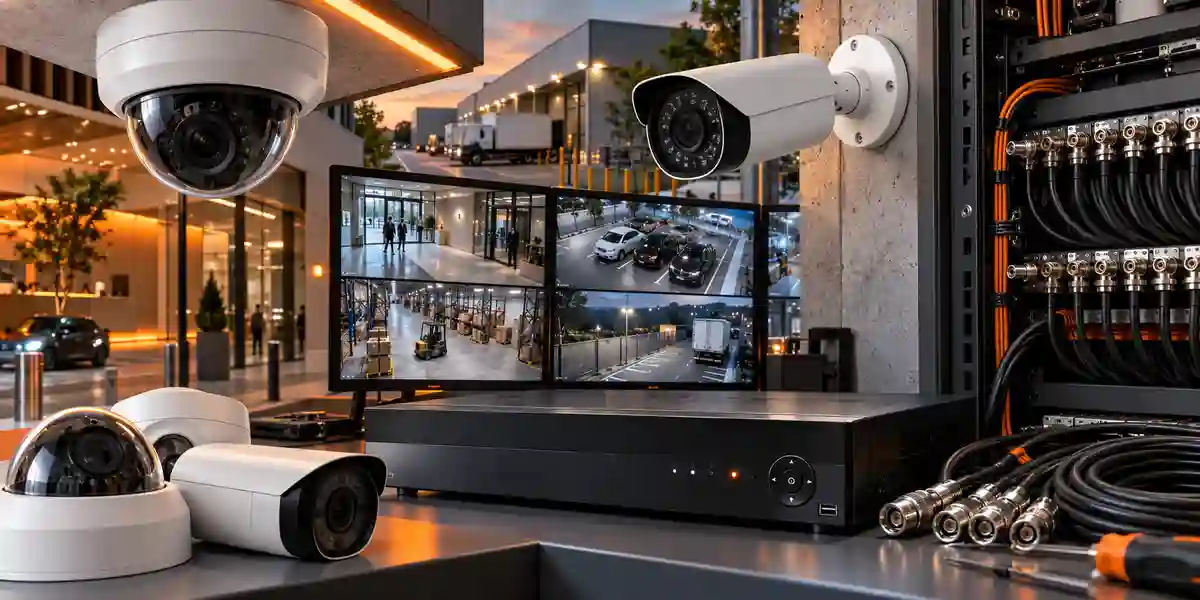
Quick product summary
The HCV-7030R belongs to Hanwha’s Wisenet HD+ analog family and is intended for organizations that need higher-than-1080p video over coaxial infrastructure. The camera uses a 1/3-inch 4MP CMOS sensor and produces 2560 × 1440 video. Depending on video standard, the platform supports up to 30 fps at 4MP for NTSC variants and 25 fps for PAL variants. A BNC AHD output is provided, with an additional CVBS connection intended for installation and setup. Because this is not an IP camera, it should be evaluated as part of a compatible analog HD recorder architecture rather than as a direct Ethernet or PoE endpoint.
The fixed 6.0 mm lens gives the HCV-7030R a horizontal field of view of about 49 degrees, vertical field of view of about 27.6 degrees and diagonal field of view of about 55.6 degrees. This is materially tighter than the 2.8 mm and 4.0 mm siblings in the same family. For buyers, that means the HCV-7030R is better suited to a defined subject zone than to very wide room or forecourt coverage. The selected mounting position, target distance and desired pixel density should therefore be checked before procurement.
Overview and buyer-fit guidance
The strongest reason to consider an HCV-7030R today is usually continuity with an installed Wisenet HD+ coaxial system. Where an organization already has compatible recorders, coax cable routes and 12 V DC camera power, replacing a failed dome with the same optical profile may be simpler than changing the surrounding architecture. However, the discontinued status changes the buying decision: organizations should not treat this model as a default choice for a new surveillance design without comparing current Hanwha analog and network-camera options.
The 6 mm fixed lens is useful when the camera is aimed at a relatively specific zone such as a doorway, gate lane, cash-handling approach, corridor end, loading-bay throat, perimeter opening or equipment area. It is not a motorized zoom lens. The installer cannot remotely widen or tighten the focal length after commissioning, so scene geometry must be checked in advance. The dome can be physically adjusted through its pan, tilt and rotate mechanism, but the optical focal length remains fixed.
For retrofit work, confirm the recorder accepts the HCV-7030R’s AHD format and target resolution. A market listing for this legacy product also notes that it is not compatible with HRX-series DVRs, so recorder model identification should be treated as a mandatory pre-order step rather than assumed from the Hanwha brand name alone.
Key features and business benefits
4MP QHD detail
The 2560 × 1440 output provides more image detail than traditional 1080p analog HD cameras when paired with a compatible recording platform. For retrofit projects, that can improve useful scene detail without automatically requiring a complete move to IP networking.
Focused 6 mm view
The 6.0 mm fixed lens offers a narrower view than common 2.8 mm wide-angle domes. This can suit entrances and defined surveillance lanes where the goal is to concentrate pixels on a smaller area rather than monitor a broad space.
IR for low-light operation
Integrated infrared illumination is rated for a viewable length of up to 30 m. The camera supports true day/night operation with an infrared cut filter and can operate in black-and-white mode with the IR LEDs active when the scene becomes dark.
Outdoor and vandal resistance
IP66 ingress protection and IK10 impact resistance support exposed and publicly accessible mounting positions. Correct mounting, sealing and cable-entry work still matter; environmental ratings do not replace good installation practice.
Coaxial transmission
Hanwha specifies transmission up to 500 m with 5C2V coaxial cable under the stated conditions. Real project performance depends on cable quality, connectors, interference, recorder support and the condition of existing infrastructure.
Image controls
The camera includes D-WDR, backlight compensation, highlight compensation, 2D digital noise reduction, motion detection and privacy masking. These controls help installers tune difficult scenes but should be commissioned against the actual lighting environment.
Verified technical specifications
| Specification | Hanwha HCV-7030R |
|---|---|
| Camera type | QHD 4MP analog outdoor vandal-resistant IR dome |
| Imaging device | 1/3-inch 4MP CMOS |
| Resolution | 2560 × 1440 |
| Maximum frame rate | 30 fps at 4MP NTSC / 25 fps at 4MP PAL |
| Lens | 6.0 mm fixed, F2.0 |
| Field of view | H 49.01° / V 27.61° / D 55.6° |
| Minimum illumination | 0.27 lux color at F2.0; 0 lux B/W with IR LED on |
| IR viewable length | Up to 30 m |
| Video output | BNC AHD; additional CVBS for installation |
| Day/night | Auto ICR / Color / B/W |
| Dynamic range | D-WDR |
| Motion detection | 4 zones |
| Privacy masking | 2 rectangular zones |
| Transmission distance | Up to 500 m using 5C2V coaxial cable under specified conditions |
| Protection | IP66 / IK10 |
| Operating range | -30°C to +55°C, less than 90% RH; startup above -10°C |
| Power | 12 V DC ±10%, max. 5 W |
| Dimensions | Ø120.3 × 91.7 mm |
| Weight | 510 g |
| Lifecycle | Discontinued |
Compatibility, configuration and installation guidance
The HCV-7030R should be treated as part of a recorder-led analog surveillance system. Before purchase, identify the installed DVR model and verify support for the camera’s AHD signal and 4MP operating mode. Do not assume that every Hanwha DVR supports every legacy HD+ camera merely because the brand matches. Available product documentation and specialist listings indicate model-specific compatibility limitations, including a warning against HRX-series DVRs for this camera. If the existing recorder is unknown, photograph its model label and collect a channel configuration export before planning a replacement.
Power is 12 V DC rather than PoE. Existing power supplies should be checked for voltage, polarity, condition and available current capacity. Cable quality is equally important. Long coax runs, damaged connectors, corrosion, mixed cable types and poor termination can produce symptoms that resemble a camera fault. For a refurbishment project, it is prudent to test the end-to-end link before buying multiple replacement cameras.
The 6 mm fixed lens is a configuration decision made by the model itself. If the existing scene needs wider coverage, the related 2.8 mm or 4.0 mm family members historically provided different viewing angles, while a current varifocal model may offer more flexibility. For new systems, compare current Hanwha network cameras as well, especially where centralized PoE, remote configuration, analytics or future expansion are design priorities.
Ideal customers and use cases
The HCV-7030R is most relevant to organizations maintaining an established Wisenet HD+ coaxial estate. Typical candidates include retail branches, warehouses, schools, offices, residential compounds, hospitality sites, workshops, parking facilities, distribution centers and mixed-use buildings that already have compatible analog HD recorders and 12 V DC camera infrastructure. The camera’s relatively focused 6 mm view can work well where the installer wants to observe a particular doorway, gate, aisle end, corridor, loading point or restricted approach.
For a completely new project, lifecycle should weigh heavily in the decision. A discontinued camera can be useful as a like-for-like service replacement, but it may not be the best foundation for a fresh multi-year deployment. Buyers should compare replacement availability, recorder roadmap, image requirements, analytics needs, cybersecurity policies, remote management requirements and the cost of continuing coax versus migrating selected areas to IP.
What to confirm before ordering
- Confirm that HCV-7030R, not HCV-7030RA or another similar model, is the required replacement.
- Record the existing DVR make and exact model, then verify AHD and 4MP channel compatibility.
- Confirm whether the installation uses NTSC or PAL.
- Check that a 6.0 mm fixed lens and approximately 49° horizontal field of view match the intended scene.
- Verify 12 V DC power at the camera location and inspect the power supply capacity.
- Test the coaxial cable route, BNC terminations and any baluns or converters.
- Confirm the mounting surface, cable entry, weather sealing and vandal-resistance requirements.
- Because the model is discontinued, compare current alternatives before committing to a larger quantity.
HCV-7030R alternatives and related-model guidance
Within the historical fixed-lens family, HCV-7010R used a 2.8 mm lens for a much wider view, HCV-7020R used a 4.0 mm lens for a middle field of view, and HCV-7030R used the 6.0 mm lens for the tightest view of the three. The HCV-7070RA family provides a varifocal approach and may be relevant when scene width cannot be fixed in advance. Current Hanwha analog cameras and IP cameras should also be compared because product lifecycle, recorder compatibility and required features can matter more than preserving an exact older model number.
When evaluating a replacement, match the job rather than only the megapixel count. Compare field of view, IR reach, environmental rating, vandal resistance, power method, recorder protocol, mounting accessories and whether remote zoom or analytics are required. For a legacy repair, preserving cabling can be valuable. For a new deployment, the broader architecture and support lifecycle usually deserve more weight.
Hanwha HCV-7030R Dubai
Dubai buyers searching for the Hanwha HCV-7030R are often dealing with an existing CCTV installation rather than designing a greenfield system. The most common practical questions are whether the camera will work with an installed DVR, whether a replacement can reuse existing coaxial cable, whether the 6 mm lens will match the previous field of view, and what current model should be considered if the original unit is unavailable. These questions matter because the HCV-7030R is discontinued, and a purchase decision should be based on system continuity rather than on the model name alone.
For Dubai commercial properties, retail sites, warehouses, workshops, offices, hospitality facilities, residential communities and parking areas, the camera’s IP66 and IK10 ratings are useful where a dome is exposed to dust, weather or tampering. The specified operating range reaches +55°C, but local installations still require sensible placement, correct sealing, stable power and attention to direct sun and enclosure heat. Environmental ratings describe the camera’s tested protection; they do not compensate for poor mounting or cable termination.
The HCV-7030R’s 6 mm lens provides a narrower view than many wide-angle domes. In Dubai applications it may be appropriate for a reception approach, entrance lane, gate, loading point, corridor end or other defined zone. It is less suitable when one camera must cover a wide lobby or open yard. Before ordering, measure the scene width and camera-to-target distance, then compare them with the approximately 49-degree horizontal view.
FourTeck can assist with compatibility review and product selection for Dubai projects without assuming stock, price or delivery timing. Bring the DVR model, existing camera model, approximate cable length, mounting location and required scene coverage. If the old system is approaching the end of its service life, it may be more practical to compare a current analog or IP replacement path rather than source a discontinued unit repeatedly. For local product assistance, use the FourTeck UAE resource or contact FourTeck sales.
Hanwha HCV-7030R UAE
Across the UAE, HCV-7030R requirements may involve multi-emirate organizations maintaining a common surveillance standard across branches, warehouses, schools, clinics, offices or accommodation sites. In that situation, procurement is not only about finding a camera with a similar headline specification. Teams should determine whether the same recorder generation is deployed at every site, whether cabling and power are consistent, and whether a single replacement model can be standardized without creating channel-level compatibility issues.
The HCV-7030R offers 4MP AHD video, a fixed 6 mm lens, up to 30 m IR illumination and IP66/IK10 protection. These specifications make sense for focused outdoor or semi-exposed views, but the fixed optics require careful site matching. If a facility in Abu Dhabi, Sharjah, Ajman, Ras Al Khaimah, Fujairah or Umm Al Quwain has a different mounting distance or scene width from a Dubai branch, using the same 6 mm camera everywhere can produce inconsistent coverage. A wider or varifocal alternative may be better for some locations.
UAE procurement teams should also check lifecycle risk. Because the HCV-7030R is discontinued, a one-off service replacement and a fleet-wide refresh are two different decisions. For a one-off repair, preserving the existing coax system can reduce disruption. For a larger refresh, comparing current Hanwha models may improve long-term serviceability and simplify future expansion. Recorder support, channel resolution limits, power architecture, storage planning and monitoring software should be included in that comparison.
FourTeck can help UAE buyers document the installed environment and shortlist a compatible route. Useful inputs include the DVR model, firmware version where known, number of affected channels, cable type and run length, camera power arrangement, mounting location and target coverage. For broader UAE enquiries, visit FourTeck UAE. For infrastructure requirements beyond cameras, FourTeck IT services in the UAE can provide a relevant regional contact route.
Hanwha HCV-7030R Kenya
Kenyan organizations searching for an HCV-7030R may be supporting older analog HD surveillance in offices, educational facilities, retail premises, warehouses, manufacturing sites, residential developments, logistics yards or hospitality properties. Where coaxial cabling is already in place and functioning well, maintaining an analog HD channel can be a practical way to restore coverage without immediately redesigning the entire site. The key is to verify that the recorder can accept the HCV-7030R’s AHD signal and 4MP resolution.
The 6 mm fixed lens deserves special attention. It provides a focused view rather than a wide scene, which can suit gates, narrow approaches, cashier zones, corridor ends or controlled access points. If the camera must observe a broad forecourt, classroom, lobby or compound, the HCV-7030R may not provide enough width. Buyers should compare target distance and scene width before deciding that a matching 4MP specification is sufficient.
For locations with limited nighttime lighting, the integrated IR system offers a specified viewable length up to 30 m, while true day/night switching allows the camera to move into black-and-white operation in dark conditions. Cabling condition is particularly important on inherited systems. Before replacing the camera, test coax continuity, BNC terminations and the 12 V DC supply so that a cable or power fault is not mistaken for a failed camera.
Because the HCV-7030R is discontinued, Kenyan buyers should ask whether the requirement is an exact service replacement or an opportunity to move to a current model. A current replacement may be a better choice for projects that require multiple cameras, future expansion or longer support life. FourTeck can assist with model comparison and configuration review without making unverified stock or delivery claims. For Kenya-focused enquiries, use FourTeck Kenya, and provide the DVR model, required camera count and existing lens/view information when requesting assistance.
Hanwha HCV-7030R Kuwait
In Kuwait, interest in the HCV-7030R is likely to come from maintenance teams, contractors and facilities managers supporting existing Wisenet HD+ installations. The camera’s IP66 enclosure, IK10 vandal resistance and +55°C specified operating limit are relevant to demanding sites, but the suitability of any outdoor installation still depends on mounting position, direct solar loading, cable protection, sealed entries and stable 12 V DC power. An environmental rating should be viewed as part of the design, not as a substitute for correct installation practice.
The model records at 2560 × 1440 on compatible AHD infrastructure and uses a fixed 6 mm lens. That optical choice can be useful for a gate, loading-bay approach, doorway, service corridor or other narrow target zone. It should not be selected solely because an existing camera is described as 4MP. If the old camera had a wider lens, replacing it with the HCV-7030R could reduce scene coverage even if resolution remains similar.
For legacy-system repair, identify the recorder before ordering. Confirm the exact DVR model, supported analog HD format, maximum channel resolution and whether any channels share bandwidth or configuration limits. Test the coax run and power at the camera end. If a current recorder or camera replacement is being introduced at the same time, verify interoperability as a complete system rather than one device at a time.
The discontinued status also means Kuwaiti buyers should consider supply continuity for multi-camera projects. A current Hanwha model may be a more sustainable choice if the requirement extends beyond a single replacement. FourTeck can help evaluate the installed environment and compare suitable options based on field of view, recorder support, IR range and mounting needs. For regional enquiries, visit FourTeck Kuwait. Include site details and recorder information so the discussion can focus on technical fit rather than only the camera model number.
Hanwha HCV-7030R Ghana
Ghanaian businesses and institutions may encounter the HCV-7030R when maintaining earlier-generation CCTV systems that use coaxial cabling and analog HD DVRs. For a bank branch, retail location, school, warehouse, office, residence, hotel or industrial site, keeping a functioning coax route can be cost-effective when only a small number of channels require service. The HCV-7030R can fit that kind of maintenance scenario if the recorder supports its AHD 4MP output and the 6 mm optical view matches the existing scene.
At night, the integrated infrared system is specified for up to 30 m of viewable distance, subject to scene reflectivity, installation angle and environmental conditions. True day/night operation uses an infrared cut filter for daytime color and low-light switching. For sites with bright entrances, vehicle lights or strong contrast, the available backlight controls and D-WDR can help, but installers should commission these settings against real conditions rather than leave every camera on a generic profile.
The camera is rated IP66 and IK10, supporting outdoor and accessible mounting points where dust, rain or impact are concerns. Cable joints, junction points and power adapters still need suitable protection. Existing sites should be inspected for corrosion, voltage drop and damaged connectors, especially before assuming a failed image is caused by the camera itself.
Because Hanwha lists this model as discontinued, Ghana buyers should distinguish between an exact replacement request and a broader modernization project. If the site expects additional cameras, remote management, analytics or network integration, it may be better to compare a current analog or IP platform. FourTeck can help review the required scene, recorder and cabling before a purchase decision. For Ghana-focused contact and regional product assistance, visit FourTeck Ghana. Supplying the DVR model and a photo of the existing camera label can make replacement discussions more precise.
Hanwha HCV-7030R Uganda
Uganda buyers searching for the Hanwha HCV-7030R may be servicing surveillance systems installed when Wisenet HD+ analog cameras were a common way to obtain higher resolution over coax. In an office, retail site, warehouse, school, clinic, hotel, residence or industrial facility, the first question should be whether the existing DVR remains healthy and compatible. If it does, replacing a failed channel can be simpler than replacing the entire CCTV architecture. If the recorder is also aging, a current platform comparison may be more cost-effective over the full system lifecycle.
The HCV-7030R uses a 6 mm fixed lens and therefore provides a relatively narrow approximately 49-degree horizontal field of view. This is useful when the camera needs to concentrate on a doorway, gate, passage or other defined zone. It is not an all-purpose wide-angle dome. For a shop floor, lobby, yard or classroom, measure the required scene width and mounting distance before committing to this focal length.
The 4MP 2560 × 1440 output, up to 30 m IR illumination, true day/night function, IP66 protection and IK10 impact rating make the model technically capable for many legacy surveillance roles. Yet the installation should be assessed as a system: verify 12 V DC power, coax quality, BNC connectors, recorder format and channel resolution. This avoids replacing a camera only to discover that voltage drop or cabling is the real fault.
The discontinued lifecycle status is also important for procurement. For one or two exact replacements, buyers may prioritize continuity. For a larger rollout or planned expansion, a current Hanwha model can provide a cleaner long-term path. FourTeck can help compare these options using the installed recorder and site requirements as the starting point. For local enquiries, visit FourTeck Uganda and include the DVR model, camera quantity, target distance and intended mounting environment.
Hanwha HCV-7030R Nigeria
In Nigeria, legacy CCTV estates can contain a mix of camera generations, recorder types, replacement power supplies and cabling installed at different times. That makes exact compatibility checking especially important when sourcing an older model such as the HCV-7030R. The camera outputs 4MP AHD video and is not an IP/PoE device. A buyer should therefore confirm the DVR model and channel support before ordering, even if other cameras on the property are also Hanwha or Samsung-branded legacy units.
The 6 mm fixed lens makes the HCV-7030R most useful where a focused scene is required. Examples include an entrance, gate lane, corridor end, secure door, loading approach or selected perimeter opening. A broader space may need a wider lens or a varifocal alternative. The camera’s up-to-30 m IR specification can assist night surveillance, but usable range depends on the scene, reflectivity and mounting angle. Strong nearby surfaces can reflect infrared light back toward the lens, while very open scenes may appear darker at distance.
The IP66 and IK10 ratings support outdoor and vandal-prone positions, while the 12 V DC input and coaxial transmission suit many older installations. Power stability should be reviewed carefully. A weak centralized supply, undersized conductors or corroded joints can create intermittent camera behavior, especially at long cable distances. Testing voltage at the camera under load is more useful than checking only the power supply label.
Since the HCV-7030R is discontinued, Nigerian organizations planning more than a small repair should compare current alternatives. A replacement strategy can preserve selected coax channels where that is economical while moving new areas to a more current architecture. FourTeck can assist with that evaluation based on actual equipment and site requirements rather than generic compatibility assumptions. For Nigeria-focused enquiries, visit FourTeck Nigeria, and share the DVR model, installed camera type and required field of view when asking for product assistance.
Hanwha HCV-7030R Seychelles
Seychelles projects can place special emphasis on environmental exposure, distributed sites and the practical cost of maintaining existing infrastructure. If a property already has good coaxial routes and a compatible analog HD recorder, an HCV-7030R replacement may allow a failed surveillance point to be restored without converting the whole system. The camera’s IP66 rating and IK10 resistance are relevant to exposed or accessible positions, but coastal environments still require careful attention to mounting hardware, junction protection, cable entries and corrosion management.
The HCV-7030R delivers 4MP 2560 × 1440 video with a 6 mm fixed lens and up to 30 m infrared viewing. The narrower lens can be helpful for entrances, service gates, hotel access points, storage areas, corridor approaches and defined perimeter zones. For wide resort grounds, open parking spaces or broad reception areas, a wider or varifocal model may give more practical scene coverage. Checking the required horizontal view before procurement prevents a technically compatible camera from producing the wrong composition.
For island properties and multi-building sites, maintenance planning is as important as the individual camera specification. Confirm recorder compatibility, 12 V DC power, cable condition and the availability of a replacement path. If an exact discontinued unit becomes difficult to source, a pre-approved current alternative can reduce future downtime and simplify procurement. Where multiple channels are aging together, compare the cost of repeated legacy replacements with a phased modernization plan.
FourTeck can help Seychelles buyers review the legacy setup and compare a compatible current route without making unverified promises about stock or delivery. Useful information includes the recorder model, camera quantity, lens or scene requirement, approximate cable lengths and mounting environment. For regional assistance, use FourTeck Africa. For broader product questions and procurement coordination, the FourTeck contact page provides a direct enquiry route.
Regional FourTeck resources
FourTeck Kenya – Kenya product enquiries
FourTeck Kuwait – Kuwait product enquiries
FourTeck Ghana – Ghana product enquiries
FourTeck Uganda – Uganda product enquiries
FourTeck Nigeria – Nigeria product enquiries
FourTeck Africa – Seychelles and wider Africa enquiries
Related Hanwha product guidance
When the exact HCV-7030R is not the right fit, compare Hanwha’s current analog-camera portfolio and network-camera range by lens width, resolution, IR reach, vandal resistance and recorder compatibility. The historical HCV-7010R, HCV-7020R and HCV-7030R family used 2.8 mm, 4.0 mm and 6.0 mm fixed lenses respectively, while the HCV-7070RA family uses a varifocal lens for adjustable framing. For a new installation, network cameras may also provide benefits such as PoE power, IP-based management and newer analytics depending on the selected model and recorder platform.
FourTeck product-page URLs were not added here because no same-site Hanwha product pages could be independently verified during preparation. This avoids sending buyers to guessed or broken URLs. Use the regional resources above or contact FourTeck to request a current model shortlist.
Why contact FourTeck
A discontinued surveillance camera should be evaluated in the context of the complete installed system. FourTeck can help structure that discussion around the exact recorder model, signal format, camera power, cabling, focal length, IR requirement, mounting conditions and desired replacement strategy. This is particularly useful when a site needs to decide between finding an exact service replacement and moving to a current alternative.
To make the enquiry productive, provide photographs of the old camera and DVR labels, the number of channels affected, approximate cable distances and a short description of the scene. If possible, include the width of the area that must be covered and the distance from the camera to the main target. These details are more valuable than asking for a camera based only on megapixel count.
Frequently asked questions
Is the Hanwha HCV-7030R discontinued?
Yes. Hanwha’s current product page identifies the HCV-7030R as discontinued. Buyers should therefore treat it primarily as a legacy-system replacement and compare a current alternative when planning new installations or larger refresh projects.
What resolution does the HCV-7030R provide?
The camera provides 2560 × 1440 QHD video, commonly described as 4MP. Maximum frame rate is 30 fps for NTSC variants and 25 fps for PAL variants when operating at 4MP on a compatible recorder.
Is the HCV-7030R an IP camera?
No. The HCV-7030R is an analog HD camera using AHD over coaxial cabling, with an additional CVBS service output for installation. It is powered by 12 V DC and should not be connected as though it were a PoE network camera.
What lens does the HCV-7030R use?
It uses a 6.0 mm fixed lens with an F2.0 maximum aperture. Hanwha specifies an approximate horizontal field of view of 49.01 degrees, so it is better for focused scenes than for very wide-area coverage.
How far can the HCV-7030R see at night?
Hanwha specifies an IR viewable length of up to 30 m for the HCV-7030R. Actual usable detail depends on the scene, target reflectivity, mounting angle, nearby surfaces and the amount of ambient light.
Can the HCV-7030R be used outdoors?
Yes. The camera carries an IP66 ingress-protection rating and IK10 vandal-resistance rating. Correct sealing, mounting and cable protection are still required, especially in exposed outdoor locations.
Does the HCV-7030R support PoE?
No. It uses 12 V DC ±10% power and consumes up to 5 W. Existing analog installations should be checked for power-supply condition and voltage at the camera before a replacement is fitted.
Will the HCV-7030R work with any Hanwha DVR?
No compatibility should be assumed. Verify the exact DVR model, analog format and supported channel resolution before ordering. A specialist listing for the HCV-7030R specifically warns that it is not compatible with HRX-series DVRs.
How is HCV-7030R different from HCV-7010R and HCV-7020R?
The main difference in the fixed-lens family is focal length and resulting scene width. HCV-7010R uses 2.8 mm, HCV-7020R uses 4.0 mm and HCV-7030R uses 6.0 mm. The HCV-7030R therefore gives the narrowest, most focused view of the three.
What should I send FourTeck for a replacement recommendation?
Send the exact DVR model, a photo of the old camera label, the number of cameras required, approximate cable length, power arrangement, mounting location and the scene you need to cover. These details help determine whether an exact legacy replacement or a current alternative is more suitable.
Need help with a Hanwha HCV-7030R replacement?
Share your recorder model, existing camera label and required scene coverage. FourTeck can help review compatibility and discuss a current replacement path where the discontinued HCV-7030R is not the best option.
Reviews
There are no reviews yet.