

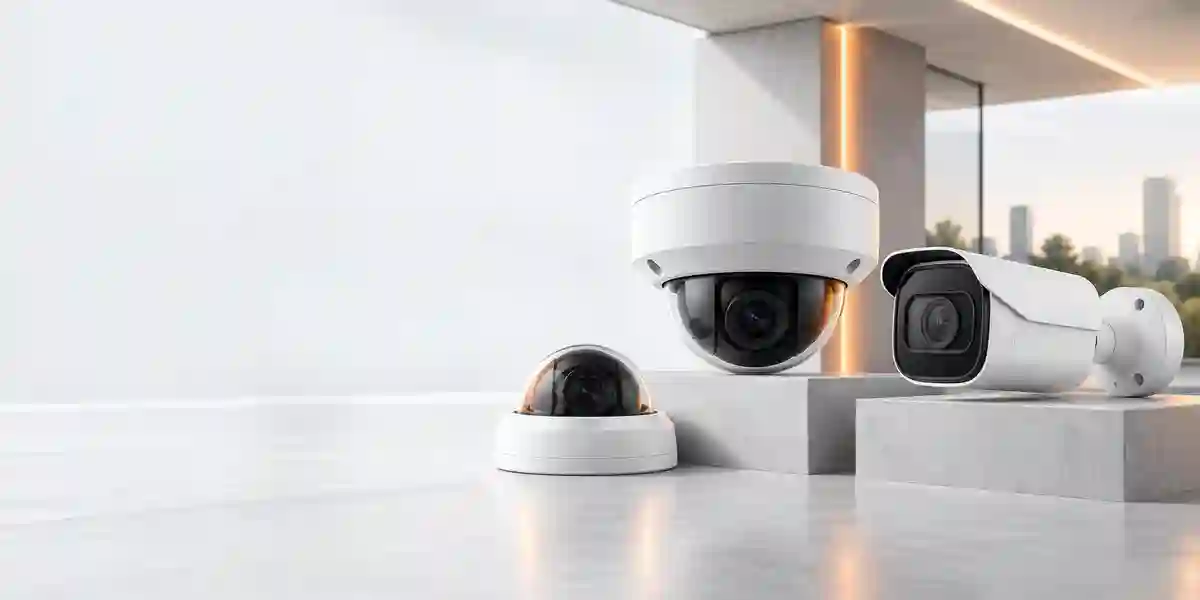
Quick Product Summary
Indoor 2MP IR network dome for fixed-view surveillance.
4mm fixed lens with approximately 87.6° horizontal, 46.4° vertical and 104.5° diagonal coverage.
Integrated IR illumination with a stated viewable distance of up to 20m.
H.265, H.264 and MJPEG streaming, ONVIF profiles S/G/T, SUNAPI and edge storage support.
Overview: where the QND-6022R fits
The QND-6022R sits in Hanwha Vision’s Q-series indoor dome family. It is intended for projects that need dependable Full HD coverage without the cost or complexity of a motorized zoom lens. The 4mm lens makes it a practical middle option between a wider 2.8mm fixed-lens camera and a narrower 6mm fixed-lens camera. In real projects, that matters because camera selection should begin with the scene: the distance to the subject, the width of the corridor or room, the mounting height, the required identification detail and the lighting conditions. A 4mm lens can work well where the installer wants more concentration than an ultra-wide lens while still retaining broad general coverage.
The camera records up to 1920×1080 and can stream H.265 or H.264 at up to 30fps in 60Hz environments or 25fps in 50Hz environments. MJPEG is also supported. Hanwha’s WiseStream II can help reduce unnecessary network and storage load when configured appropriately. The camera also supports multiple streams, giving system designers flexibility to assign a high-quality stream for recording and a lighter stream for mobile viewing or multi-camera display walls.
For mixed-light interiors, 120dB Wide Dynamic Range is particularly useful at reception doors, glazed entrances and indoor areas where sunlight or bright exterior illumination appears behind a person. Day/Night operation with an IR cut filter and the integrated infrared LEDs support round-the-clock use. The camera further offers Hallway View rotation, lens distortion correction, privacy masking and event analytics such as motion, defocus, tampering, virtual line and directional or enter/exit events. These functions are tools for system design; they should be configured to suit the site rather than treated as replacements for proper camera placement.
Key Features and Business Benefits
2MP Full HD video
A maximum resolution of 1920×1080 provides a familiar Full HD format for general indoor surveillance, supporting practical monitoring of people, movement and events without the storage demand of much higher-resolution models.
Balanced 4mm fixed view
The 87.6° horizontal view is useful for many rooms, passageways and entry zones. Because the lens is fixed, confirm the scene dimensions before ordering; framing cannot be optically adjusted after installation.
IR for dark interiors
Integrated infrared illumination is specified up to 20m, supporting monitoring when room lighting is turned off. Actual usable detail depends on scene reflectivity, mounting angle, subject distance and ambient conditions.
120dB WDR
Wide Dynamic Range helps retain useful detail when a scene contains bright and dark areas at the same time, such as an indoor camera facing a bright doorway or window.
H.265 and WiseStream II
Efficient compression and smart streaming can reduce bandwidth and storage pressure when compared with less efficient configurations, while allowing the integrator to select recording quality for the project.
PoE installation
Power over Ethernet can carry data and power over one network cable from a compatible PoE switch or injector, simplifying many indoor deployments. A 12VDC input is also supported.
Verified Technical Specifications
| Specification | Hanwha QND-6022R |
|---|---|
| Imaging sensor | 1/2.8-inch CMOS, 2MP |
| Maximum resolution | 1920 × 1080 |
| Maximum frame rate | H.265/H.264: 30fps/25fps for 60Hz/50Hz |
| Lens | 4mm fixed, F1.6 |
| Field of view | H 87.6° / V 46.4° / D 104.5° |
| IR distance | Up to 20m |
| Wide Dynamic Range | 120dB |
| Video compression | H.265, H.264, MJPEG |
| Smart codec | WiseStream II |
| Edge storage | microSD/SDHC/SDXC slot, model documentation states support up to 128GB |
| Audio | Built-in microphone |
| Alarm I/O | 1 input / 1 output |
| Network | RJ-45 10/100BASE-T |
| API / interoperability | ONVIF S/G/T, SUNAPI, Hanwha open platform support |
| Power | PoE IEEE 802.3af Class 3 or 12VDC |
| Operating environment | Indoor; -10°C to +55°C, less than 90% RH in published product documentation |
| Approx. dimensions / weight | Approx. Ø110 × 86mm, 255g |
Compatibility, Configuration and Deployment Guidance
Before selecting the QND-6022R, confirm the intended network video recorder or video management platform. ONVIF support improves interoperability, but recording, analytics, audio, alarm functions and camera-side settings can vary by platform. For the smoothest deployment, verify the exact recorder model, firmware, channel count, required retention period and supported recording profiles. The camera can also record to supported microSD media for edge storage, but card capacity, endurance and retention should be sized to the recording schedule and bitrate.
The camera supports PoE, so a compatible PoE switch is often the cleanest option for a structured network installation. Check the switch’s total power budget, cable length, VLAN design and available uplink capacity when multiple cameras share the same access switch. If 12VDC is used, power supplies should be professionally specified and installed. Network security should also be part of commissioning: change default credentials, use secure protocols where supported, restrict management access, update firmware through approved channels and place cameras on an appropriately designed network segment.
Because the QND-6022R is an indoor dome rather than an outdoor-rated vandal dome, do not treat it as a substitute for a weather-resistant model. For exposed exteriors, washdown areas or locations vulnerable to impact, choose an appropriate Hanwha outdoor or vandal-resistant camera after checking IP and IK ratings. For mounting, Hanwha documentation lists compatible accessory families for ceiling, wall or hanging arrangements; accessory fit should be checked against the exact installation surface and current accessory availability.
Ideal Customers and Use Cases
The QND-6022R is most suitable where indoor general surveillance, a discreet dome appearance and a fixed mid-wide field of view are desired. Typical buyers include offices needing corridor and reception coverage, schools monitoring internal hallways and classrooms, retailers viewing aisles or sales-floor zones, healthcare facilities monitoring permitted common areas, hotels covering indoor public circulation spaces, warehouses monitoring indoor work zones and commercial buildings adding cameras to an existing IP surveillance network.
It can also be useful in multi-camera projects where fixed lenses are deliberately selected to reduce moving parts and simplify commissioning. However, fixed-lens cameras demand careful planning. If the exact view is uncertain, if the mounting point may change, or if a narrower or wider scene could be required after installation, a varifocal model may provide greater flexibility. The right choice is therefore based less on the camera’s headline resolution and more on the scene geometry and the operational requirement.
What to Confirm Before Ordering
- Confirm that a 4mm fixed lens and 87.6° horizontal field of view match the target scene.
- Confirm the location is an indoor environment appropriate for the QND dome housing.
- Confirm whether 20m integrated IR is suitable for the night scene and mounting height.
- Check NVR/VMS compatibility, firmware requirements and ONVIF feature support.
- Calculate recording retention, bitrate and storage capacity for the selected frame rate and quality.
- Check PoE switch capacity or the 12VDC power design.
- Confirm whether audio recording is permitted and required for the site.
- Confirm microSD card type and endurance if edge recording will be used.
- Check mounting accessories, ceiling construction and cable entry method.
- For Dubai regulated security projects, verify the current authority and project compliance requirements before procurement and installation.
QND-6022R vs Related Fixed-Lens Options
Within the related 2MP Q-series indoor dome family, lens choice is one of the clearest differentiators. The QND-6012R uses a 2.8mm fixed lens and is better suited when a wider scene is the priority. The QND-6022R uses a 4mm fixed lens, offering a more concentrated view. The QND-6032R uses a 6mm fixed lens, narrowing the scene further. A narrower lens does not automatically mean a better camera; it changes how much of the scene fills the image. Projects that need adjustable framing should consider a varifocal Q-series dome such as the QND-6072R or QND-6082R family, subject to current model availability and project requirements.
For exterior areas, Hanwha QNV vandal dome or QNO bullet families are generally more appropriate because they are designed around outdoor environmental protection. The exact alternative should be chosen only after confirming mounting position, weather exposure, vandal risk, lens requirement, IR distance and recorder compatibility.
Hanwha QND-6022R Dubai
Dubai buyers looking for the Hanwha QND-6022R typically need more than a product code. They need to know whether the camera is suitable for the actual indoor scene, whether it will integrate with the planned recorder, and whether the lens will show enough of the entrance, corridor, lobby or workspace. In commercial towers, retail interiors, hospitality properties, education facilities, clinics and warehouses, those questions often matter more than simply comparing megapixel numbers. The QND-6022R’s 4mm lens and 87.6° horizontal view make it a balanced option for many indoor areas, but a site with a very wide room may suit a 2.8mm lens while a longer, tighter scene may benefit from 6mm or a varifocal camera.
Dubai projects should also consider the relationship between the camera and the rest of the security system. The QND-6022R supports H.265, H.264 and MJPEG, multiple streams, WiseStream II and ONVIF profiles S/G/T, giving integrators useful choices for bandwidth, recording and interoperability. For larger deployments, the network design should include PoE power budgeting, switch capacity, uplink bandwidth, VLAN design, NVR throughput and retention calculations. Where a camera faces a bright glazed entrance, the 120dB WDR capability can help manage difficult contrast, while Hallway View is useful when a portrait-oriented stream provides more efficient corridor coverage.
The integrated IR illumination is specified to 20m, which is relevant for interiors that become dark after operating hours. However, infrared performance depends on mounting angle, nearby reflective surfaces and the distance of the subject. For that reason, commissioning should include night testing rather than relying only on catalogue distance. Dubai surveillance requirements may also involve project-specific approvals, documentation and installation standards. These can change, so buyers should confirm current regulatory obligations with the project consultant, security integrator and relevant authority before final selection.
FourTeck can assist with product selection, system compatibility discussions and quotation requests without assuming that every project needs the same camera. For broader Dubai technology procurement, visit FourTeck or request assistance through the contact route below. Current price, stock position, lead time and warranty terms should be confirmed for the specific quotation rather than assumed from third-party listings.
Hanwha QND-6022R UAE
Across the UAE, the QND-6022R can be considered for indoor surveillance projects that need standardized Full HD dome cameras across offices, branches, education sites, hospitality spaces, retail facilities and multi-emirate commercial operations. A centralized buyer may value the ability to deploy one camera family in repeatable layouts, but the same camera should not be forced into every scene. Branch reception areas may require strong WDR, corridors may benefit from Hallway View, while larger open spaces may need a different lens or higher-resolution model.
For organizations purchasing across Abu Dhabi, Dubai, Sharjah, Ajman, Ras Al Khaimah, Fujairah and Umm Al Quwain, system consistency can reduce operational complexity. The QND-6022R supports standard network protocols and ONVIF profiles, which can help in mixed-system planning, but advanced feature compatibility must still be checked against the chosen recorder or VMS. IT teams should document camera addressing, password policies, firmware baselines, time synchronization, network segmentation and retention settings as part of the deployment standard.
UAE buyers also frequently compare indoor domes against outdoor-rated vandal domes and bullet cameras. The QND-6022R is designed for indoor deployment, so exposed parking, perimeter and outdoor loading areas normally call for an appropriately rated camera. Likewise, a fixed 4mm lens works best when scene geometry is known. A project that has variable mounting distances should consider a varifocal option to reduce the risk of arriving on site with the wrong framing.
For procurement discussions covering the wider Emirates, FourTeck UAE technology solutions can be used as a regional route for enquiries, while FourTeck’s main site supports broader product assistance. Buyers should request confirmation of the exact model revision, accessories, compatible recording solution and commercial terms at quotation stage. This approach avoids treating third-party online prices or inventory snapshots as a guarantee of what is currently available in the UAE.
Hanwha QND-6022R Kenya
Kenyan buyers researching the Hanwha QND-6022R are likely to compare local price, supplier availability, NVR compatibility and suitability for office, school, retail, banking, healthcare and commercial security projects. Current online listings in Kenya show that the model is actively recognized in the market, but product descriptions can sometimes contain inconsistent lens information. The manufacturer specification identifies the QND-6022R with a 4mm fixed lens, so project decisions should be based on the current Hanwha documentation rather than a reseller field that may have been copied from a related model.
For Nairobi offices, branch networks and institutional sites, the 2MP resolution can be a practical balance where storage efficiency and reliable general surveillance matter. H.265, H.264 and WiseStream II support give integrators options to tune bitrate, while 120dB WDR can help with bright entrances. The built-in microphone may be useful in permitted applications, though local policy and privacy requirements should be checked before audio recording is enabled. The camera’s 20m IR range also makes it relevant for indoor zones that have limited lighting overnight.
Network design is especially important when cameras are distributed across several buildings. Confirm PoE switch budgets, cable distance, surge protection strategy, recorder throughput, storage duration and remote-access security. If internet connectivity is variable, local recording architecture should not depend entirely on cloud access. Edge recording to microSD can provide an additional recording path, but it should be configured as part of a planned resilience strategy rather than assumed to replace an NVR.
For Kenya enquiries, visit FourTeck Kenya to discuss project requirements and commercial availability. Ask for a quote that confirms the exact Hanwha model, compatible mounting parts, recorder or VMS choice and installation assumptions. If the project includes exposed outdoor cameras, request separate recommendations from Hanwha’s outdoor dome or bullet families instead of using the indoor QND housing where it is not intended.
Hanwha QND-6022R Kuwait
In Kuwait, the QND-6022R is most relevant to buyers seeking a fixed indoor network dome for offices, commercial buildings, retail interiors, hospitality spaces and institutional facilities. The model’s 4mm fixed lens gives a medium-wide view rather than an ultra-wide room overview. That distinction is important in lobbies and corridors where designers want usable detail at a reasonable distance without capturing excessive wall or ceiling area. A pre-installation view calculation can reduce rework and make sure the selected lens matches the intended target zone.
The camera supports Full HD recording, H.265/H.264 compression and WiseStream II, which can help reduce the network and storage load of multi-camera sites when configured sensibly. For organizations with existing CCTV infrastructure, check the NVR’s ONVIF implementation and test camera features that matter operationally, such as audio, event triggers, motion events and edge recording. Basic live video interoperability does not always guarantee that every advanced function is exposed through a third-party VMS.
Indoor cameras in Kuwait should also be chosen with the actual conditioned environment in mind. The QND-6022R documentation states an operating range of approximately -10°C to +55°C for the indoor dome, but that does not make it an outdoor camera. Exterior heat, dust, humidity, washdown and physical exposure require a model with the appropriate environmental ratings. In locations with strong backlighting from glass façades, the camera’s 120dB WDR can be useful, while integrated IR supports dark interiors after closing hours.
For local procurement discussions, use FourTeck Kuwait. Buyers should request confirmation of current availability, revision, accessory compatibility, recorder support and quotation terms. A system quote should also account for PoE switching, structured cabling, storage, monitors, network configuration and installation services where required, rather than evaluating the camera price in isolation.
Hanwha QND-6022R Ghana
Ghanaian organizations evaluating the Hanwha QND-6022R may be planning CCTV for offices, retail outlets, schools, clinics, hotels, banks, warehouses or multi-branch operations. In these environments, a 2MP indoor dome remains useful when the goal is dependable general surveillance with controlled storage requirements. The QND-6022R’s fixed 4mm lens provides an 87.6° horizontal field of view, which can work well for passageways and moderate-width rooms when camera placement is known in advance.
The camera’s network features make it suitable for structured IP surveillance. H.265 and WiseStream II can reduce bitrate, while multiple streaming enables separate profiles for recording and viewing. If the site uses a third-party recorder, ONVIF S/G/T support can help integration, but the installer should still confirm how the specific recorder handles audio, event metadata and edge-recorded footage. For businesses that need evidence retention over several weeks, storage sizing should be calculated from camera count, bitrate, frame rate, recording schedule and retention target.
Power quality and network resilience should be considered as part of the complete design. PoE simplifies camera cabling, but the PoE switch needs enough budget for every endpoint and should be supported by a suitable UPS where continuity is important. The microSD slot can add local recording capability, while an NVR or VMS provides centralized management. Remote viewing should be secured rather than exposed using weak passwords or unnecessary port forwarding.
For product and solution enquiries in Ghana, visit FourTeck Ghana. Ask for confirmation of the exact QND-6022R configuration, compatible NVR, storage requirement and mounting accessories. Outdoor areas such as gates, compounds and exposed loading spaces should be designed with suitably rated Hanwha outdoor models rather than assuming the QND indoor dome can be installed in every location.
Hanwha QND-6022R Uganda
Uganda buyers searching for the QND-6022R may be planning CCTV for offices, educational institutions, healthcare facilities, retail branches, hotels and indoor logistics areas. A strong product selection process starts by mapping each camera to a defined surveillance objective. For a corridor, the QND-6022R’s 4mm view and Hallway View mode can be useful. For a reception desk, WDR can help with backlight. For a dark interior after hours, the 20m IR capability can support monitoring. Each benefit depends on correct mounting and configuration.
The model supports PoE, reducing the need for separate local power at each camera. This can simplify deployment when cameras are connected to managed PoE switches in network cabinets. For larger Ugandan sites, plan for power backup at the switches and recorder, not only at individual endpoints. A UPS strategy can help keep the CCTV system recording during short interruptions, while network segmentation and controlled remote access improve security.
Storage planning deserves equal attention. Full HD cameras can create manageable data volumes, but retention rises quickly when dozens of channels record continuously. H.265, WiseStream II, motion-based schedules and correctly selected bitrates can reduce storage use, yet the final configuration should still preserve the evidence quality required by the organization. Edge microSD recording can complement centralized recording, subject to card capacity and endurance.
For Uganda enquiries, visit FourTeck Uganda. Discuss the camera together with compatible recorders, PoE switches, storage and mounting hardware. If the site includes open yards, gates or building exteriors, request appropriately rated cameras for those locations. Current price, availability and delivery arrangements should be confirmed during quotation because they vary with sourcing, quantity and project timing.
Hanwha QND-6022R Nigeria
For Nigerian security projects, the Hanwha QND-6022R is a candidate for indoor surveillance where a compact dome, Full HD video and a fixed 4mm lens are suitable. Offices, banks, schools, hospitals, retail stores, hotels and enterprise campuses may use this type of camera for circulation spaces and controlled indoor zones. Buyers should assess field of view before purchase: the 87.6° horizontal view is neither an ultra-wide room lens nor a telephoto view, making it a practical middle ground for many indoor layouts.
Where electricity and network continuity are business concerns, the CCTV design should include more than cameras. PoE switches, UPS capacity, recorder storage, secure remote access and network segmentation all affect the usability of the final system. The QND-6022R supports PoE and 12VDC, while edge microSD recording can provide local storage. For multi-site organizations, standardized naming, firmware, time synchronization and credential policies can simplify support and incident review.
The camera’s H.265/H.264 support and WiseStream II are useful when bandwidth must be controlled, especially where remote monitoring traverses WAN links. However, bitrate reductions should be tested against the required image detail. WDR should be enabled and tuned where bright exterior light enters the scene, and IR behavior should be checked at night for reflections from nearby walls, signs or glass.
For Nigeria product assistance, visit FourTeck Nigeria. A useful quote should confirm the camera model, quantity, recorder compatibility, storage target, PoE infrastructure and mounting accessories. For exterior deployment, select an outdoor-rated Hanwha model rather than the QND indoor dome. Commercial terms and current availability should always be confirmed for the specific project instead of being inferred from online listings in other countries.
Hanwha QND-6022R Seychelles
In Seychelles, surveillance projects often involve hospitality, offices, retail, institutional buildings and commercial properties where indoor and outdoor conditions differ significantly. The Hanwha QND-6022R is an indoor dome and is therefore best evaluated for conditioned internal spaces rather than exposed coastal locations. For hotel corridors, reception areas, indoor retail zones and back-of-house rooms, its 4mm fixed lens, Full HD resolution, 120dB WDR and 20m IR capability can offer a useful mix of coverage and low-light support.
Coastal environments make the distinction between indoor and outdoor equipment especially important. Salt air, humidity, rain and exterior exposure require cameras and mounting hardware with suitable environmental protection. A project should therefore separate internal QND locations from outdoor positions and specify weather-resistant Hanwha alternatives where needed. Even indoors, camera placement should avoid direct reflections and strong backlight where possible, with WDR configured for entrances and glazed areas.
For sites spread across separate buildings, network and recording architecture should be planned around available connectivity. Local NVR recording may be preferred for primary evidence retention, while remote viewing can be provided securely over the network. H.265 and WiseStream II can help reduce bandwidth, but storage and stream settings should be based on the number of cameras, recording schedule and required retention. PoE can simplify cabling within each building where suitable Ethernet infrastructure is available.
For Seychelles enquiries, use FourTeck Africa as the regional route for product discussions. Confirm current sourcing, accessories, recorder compatibility and commercial terms before ordering. If a project includes hotel exteriors, perimeter areas, marinas or exposed service zones, request a separate recommendation for suitably rated outdoor cameras rather than extending the indoor QND-6022R beyond its intended environment.
Regional FourTeck Resources
Why Contact FourTeck?
A camera model number is only one part of a working surveillance design. FourTeck can help buyers discuss lens selection, recorder compatibility, PoE switching, storage, mounting and regional procurement requirements before a quotation is finalized. This is particularly useful when a project mixes indoor domes, outdoor cameras, NVRs, displays and network infrastructure. Rather than assuming a listed model is automatically suitable, provide the room dimensions, mounting location, target distance, lighting condition and retention requirement so the system can be evaluated against the actual use case.
Frequently Asked Questions
1. What resolution does the Hanwha QND-6022R support?
The QND-6022R supports a maximum resolution of 1920×1080, commonly called 2MP Full HD. With H.265 or H.264 it can deliver up to 30fps in a 60Hz configuration or 25fps in a 50Hz configuration. Lower resolutions are also available for secondary streams or bandwidth-sensitive viewing.
2. Is the QND-6022R an indoor or outdoor camera?
It is an indoor dome camera. It should not be treated as an outdoor weather-resistant camera simply because its operating temperature range is broad. For exposed external locations, choose a Hanwha model with appropriate IP and, where required, IK ratings after evaluating the site.
3. What lens does the QND-6022R use?
The manufacturer specifies a 4mm fixed lens with an F1.6 maximum aperture and approximately 87.6° horizontal field of view. Because it is fixed rather than varifocal, the installer cannot optically zoom the camera after installation. Confirm the desired scene width before ordering.
4. How far can the infrared illumination reach?
Hanwha specifies an IR viewable length of up to 20m for this model. Real scene performance depends on the mounting angle, subject distance, reflective surfaces and ambient light. A commissioning test after dark is recommended for critical locations.
5. Does the QND-6022R support PoE?
Yes. The camera supports Power over Ethernet using IEEE 802.3af Class 3, allowing network data and power to share one Ethernet cable from a compatible PoE switch or injector. It also supports 12VDC input. Check total PoE switch capacity when several cameras are connected.
6. Can the camera record to a microSD card?
Yes. The QND-6022R includes a microSD/SDHC/SDXC slot, with published documentation specifying support up to 128GB. Edge storage can be used for local recording, but capacity and card endurance should be selected for the intended bitrate and recording schedule.
7. Does it work with third-party NVRs?
The camera supports ONVIF profiles S, G and T, which can improve interoperability with compatible third-party recorders and video management systems. However, advanced functions such as events, audio and edge recording may behave differently by platform, so compatibility should be checked against the exact NVR or VMS.
8. What does 120dB WDR help with?
Wide Dynamic Range helps balance scenes containing bright and dark areas at the same time. A common example is an indoor camera facing a sunlit doorway. WDR can help preserve more usable detail on people entering from the bright exterior while retaining detail inside the darker room.
9. What is Hallway View?
Hallway View rotates the video orientation by 90° or 270° so a vertically shaped scene such as a corridor can use more of the image area. It can reduce wasted pixels on side walls compared with a standard landscape view, provided the camera is mounted and configured accordingly.
10. How do QND-6012R, QND-6022R and QND-6032R differ?
They are related 2MP indoor IR domes with different fixed lenses. The QND-6012R uses 2.8mm for a wider view, the QND-6022R uses 4mm for a medium-wide view, and the QND-6032R uses 6mm for a narrower view. Select the lens according to the scene width and target distance.
Need Help Specifying the Hanwha QND-6022R?
Send FourTeck your site type, camera quantity, indoor scene dimensions, recorder model and retention target. The team can help you discuss configuration, compatibility and current quotation details for Dubai, the UAE and supported regional markets.
Reviews
There are no reviews yet.