

Hanwha QND-6072R Dubai
The Hanwha QND-6072R is a 2MP H.265 IR dome camera built for practical indoor IP surveillance. Its 3.2–10mm manual varifocal lens lets installers adjust framing from a broad room view to a tighter scene, while 120dB WDR, infrared illumination up to 20m and multiple-stream support help it handle mixed lighting, after-hours monitoring and network-based recording.
Quick product summary
2MP indoor network IR dome camera designed for fixed surveillance points where a discreet ceiling or wall-mounted form factor is preferred.
3.2–10mm manual varifocal lens with approximately 109° to 33° horizontal viewing angle for adjustable scene composition.
Integrated 850nm IR illumination provides a manufacturer-specified viewable distance up to 20m when the scene is dark.
PoE simplifies installation by combining network and power on one cable, while 12VDC remains available where required.
Product overview and buyer fit
The QND-6072R is useful where buyers need an indoor dome camera with more framing control than a fixed-lens model. The 3.2–10mm range makes it easier to tune the field of view after the actual mounting position is known. A wider setting can cover a reception, small lobby, retail aisle or open office zone, while a tighter setting can concentrate pixels on a doorway, counter, corridor end or other defined subject area. Because focus is manual, installation quality matters: the lens should be framed and focused at the final mounting point rather than treated as a plug-and-forget fixed camera.
The camera records up to 1920 × 1080 at 30fps/25fps for H.265 or H.264, supports MJPEG, and offers multiple streaming. That combination is practical when one stream is used for high-quality recording and another is used for lower-bandwidth live viewing. The 120dB WDR function is particularly relevant in entrances, glass-fronted areas and rooms where bright exterior light can sit behind the subject. Hallway view at 90° or 270° can also help use the available pixels more efficiently in long vertical scenes such as corridors.
For Dubai projects, the QND-6072R appears on the SIRA approved-camera list. That does not remove the need to confirm the current approval path, system design and site-specific requirements for a regulated installation. Procurement teams should verify the exact model suffix supplied, the proposed recorder/VMS, storage retention, user permissions, mounting position and any project documentation before ordering.
Key features and business benefits
Adjustable field of view
The manual 3.2–10mm varifocal lens can be tuned between broad coverage and narrower observation. This is useful when camera positions are dictated by ceiling points, décor, cable routes or existing infrastructure rather than a perfect textbook mounting position.
Mixed-light handling
120dB WDR helps balance bright and dark areas in the same frame, improving scene usability around doors, windows, reception areas and indoor locations with changing daylight.
Efficient compression
H.265 and H.264 support gives integrators flexibility when balancing recording quality, bandwidth and storage. Final retention still depends on bitrate, frame rate, motion, recording schedule and the NVR or VMS configuration.
Local edge recording
A microSD/SDHC/SDXC slot supports cards up to 128GB. Edge storage can be useful for event recording or resilience, but the correct recording architecture should be selected according to project policy and retention needs.
Event awareness
Supported analytics include motion detection, tampering, defocus detection, virtual line and virtual area events. These functions can support more useful notifications and event-driven recording when configured appropriately.
Simplified power design
IEEE 802.3af PoE allows one Ethernet cable to carry network and power, reducing separate power wiring. A 12VDC input provides an alternative for sites designed around local power supplies.
Verified technical specifications
| Specification | Hanwha QND-6072R |
|---|---|
| Image sensor | 1/2.8-inch CMOS |
| Maximum resolution | 1920 × 1080 (2MP) |
| Maximum frame rate | 30fps / 25fps for H.265/H.264 |
| Lens | 3.2–10mm, 3.1× manual varifocal, DC auto iris |
| Horizontal field of view | Approximately 109° to 33° |
| Minimum illumination | 0.03 lux colour; 0 lux with IR on |
| Wide Dynamic Range | 120dB |
| IR illumination | Up to 20m, 850nm |
| Video codecs | H.265, H.264, MJPEG |
| Onboard storage | microSD/SDHC/SDXC up to 128GB |
| Audio | Built-in microphone |
| Alarm I/O | 1 input / 1 output |
| Power | PoE IEEE 802.3af Class 3 or 12VDC |
| Operating temperature | -10°C to +55°C |
| Dimensions | Ø119.8 × 98.8mm |
| Weight | 320g |
Important: Hanwha’s current official specification for QND-6072R does not state an outdoor IP or IK environmental rating. Treat this model as an indoor dome unless the exact project documentation for the supplied variant states otherwise.
Compatibility, configuration and deployment guidance
A successful QND-6072R installation depends on more than matching a camera to an Ethernet cable. Confirm that the selected NVR or VMS supports the required video profile, codec, stream count, resolution and event functions. Where a Hanwha recorder or VMS is proposed, review the supported firmware and integration notes for the chosen platform. Where an ONVIF-based third-party system is used, test the functions that matter to the project rather than assuming every advanced feature will behave identically across platforms.
Network design should account for PoE budget, switch port availability, VLAN strategy, IP addressing, multicast requirements if used, remote access policy and cybersecurity controls. A camera that can operate from PoE does not mean every switch has enough power or uplink capacity for a complete camera estate. For larger projects, calculate aggregate bitrate and switch loading, then leave practical headroom.
Storage should be sized from the actual camera count, resolution, frame rate, bitrate, codec, recording schedule and target retention period. H.265 can reduce bandwidth and storage compared with older compression at comparable quality, but it does not make storage planning unnecessary. Busy retail entrances, long operating hours and continuous recording can create very different storage needs from a quiet office corridor recorded on motion events.
At commissioning, set the lens framing and focus carefully, confirm WDR performance in real site lighting, check night IR behaviour, verify time synchronization, configure strong credentials, review user roles, test recording and playback, and document the final camera name and network address. If audio is enabled, confirm whether recording audio is permitted for the site and whether it is actually required.
Ideal customers and use cases
The QND-6072R is well suited to indoor commercial surveillance points that benefit from a compact dome form factor and adjustable framing. Typical examples include office entrances, reception desks, corridors, meeting-area approaches, retail counters, back-office zones, indoor warehouse administration areas, school corridors, clinic reception areas, hotel internal circulation zones and building lobbies. It is also useful when an integrator wants one model that can be tuned for several indoor views instead of selecting different fixed focal lengths for every location.
It is less suitable where a project specifically requires an outdoor weather rating, vandal-resistant housing, 4MP/5MP/4K resolution, built-in deep-learning analytics or long-range IR. In those cases, a different Hanwha Q, X, P or vandal-resistant model may be a better technical fit. Choosing the camera by location and evidence requirement is more important than selecting it only because the model is available.
What to confirm before ordering
- Confirm that QND-6072R is the exact model and suffix required by the project specification.
- Confirm indoor placement and do not assume an outdoor weather rating.
- Confirm whether the 3.2–10mm manual varifocal range gives the required identification and observation view from the planned mounting point.
- Confirm NVR or VMS compatibility, required codecs and event integration.
- Calculate PoE budget, switch ports, network bandwidth and uplink capacity.
- Calculate storage capacity from retention days, frame rate, bitrate and recording mode.
- Confirm whether microSD edge recording is required and select a suitable surveillance-rated card where appropriate.
- Confirm audio policy before enabling the built-in microphone.
- For Dubai regulated projects, confirm current SIRA/project compliance requirements and documentation.
- Confirm mounting accessories, cable routes, ceiling type, viewing height and commissioning scope.
Comparison and related-model guidance
Within the older Hanwha Q Series 2MP dome family, QND-6072R is the manual-varifocal option, while QND-6082R uses a related 3.2–10mm range with motorized focus control. Fixed-lens QND models can be simpler when the required viewing angle is known in advance, while vandal-resistant QNV models are generally more appropriate where stronger physical protection is required. Outdoor bullet models such as QNO variants are designed for different mounting and environmental requirements. For projects that need higher resolution or newer analytics, current Hanwha Q, X or P Series products may offer a better long-term fit. FourTeck can help compare models against the actual scene, recording evidence target and integration platform rather than treating every 2MP camera as interchangeable.
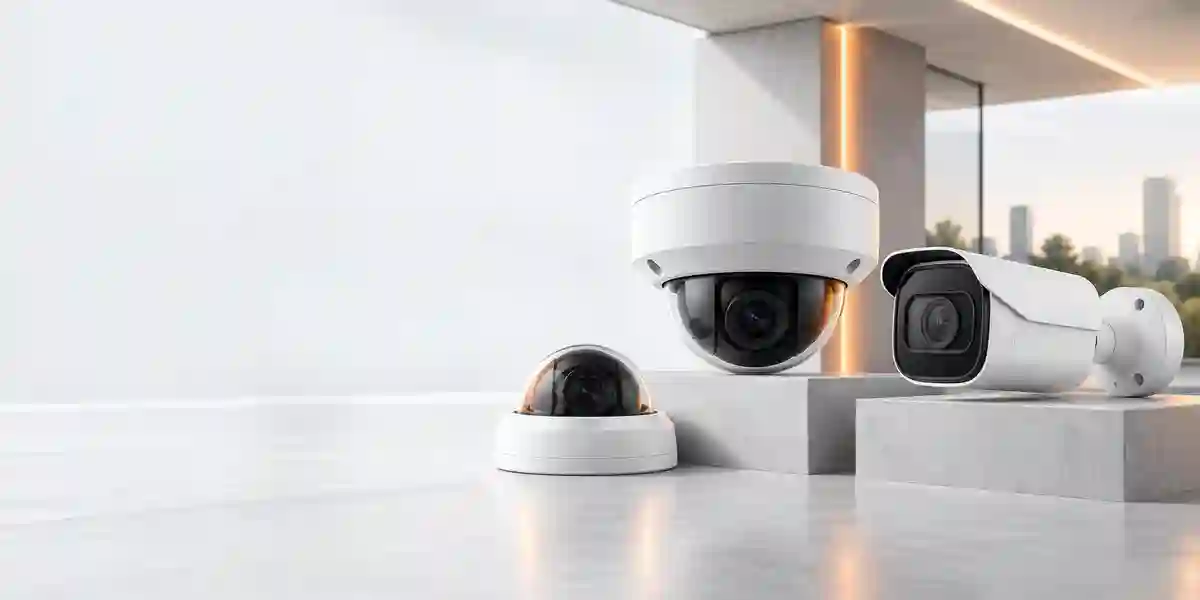
Illustrative Hanwha Q Series camera range image; exact appearance varies by model.
Hanwha QND-6072R Dubai
Dubai buyers considering the Hanwha QND-6072R are usually balancing three practical questions: whether the camera is appropriate for the intended indoor scene, whether it will integrate cleanly with the recorder or VMS, and whether the overall CCTV design meets the project’s regulatory and operational requirements. The QND-6072R fits many indoor commercial locations because it combines 2MP video with a 3.2–10mm manual varifocal lens rather than forcing the installer into one fixed field of view. In an office or commercial property, this can help when camera positions are constrained by ceiling layout, architectural finishes, lighting fixtures or cable routes. The installer can frame a broad reception area at the wide end or narrow the view toward a doorway, counter or corridor section where more pixel density is wanted.
Dubai environments often create challenging contrast even indoors. A glass entrance can place a person in shadow against strong daylight, while brightly lit retail displays and darker surrounding areas can exist in the same scene. The camera’s 120dB WDR is therefore a meaningful specification rather than a marketing extra. After business hours, the integrated IR system provides a manufacturer-rated viewable distance up to 20m, although the real result will depend on walls, reflective surfaces, subject clothing, camera angle and ambient light. The dome should be positioned so nearby surfaces do not bounce excessive IR back into the lens.
The model appears on Dubai’s SIRA approved-camera list, but project approval is never just a model-number exercise. Regulated installations should still confirm the current requirements for the property type, recorder, storage period, camera placement, documentation and installer process. Buyers should also distinguish this indoor QND dome from outdoor-rated Hanwha products; the official QND-6072R data does not specify an outdoor IP/IK rating.
For a Dubai quotation, provide FourTeck with the site type, number of cameras, approximate mounting positions, expected retention days, existing NVR or VMS if any, network switch details and whether installation is required. This allows the commercial proposal to be based on a real system design rather than an isolated camera price. For wider CCTV planning, visit FourTeck CCTV installation guidance for Dubai and the UAE or use the FourTeck contact route to discuss the project.
Hanwha QND-6072R UAE
Across the UAE, the Hanwha QND-6072R is best assessed as part of a complete IP surveillance design rather than as a standalone camera specification. Multi-emirate businesses frequently need consistent camera standards across offices, retail branches, warehouses and service locations in Dubai, Abu Dhabi, Sharjah, Ajman, Ras Al Khaimah and other emirates. A common indoor model can simplify spares, documentation and user training, but only when the viewing requirement is similar at each site. The QND-6072R’s manual varifocal lens gives deployment teams some flexibility to standardise one indoor dome while still adjusting the framing locally.
For UAE procurement, first define what the recorded video must show. A reception camera may need an overview of visitors and staff movement, while a cash counter or restricted doorway may need a narrower field of view. The same 2MP sensor will deliver different evidential value depending on how many metres of scene are packed into the frame. This is why lens setup, mounting distance and scene width should be considered alongside the resolution figure. The DORI values published by Hanwha can help integrators understand approximate detect, observe, recognise and identify ranges, but final acceptance should still be based on the actual installed view.
Network and storage planning are equally important. PoE can simplify branch deployment, yet the switching infrastructure must have sufficient PoE budget and stable uplinks. H.265 can reduce storage demand, but retention calculations should be performed with realistic bitrate assumptions and recording schedules. Sites with continuous recording, high motion or longer retention periods may require significantly more storage than a basic office deployment.
The QND-6072R supports a built-in microphone, alarm I/O, event analytics and local microSD storage. Whether those functions should be enabled depends on corporate policy, local requirements and the chosen NVR/VMS. For UAE buyers coordinating several sites, FourTeck can help map one camera specification to multiple branch layouts and highlight where a different model is needed. Use FourTeck UAE for UAE technology enquiries and CCTV and access-control planning guidance when the camera forms part of a wider physical-security project.
Hanwha QND-6072R Kenya
Kenya-based buyers evaluating the Hanwha QND-6072R often need a camera that can fit offices, retail locations, education facilities, hospitality properties, clinics and branch environments where a professional network-camera platform is preferred over basic consumer surveillance. The QND-6072R is an indoor dome, so its strongest fit is in controlled interior spaces rather than exposed perimeter locations. The adjustable 3.2–10mm lens can be particularly useful when a project has mixed room dimensions and the installer needs to tune each view instead of stocking several fixed-lens variants.
For Nairobi offices and branch projects elsewhere in Kenya, network reliability should be planned with the same care as camera selection. PoE allows the camera to receive power and data over one cable, but switches should be chosen with adequate power budget and UPS support where power interruptions would otherwise stop recording. If the business needs footage during short outages, backup planning should include the NVR, core switch, router where remote access is required and any local display used by security staff. The camera itself cannot preserve a complete surveillance system if the recorder or switching layer is down.
Storage retention is another common procurement issue. The camera’s H.265 support can help reduce bandwidth and disk usage, while the microSD slot can provide local recording options up to the manufacturer-specified 128GB capacity. However, businesses that need formal incident review should normally calculate central recorder storage from camera count, expected bitrate, recording mode and retention period. Retail, logistics and education sites with long operating hours often generate more activity than a lightly occupied office, so a single generic storage estimate is rarely reliable.
Before importing or ordering for Kenya, confirm the exact QND-6072R variant, compatible recorder, mounting accessories, power design and support route. If exterior cameras are part of the same project, pair the indoor dome requirement with purpose-built outdoor models rather than exposing QND-6072R to conditions for which no outdoor IP rating is stated. Kenya customers can use FourTeck Kenya to discuss branch CCTV requirements, recorder sizing, camera mix and project procurement.
Hanwha QND-6072R Kuwait
For Kuwait commercial surveillance projects, the Hanwha QND-6072R is most relevant as an indoor IP dome for offices, retail interiors, corridors, receptions, clinics, hospitality spaces and administration areas. Buildings in Kuwait often combine strong exterior sunlight with cooled indoor environments, and that contrast can affect cameras positioned near entrances or glass façades. The QND-6072R’s 120dB WDR provides useful headroom in these mixed-light scenes, while the 3.2–10mm manual varifocal lens allows the installer to control how much of the scene is included after the exact mounting point is selected.
The 20m IR specification supports after-hours indoor monitoring, but infrared performance should be validated during commissioning. Highly reflective walls, low ceilings, glass partitions and nearby surfaces can change the distribution of IR light. A camera mounted too close to a wall or glossy surface may create glare that reduces useful detail. The final installation should therefore be tested in both daytime and night conditions, with the view adjusted to the evidence requirement rather than simply accepting the default settings.
Kuwait buyers should also consider recorder and network architecture early. With PoE, network switches become part of the power system, so switch quality, UPS support and rack cooling all affect surveillance continuity. The camera supports H.265, H.264 and MJPEG as well as multiple streaming, which gives integrators options for recording and viewing profiles. For larger facilities, bandwidth planning should include aggregate camera traffic and uplink capacity between floors, buildings or network cabinets.
Procurement teams should ask whether the requirement truly calls for a 2MP indoor dome or whether a higher-resolution, vandal-resistant or outdoor model would produce better value for the intended location. If the project includes several camera types, FourTeck can help build a matched bill of materials rather than forcing one model into every position. For Kuwait product and project enquiries, use FourTeck Kuwait. Share the camera count, site type, preferred recorder platform and required retention period so the proposed configuration can be checked before purchase.
Hanwha QND-6072R Ghana
Ghana businesses looking at Hanwha QND-6072R commonly need dependable indoor video coverage for offices, retail branches, hospitality properties, clinics, schools, financial-service interiors, warehouses with administration zones and multi-site organisations. The QND-6072R offers a practical middle ground between a basic fixed-lens camera and a more complex premium model. Its manual varifocal lens gives the installation team room to adjust the composition based on the actual scene, which is valuable where architectural drawings do not perfectly predict the final furniture, counters, partitions or circulation paths.
For Accra and regional deployments, the surveillance network should be designed so that power and connectivity are not afterthoughts. PoE simplifies individual camera wiring, but each PoE switch needs sufficient capacity for all connected devices. UPS-backed switching and recording can help maintain operation through short power disturbances when continuity is important. Network segmentation can also separate camera traffic from general user traffic, supporting cleaner troubleshooting and more controlled access.
The QND-6072R records up to 1080p and supports H.265, H.264 and MJPEG. That is adequate for many overview and medium-range indoor tasks, but buyers should avoid assuming 2MP is enough for every evidence requirement. Where faces, labels, cash-handling detail or wider scenes must be captured with greater pixel density, camera position, lens setting and possibly a higher-resolution model should be assessed. The published DORI ranges provide reference values, but they are not a substitute for viewing the real installed image.
The built-in microphone and alarm interfaces can support integrated use cases, yet audio recording and event workflows should be enabled only where they are appropriate and authorised. For a Ghana project, identify which cameras need continuous recording, which can use events, how many days of footage must be retained and who will have remote access. FourTeck can help align those requirements with the camera, NVR, switching and storage design. Contact FourTeck Ghana for product selection and regional project discussions.
Hanwha QND-6072R Uganda
Uganda organisations considering the Hanwha QND-6072R may include offices, schools, healthcare facilities, hotels, retail shops, NGOs, branch networks, banks and businesses that want centrally managed IP surveillance. This model is designed as an indoor dome and is useful where a clean ceiling-mounted appearance is preferred. The 3.2–10mm manual varifocal lens can reduce uncertainty during installation because it gives the technician latitude to widen or tighten the view after the final mounting point is known.
In Kampala offices, a wide lens position may suit a reception or open lobby, while the tele end can focus attention on a doorway, access-controlled passage or counter. The choice should be based on the required subject detail. Packing a very wide scene into 1920 × 1080 pixels reduces the number of pixels available on each person or object, so camera placement and lens setup remain fundamental. Where the site needs stronger identification at distance, a higher-resolution or more tightly framed camera may be more appropriate.
Power resilience deserves particular attention in surveillance design. PoE centralises camera power at the switch, which is helpful because an appropriately sized UPS can then protect multiple cameras and the network equipment together. The NVR or VMS server and storage should also be protected according to the continuity target. If remote viewing is essential, the router and internet path must be included in the resilience plan rather than protecting only the cameras.
The QND-6072R can record to microSD and supports event analytics including motion, tamper, defocus, virtual line and virtual area functions. Integrators can use these features to support event recording and notifications, but they should be tuned to the site to avoid unnecessary alerts. Uganda buyers should confirm the recorder platform, retention days, PoE capacity, mounting accessories and indoor placement before ordering. For local and regional support, visit FourTeck Uganda and share the project size, site type and existing infrastructure for configuration guidance.
Hanwha QND-6072R Nigeria
Nigeria buyers often evaluate professional CCTV cameras for office buildings, retail chains, hospitality sites, schools, clinics, financial-service locations, logistics operations and branch networks where remote supervision and reliable footage review matter. The Hanwha QND-6072R is a 2MP indoor IR dome aimed at these structured IP surveillance environments. Its adjustable 3.2–10mm lens is an advantage for multi-site rollouts because each branch can retain the same camera model while installers tune the angle to the actual doorway, corridor, counter or room layout.
The camera’s PoE support can simplify deployment, but Nigerian projects should place special emphasis on power architecture. A surveillance system is only as resilient as its switch, recorder, storage and backup power. Where uninterrupted recording is required, calculate UPS capacity for the PoE switches, NVR or server, storage devices and essential network equipment. For distributed sites using central monitoring, WAN reliability and secure remote-access design are equally important.
H.265 support helps control bandwidth and storage demand, particularly for branch deployments where recordings are retained locally and live video is viewed remotely. Multiple streaming can allow a high-quality recording profile and a lighter live-view profile. However, storage retention should still be calculated site by site because scene activity and camera count have a major effect on actual disk usage. The 128GB microSD capability can provide local edge recording, but it should not automatically replace a properly sized NVR where longer retention or central evidence management is required.
Indoor placement is an important buying check. Some online listings incorrectly describe QND-6072R as weatherproof, yet the current manufacturer specification does not state an outdoor IP rating for this model. Exterior entrances, yards, perimeter walls and exposed loading areas should therefore be matched with suitable outdoor Hanwha cameras instead. Nigeria customers can use FourTeck Nigeria to discuss model selection, NVR compatibility, power planning and regional procurement for single-site or multi-branch CCTV systems.
Hanwha QND-6072R Seychelles
Seychelles buyers considering Hanwha QND-6072R may include hotels, resorts, offices, retail environments, administration facilities and service businesses that need indoor network surveillance with adjustable framing. The model is particularly suitable for controlled interiors such as receptions, corridors, offices, cashier areas and indoor access points. Because the manufacturer does not publish an outdoor IP rating for QND-6072R, exposed coastal and exterior positions should use purpose-built outdoor cameras with environmental ratings appropriate to the site.
The 3.2–10mm manual varifocal lens can help hospitality and commercial projects accommodate different room shapes without changing models at every interior point. A broad view can cover a lobby or reception, while a narrower setting can concentrate on a doorway or controlled passage. The installer should check the framing at the final mounting height and focus carefully; manual varifocal cameras depend on commissioning quality for their best result.
Network design is important on island properties where equipment may be distributed across several buildings or network cabinets. PoE can simplify cabling, while VLAN separation can help keep CCTV traffic organised. For larger hotels or campuses, uplink bandwidth between switches, recorder location and storage capacity should be planned from the beginning. H.265 support can reduce bandwidth and disk usage, but the retention requirement should be calculated with realistic settings. Backup power may also be needed for switches and recorders when the property expects continuous surveillance through short power disturbances.
After-hours monitoring can use the integrated IR system up to the manufacturer-rated 20m viewable distance, but reflective interiors, glass and room geometry can affect real performance. Commissioning should include night testing as well as daytime checks. For Seychelles projects, FourTeck’s wider Africa channel can help compare the QND-6072R with suitable outdoor, higher-resolution or vandal-resistant alternatives and coordinate a complete bill of materials. Visit FourTeck Africa for regional product and project enquiries.
Related FourTeck resources
Dubai CCTV planning
Guidance on camera selection, recording, storage, cabling and surveillance project planning.
UAE physical security
Combine CCTV with access control, storage, networking and project design for business sites.
UAE technology support
Use the UAE channel for local project discussions covering IT, networking, telecom and security.
Kenya projects
Regional support for surveillance procurement and infrastructure requirements.
Kuwait projects
Discuss business CCTV requirements, camera mix, recorder sizing and deployment.
Africa coverage
Use the regional channel for Seychelles and wider Africa project enquiries.
Ghana projects
Regional support for camera selection and multi-site security requirements.
Nigeria projects
Discuss power-aware CCTV design, NVR integration and branch deployment.
Why contact FourTeck for QND-6072R planning?
A camera purchase becomes much easier when the field of view, recorder, switch, storage and installation environment are considered together. FourTeck can assist with product selection, supply planning, CCTV layout guidance, PoE and networking considerations, NVR sizing, storage calculations and installation scope. The objective is to match the camera to the actual site requirement and identify early when a different Hanwha model would be more appropriate.
For a useful quotation, share the site country and city, indoor camera quantity, required mounting areas, existing recorder or VMS, desired retention period, current PoE switching, and whether you need installation or supply only. Availability, commercial terms and warranty route should be confirmed for the actual order rather than assumed from a generic web page.
Hanwha QND-6072R FAQ
Is the Hanwha QND-6072R a 2MP camera?
Yes. The QND-6072R uses a 1/2.8-inch CMOS sensor and supports a maximum resolution of 1920 × 1080. It can deliver up to 30fps or 25fps with H.265/H.264 depending on the video standard. Whether 2MP is sufficient depends on the required scene width, mounting distance and level of detail needed for observation or identification.
What lens does QND-6072R use?
It uses a 3.2–10mm manual varifocal lens with a 3.1× zoom ratio and DC auto iris. The published horizontal field of view is approximately 109° at the wide end to 33° at the tele end. Because focus and framing are manually adjusted, commissioning should include a careful final focus check at the installed position.
How far does the infrared illumination reach?
Hanwha specifies an IR viewable length up to 20m using 850nm infrared LEDs. Real performance depends on scene reflectivity, ambient lighting, mounting angle and nearby surfaces. The installer should test the final night image because walls, glass or highly reflective objects close to the camera can cause IR glare.
Does QND-6072R support PoE?
Yes. The camera supports IEEE 802.3af PoE Class 3 and can also be powered from 12VDC. When using PoE, check the switch’s total power budget as well as the number of available ports. For projects that need recording during short outages, include the PoE switch and recorder in the UPS design.
Can QND-6072R record to a memory card?
Yes. The camera has a microSD/SDHC/SDXC slot supporting up to 128GB. Local storage can be useful for event recording or resilience, but capacity is limited compared with a dedicated NVR. Decide whether edge storage is primary, backup or event-only storage based on the retention and evidence requirements.
Is QND-6072R suitable for outdoor use?
The current Hanwha specification does not state an outdoor IP or IK environmental rating for QND-6072R, so it should be treated as an indoor dome camera. If the camera position is exposed to rain, dust, direct weather or a vandal-risk environment, choose a Hanwha model specifically designed and rated for those conditions.
Does QND-6072R have WDR?
Yes. Hanwha specifies 120dB Wide Dynamic Range. WDR is useful where a scene contains both bright and dark areas, such as an indoor camera looking toward an exterior doorway or window. Correct positioning still matters because strong reflections or extreme backlight can affect any camera.
Does the camera include audio?
The QND-6072R specification includes a built-in microphone. Before enabling audio recording, confirm that it is required for the project and permitted under the applicable privacy, employment and local regulations. Some related model variants, such as QND-6072R1, are listed by Hanwha as no-audio models, so always confirm the exact model suffix supplied.
Which video codecs are supported?
The camera supports H.265, H.264 and MJPEG with multiple streaming. Integrators can use different streams for recording and live viewing when supported by the recorder or VMS. H.265 can reduce bandwidth and storage demand, but compatibility and retention calculations should be checked before final deployment.
Is Hanwha QND-6072R SIRA approved in Dubai?
The QND-6072R appears on the SIRA approved-camera list under Hanwha Vision MEA FZE. For a regulated Dubai project, confirm the current project requirements and complete approval path before deployment because camera listing alone does not determine the full compliance of a CCTV system.
Discuss your Hanwha QND-6072R requirement
Send FourTeck your project location, camera quantity, indoor mounting areas, required recording days, existing recorder or VMS, PoE switch details and installation scope. The team can help confirm whether QND-6072R fits the scene and identify compatible alternatives where higher resolution, outdoor protection, vandal resistance or newer analytics are required.
Reviews
There are no reviews yet.