

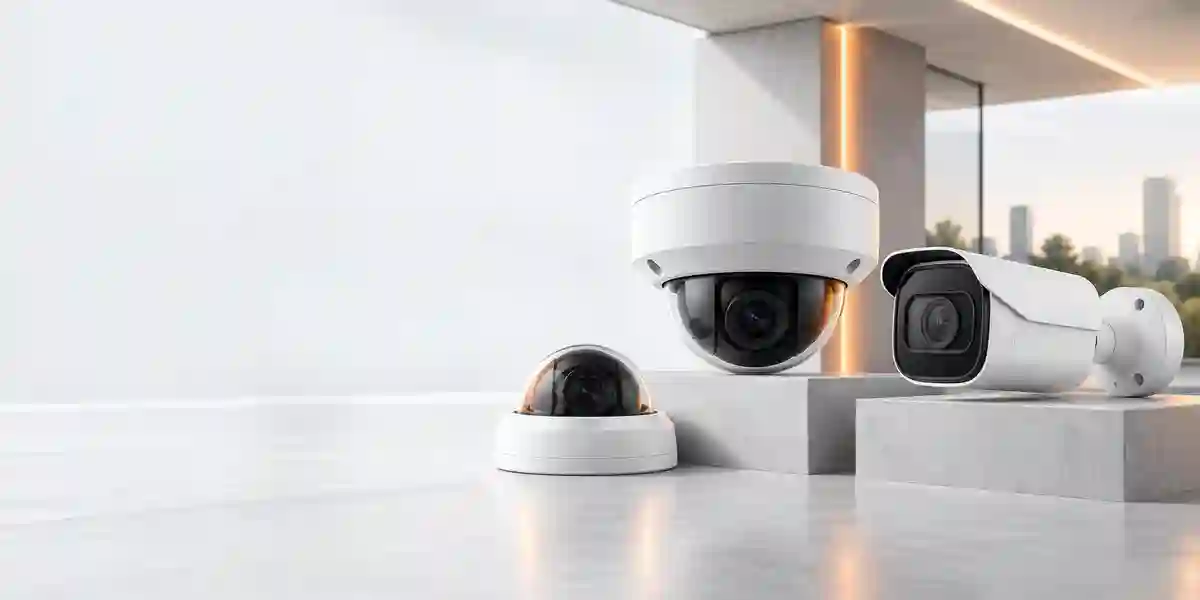
Quick Product Summary
1/3-inch CMOS sensor with maximum 4MP output at up to 30fps for detailed indoor IP surveillance.
6mm fixed lens with approximately 49° horizontal, 27.6° vertical and 55.6° diagonal field of view.
Integrated IR illumination for viewable distances up to 20m, subject to scene reflectivity and installation conditions.
H.265/H.264/MJPEG, up to three streaming profiles, WiseStream II, ONVIF Profile S/G/T and SUNAPI.
Product Overview and Buyer Fit
The QND-7032R belongs to Hanwha Vision’s Q-series family of network cameras. Its defining design choice is the 6mm fixed focal length. Compared with the 2.8mm QND-7012R or 4mm QND-7022R, the QND-7032R provides a narrower scene and places more pixels on subjects farther from the camera. That makes it useful when the surveillance objective is not to capture the widest possible room, but to watch a defined path or point such as a doorway, aisle, corridor, desk, reception approach, lift lobby, controlled entrance or stock passage. Buyers should therefore start with the required view and identification distance rather than choosing only by megapixel count.
The camera records up to 2560 × 1440 and supports H.265, H.264 and MJPEG. WiseStream II can help reduce bandwidth and storage demand when configured appropriately. A microSD/SDHC/SDXC slot supports local storage up to 128GB, while PoE IEEE 802.3af or 12VDC power allows the installer to match the camera to the site’s network and power design. Hallway view, lens distortion correction and event functions such as motion, tampering and defocus detection support common commercial surveillance requirements.
This model is best treated as an indoor dome. Buyers planning exterior mounting, exposed parking areas or locations needing weather or vandal protection should consider an outdoor-rated Hanwha model such as the QNV family instead of assuming the QND housing is suited to those conditions. Fourteck can review camera position, lighting, viewing distance, recorder/VMS platform, PoE budget and retention requirement before a quotation is prepared.
Key Features and Business Benefits
4MP at up to 30fps
Provides a useful balance of detail and bandwidth for indoor business monitoring, with enough resolution for closer review than typical 1080p footage.
Focused 6mm view
The narrower 49° horizontal field of view helps concentrate detail on a selected route, entrance or observation zone instead of spreading pixels across a very wide area.
20m IR support
Built-in infrared illumination supports monitoring after lighting levels fall. Actual usable detail depends on reflectivity, mounting height, scene geometry and ambient light.
Efficient video encoding
H.265, H.264 and WiseStream II give integrators options to manage video quality, bitrate and retention according to network and storage limits.
PoE installation
IEEE 802.3af PoE can carry power and data on one Ethernet cable, simplifying many structured CCTV installations when switch capacity is correctly sized.
Open integration options
ONVIF Profile S/G/T and Hanwha SUNAPI provide integration paths for compatible recorders and VMS platforms; exact feature interoperability should still be tested.
Verified Technical Specifications
| Specification | Hanwha QND-7032R |
|---|---|
| Camera type | 4MP indoor IR dome network camera |
| Imaging device | 1/3-inch CMOS |
| Maximum resolution / frame rate | 4MP (2560 × 1440), up to 30fps with H.265/H.264 |
| Lens | 6mm fixed focal, F2.0 |
| Field of view | H 49° / V 27.6° / D 55.6° |
| Minimum illumination | Color 0.15 lux (F2.0, 1/30 sec); B/W 0 lux with IR LED on |
| IR distance | Up to 20m |
| Compression | H.265 / H.264 / MJPEG; WiseStream II |
| Streaming | Up to 3 profiles |
| Edge storage | microSD/SDHC/SDXC, 1 slot, up to 128GB |
| API / interoperability | ONVIF Profile S/G/T; SUNAPI HTTP API |
| Power | PoE IEEE 802.3af Class 3 or 12VDC |
| Power consumption | PoE max 7.9W / typical 6.1W; 12VDC max 7.1W / typical 5.1W |
| Operating environment | -10°C to +55°C; less than 95% RH |
| Dimensions / weight | Ø110 × 86mm; 255g |
Compatibility, Configuration and Deployment Guidance
A camera purchase should be checked against the complete recording system. The QND-7032R supports ONVIF Profile S/G/T and Hanwha’s SUNAPI, which gives buyers several integration routes, but ONVIF compatibility does not automatically guarantee every advanced event, metadata or configuration feature on every third-party recorder. If the camera will be added to an existing NVR or VMS, confirm the recorder model, firmware, supported resolution, codec, channel capacity and available PoE budget before ordering.
For PoE installations, allow for the camera’s maximum PoE draw rather than sizing a switch only by typical consumption. Camera traffic should also be included in uplink and storage calculations. Retention depends on bitrate, frame rate, motion levels, recording schedule and codec settings, so there is no single hard-disk size that fits every QND-7032R project. Edge microSD can be useful for local recording or resilience workflows, but it should not be assumed to replace an NVR where centralized retention and incident review are required.
The fixed 6mm lens is not remotely zoomable, so placement matters. Before drilling or pulling cable, confirm the actual subject width, camera-to-subject distance and desired evidence level. If the site layout may change or the installer needs flexibility after mounting, the motorized varifocal QND-7082R may be a better fit. If a wider indoor scene is required, the 2.8mm QND-7012R or 4mm QND-7022R may be more appropriate.
Ideal Customers and Use Cases
The QND-7032R is suitable for organizations that need targeted indoor surveillance rather than panoramic room coverage. Office operators can use it along corridors, reception approaches, doors to sensitive rooms or controlled internal passages. Retailers can position it toward transaction areas, high-value shelves or store approaches where a defined view is more useful than a broad overview. Schools and training facilities can use focused indoor dome positions for passageways and entrances, subject to privacy and local policy. Warehouses can use the camera inside for aisle ends, stock cages or internal access routes, while hotels and healthcare facilities may use it in appropriate public circulation spaces where surveillance is permitted.
The camera is also useful in mixed-camera deployments. A site may use wide-angle domes for general coverage, QND-7032R units for longer indoor views, outdoor vandal domes for exposed locations and PTZ or specialty cameras for open areas. The best design normally combines camera types according to scene objective rather than standardizing one lens across every location.
What to Confirm Before Ordering
- Is the camera location indoors and suitably protected from weather or vandal exposure?
- Does a 6mm fixed lens and approximately 49° horizontal view match the required scene?
- Which NVR or VMS will record the camera, and has model-level compatibility been checked?
- Will the camera use PoE or 12VDC, and is sufficient power budget available?
- How many days of recording retention are required, and what bitrate/frame-rate policy will be used?
- Is microSD edge storage required, and if so, what card capacity and recording role are planned?
- Are motion, tampering, hallway view or other functions required by the project?
- What mounting surface, junction arrangement and cable path are available at the site?
- Does the project require compliance, documentation or approval beyond basic equipment supply?
- What current availability, commercial terms and support route apply to the requested quantity?
QND-7032R Compared with Related Q-Series Models
Hanwha offers several closely related 4MP indoor dome cameras. The key buying difference is primarily lens choice and, for the QND-7082R, varifocal flexibility. QND-7012R uses a 2.8mm fixed lens for a very wide view, QND-7022R uses a 4mm fixed lens for a middle-ground perspective, QND-7032R uses a 6mm fixed lens for a tighter view, and QND-7082R adds a 3.2–10mm motorized varifocal lens. A narrow corridor or more distant target often suits the QND-7032R better than the wide 2.8mm model, while a site requiring commissioning flexibility may justify the varifocal version.
Hanwha QND-7032R Dubai
Dubai buyers looking for the Hanwha QND-7032R typically need a clear answer to a practical question: will this 4MP dome place enough detail on the intended indoor target without forcing an unnecessarily wide camera view? In office towers, retail units, clinics, schools, warehouses and hospitality properties, many surveillance positions are long and narrow rather than square. Corridors, reception approaches, lift lobbies, internal doors, cashier approaches and stock aisles can benefit from the 6mm lens because it concentrates the frame on a defined zone. The approximately 49-degree horizontal view is notably tighter than the 2.8mm and 4mm variants in the same family, so placement should be checked against the actual floor plan before purchase.
Dubai projects also need careful network and power planning. The QND-7032R supports PoE, which can simplify structured cabling when the switch has adequate wattage and the rack design includes suitable UPS protection. For multi-camera sites, calculate aggregate camera bitrate and uplink capacity rather than treating each camera in isolation. If footage retention is important, determine recording days, frame rate, codec, scene activity and NVR capacity before selecting drives. H.265 and WiseStream II can help manage storage, but the final result remains configuration dependent.
Indoor environmental suitability is another key consideration. This QND model is intended for indoor use; an outdoor or exposed Dubai position should move the discussion toward a weather-rated Hanwha model. Where the camera will be mounted behind glass, facing bright entrances or looking along a reflective corridor, a site review is valuable because lighting can affect usable evidence more than resolution alone. Fourteck can assist Dubai buyers with camera selection, compatible PoE switching, NVR/VMS planning and quotation preparation without assuming stock, price or delivery until the exact quantity and configuration are confirmed. For broader CCTV project planning, visit the Fourteck CCTV installation and surveillance planning page or use Fourteck UAE for local business technology enquiries.
Hanwha QND-7032R UAE
Across the UAE, QND-7032R requirements can vary significantly between a Dubai office, an Abu Dhabi institutional site, a Sharjah warehouse, an Ajman retail unit or a multi-emirate branch rollout. The product itself remains the same, but the best bill of materials depends on how the camera is being used. A branch network may want consistent lens selection and recording policy across every location, while a single building may need a mix of wide and narrow views. Because the QND-7032R has a fixed 6mm lens, it is strongest where the camera position and target zone are already well defined.
UAE procurement teams should confirm recorder compatibility, firmware policy, cybersecurity requirements, network segmentation, user access and storage retention before standardizing the model. ONVIF Profile S/G/T can simplify interoperability discussions, while Hanwha SUNAPI may support deeper integrations within compatible environments. Still, model-level validation matters when a third-party recorder or VMS must expose specific events or settings. For larger projects, it is worth testing a representative camera and recorder combination before quantity deployment.
Power and network design are equally important. PoE reduces the need for a separate local power adapter, but the switch must have enough total power budget and suitable uplink capacity. If cameras share switching with voice, Wi-Fi or office endpoints, VLAN planning and traffic management can make support easier. Fourteck can help UAE customers review the surveillance network together with compatible switching and infrastructure through its networking, firewall and switch solutions. Buyers can also use Fourteck.com for integrated IT, telecom and security project enquiries. Availability, warranty path, commercial terms and delivery arrangements should be confirmed on the actual quotation for the chosen quantity and destination rather than assumed from a generic online listing.
Hanwha QND-7032R Kenya
Kenya buyers evaluating the Hanwha QND-7032R may be planning CCTV for offices, schools, retail, logistics, hospitality, healthcare or multi-branch operations. A common mistake in camera selection is to choose one lens for every position because the megapixel rating looks suitable. The QND-7032R should instead be selected where its 6mm fixed view matches the scene. Long indoor corridors, access approaches, cashier lanes, controlled internal doors and defined warehouse passages are examples where a narrower field can preserve more useful subject detail than a very wide lens.
For Nairobi and wider Kenya projects, network stability and supportability matter as much as the camera specification. PoE allows one Ethernet run to carry data and power, but camera networks should be planned around cable distance, switch location, UPS coverage and bandwidth. Where sites depend on central monitoring, the WAN design and remote-viewing method also need to be considered. A multi-branch organization may standardize camera naming, IP ranges, user roles and retention policies so support teams can troubleshoot consistently.
The model’s H.265 capability and WiseStream II can help reduce storage and network load when configured carefully, while the microSD slot offers a local edge-storage option up to 128GB. Recording duration should still be calculated for the exact project because motion level, frame rate and image complexity can change bitrate significantly. Buyers should also decide whether a Hanwha NVR, another ONVIF-compatible recorder or a VMS platform will be used and confirm the required events and playback functions before procurement.
Fourteck supports Kenya business enquiries through Fourteck Kenya. Share the camera count, site type, required view, preferred recorder, retention days and whether installation or supply-only assistance is needed. Fourteck can then review suitable product and infrastructure options. Current stock, price, freight, taxes, warranty handling and delivery timing depend on the actual order and should be confirmed commercially rather than inferred from another market.
Hanwha QND-7032R Kuwait
Kuwait businesses considering the Hanwha QND-7032R should first separate indoor requirements from outdoor exposure. The QND-7032R is an indoor dome with a 6mm fixed lens, so it suits protected commercial environments such as office corridors, reception routes, internal retail positions, hotel circulation areas, clinics, education buildings and indoor warehouse zones. Exterior perimeter positions, open loading yards and exposed entrances should be assessed for an outdoor-rated model instead of assuming the indoor housing is appropriate.
The 49-degree horizontal view is especially relevant to long, defined scenes. In a narrow passage, this can help place more of the 4MP image on the subject than a wide 2.8mm lens. In a small room, however, the same lens may be too tight. A simple floor-plan review or temporary positioning test can avoid ordering the correct camera family with the wrong lens. If installers need to adjust the field of view after mounting, the varifocal QND-7082R is worth comparing.
Kuwait surveillance projects should also consider network segmentation, secure passwords, firmware management and recorder sizing. H.265/H.264 support and WiseStream II provide bitrate options, while the camera’s PoE capability simplifies many IP deployments. The total design still needs a PoE power budget, uplink capacity and recording calculation. If a third-party NVR or VMS is used, ONVIF Profile S/G/T is helpful, but exact feature compatibility should be confirmed for the required workflow.
For Kuwait enquiries, businesses can contact Fourteck Kuwait with the quantity, delivery location, site type and recording platform. That allows quotation and sourcing discussions to be based on the real project rather than generic assumptions. Warranty, supply route, availability, accessories and delivery should be stated on the final commercial offer for the exact order.
Hanwha QND-7032R Ghana
Ghana customers looking at the Hanwha QND-7032R may be upgrading from lower-resolution cameras, building a new IP CCTV system or standardizing surveillance across business locations. The model provides 4MP resolution, a fixed 6mm lens, 20m IR illumination, PoE and industry-standard video codecs. Those specifications make it useful for targeted indoor coverage, but the narrower lens should be matched to the actual distance and scene width. Corridors, internal doors, reception approaches, cash zones and stock passages are stronger use cases than very wide rooms that need broad overview coverage.
For Accra and wider Ghana deployments, network design can have a direct effect on long-term reliability. PoE cameras benefit from organized rack placement, properly sized switches, labelled cabling and backup power where required. In a building with several cameras, the switching design should provide enough PoE wattage and uplink capacity, while the recorder should be sized for the selected frame rate, bitrate and number of retention days. H.265 can improve storage efficiency, but real-world retention still needs calculation rather than a generic estimate.
The camera supports local microSD storage up to 128GB and ONVIF Profile S/G/T. That can be useful for projects combining edge recording with centralized systems or integrating with a compatible third-party VMS. Buyers should verify which analytics or event functions are required because standards-based video compatibility does not guarantee every advanced feature on every platform. Where the project uses an existing recorder, provide its exact model and firmware during quotation review.
Ghana buyers can use Fourteck Ghana to discuss product sourcing and project requirements. Share the intended camera positions, quantity, recorder platform, storage target and whether PoE switching is already available. Fourteck can assist with a clearer bill of materials and commercial response. Stock, warranty route, import conditions and delivery timing remain order dependent and should be confirmed before purchase.
Hanwha QND-7032R Uganda
Uganda organizations comparing CCTV models often need equipment that is straightforward to integrate, economical with bandwidth and suitable for business interiors. The Hanwha QND-7032R fits that requirement when a 6mm fixed field of view is appropriate. In Kampala offices, hotels, schools, medical facilities, retail sites and warehouses, the camera can be considered for corridors, internal door approaches, cashier lines, reception routes and controlled indoor passages. Its narrower view should be treated as an advantage only when the target zone is defined; wide rooms may need a shorter focal length model.
The camera supports up to 4MP at 30fps with H.265/H.264 and WiseStream II. These tools can help manage network and storage demand, which may be valuable when a site has multiple cameras or when footage is reviewed remotely. However, remote viewing quality depends on the wider network, not just the camera. Internet uplink, firewall rules, secure access methods and recorder configuration all influence day-to-day usability.
For local resilience, the microSD/SDHC/SDXC slot supports up to 128GB. Buyers should decide whether edge storage is for event backup, temporary recording or part of a recorder failover strategy. The camera also supports ONVIF Profile S/G/T, giving integration options with compatible NVRs and VMS platforms. Where a project already has a recorder, model-level compatibility should be checked before placing a multi-camera order.
Fourteck supports Uganda enquiries through Fourteck Uganda. A useful quotation request includes camera quantity, site type, approximate camera-to-subject distance, existing network switch details, recorder model if already installed and desired retention days. This information helps avoid mismatched lens selection or under-sized recording equipment. Commercial availability, warranty handling, shipping and delivery schedules should be confirmed on the final Uganda quotation.
Hanwha QND-7032R Nigeria
Nigeria CCTV projects can range from a single office to large retail, logistics, education, hospitality and multi-site business deployments. The Hanwha QND-7032R is a useful indoor option when surveillance needs a focused 6mm lens rather than a very wide room view. In Lagos, Abuja and other commercial centres, typical applications can include corridors, internal entrances, cash handling approaches, controlled doors and warehouse passages. Buyers should map the lens to the scene before ordering because a fixed lens cannot be adjusted optically after installation.
For larger Nigerian projects, network architecture becomes part of the camera decision. PoE simplifies cabling, but switch selection should include the total camera wattage, port count, uplink bandwidth and the possibility of future expansion. If power continuity is important, the NVR, PoE switches and core network should be included in UPS planning. Video retention should be calculated from the actual bitrate policy and recording schedule. H.265 and WiseStream II can help reduce data consumption while maintaining useful quality, but final storage figures vary by scene and configuration.
Cybersecurity and access control also deserve attention. Camera passwords, firmware, network segmentation, recorder permissions and remote-access methods should be managed as part of the wider security system. ONVIF Profile S/G/T supports interoperability, while Hanwha SUNAPI offers another integration path in compatible systems. If a customer has a third-party VMS or recorder, Fourteck can review the required capabilities before quotation so the discussion covers more than basic video streaming.
Nigeria buyers can contact Fourteck Nigeria with quantity, city, site type, recorder preference and project timeline. This allows sourcing and configuration questions to be addressed against the real requirement. Availability, landed cost, warranty arrangement, delivery and installation scope should always be confirmed in the final commercial offer instead of assumed from overseas listings.
Hanwha QND-7032R Seychelles
Seychelles buyers may require surveillance for hotels, resorts, offices, retail businesses, education, healthcare, warehouses and other commercial facilities where reliable indoor monitoring forms part of a wider security plan. The Hanwha QND-7032R is designed as an indoor 4MP IR dome, so it is best suited to protected interior positions. Its fixed 6mm lens gives a relatively narrow 49-degree horizontal field of view, which can work well along corridors, entrances, reception approaches and defined internal routes where a broad wide-angle image is not the main objective.
Island projects can make procurement planning especially important because replacement logistics and accessory mismatches may be harder to resolve quickly. Before ordering, confirm mounting requirements, PoE switch capacity, recorder compatibility, storage drives and any junction or cabling accessories required for installation. A complete bill of materials can reduce the risk of equipment arriving without the supporting components needed to commission the system.
The QND-7032R supports H.265/H.264/MJPEG, WiseStream II, microSD storage up to 128GB and ONVIF Profile S/G/T. For remote monitoring from another island, head office or management location, plan the internet connection and security architecture carefully. Recorder access should use controlled accounts and appropriate network protection instead of exposing camera services directly. Where footage retention is required for a defined number of days, calculate capacity from camera count, bitrate and recording schedule.
Fourteck handles Seychelles and wider regional technology enquiries through Fourteck Africa. Provide the project island/location, quantity, intended indoor camera positions, existing NVR/VMS details and whether network or power infrastructure is also required. Fourteck can then discuss product and configuration options. Freight, customs, availability, warranty route and delivery timing are project specific and should be confirmed in the final quotation.
Related Fourteck Products and Project Components
Fourteck’s current catalogue also includes infrastructure and access-control products that may sit alongside an IP surveillance project. These are not substitutes for the QND-7032R; they are examples of adjacent equipment available on the same website for wider security and network planning.
Fortinet FortiSwitch 348G-FPOE Dubai
Managed PoE switching for business networks where cameras, access points and other powered endpoints need structured connectivity. Confirm PoE budget and uplink design for CCTV use.
ZKTeco SpeedFace-V5L Dubai
Hybrid biometric access terminal for projects combining surveillance with controlled employee or visitor entry. Suitable when door events and CCTV form part of one security plan.
ZKTeco SenseFace 3A Dubai
Compact biometric and card-capable access terminal for controlled doors, useful in offices and facilities that need access management beside video surveillance.
ZKTeco FaceKiosk-H13A Dubai
Visitor and identity kiosk option for reception or entry workflows. Best considered when front-of-house access and camera coverage are being designed together.
ZKTeco QR10L Dubai
QR and barcode reader for credential or visitor workflows, useful in projects where digital passes complement CCTV monitoring at controlled entry points.
ZKTeco VR10 Pro Dubai
Vehicle detection/radar component for parking and barrier projects. It can form part of a wider physical-security design alongside separate LPR or surveillance cameras.
ZKTeco SC02 Interactive Whiteboard UAE
A separate collaboration display product in the Fourteck catalogue, relevant to education and meeting-room projects that may also require managed networking and CCTV infrastructure.
Regional Fourteck Resources
For Dubai and UAE enquiries, use Fourteck UAE or Fourteck.com. Regional business enquiries can be routed through Fourteck Kenya, Fourteck Uganda, Fourteck Kuwait, Fourteck Ghana, Fourteck Nigeria and Fourteck Africa. These routes help buyers discuss country-specific sourcing, project scope and commercial requirements without assuming identical stock, warranty or logistics in every market.
Why Contact Fourteck for the QND-7032R?
A CCTV camera should be purchased as part of a working surveillance design, not as an isolated specification sheet. Fourteck can assist with product selection, camera placement discussion, PoE switching, recorder sizing, storage planning, cabling considerations and broader network integration. This is particularly useful when a project mixes indoor and outdoor cameras or when the QND-7032R must integrate with an existing NVR or VMS. Commercial availability, price, warranty route and delivery are confirmed against the actual quotation rather than presented as fixed claims.
Hanwha QND-7032R FAQs
What resolution does the Hanwha QND-7032R support?
The QND-7032R supports a maximum 2560 × 1440 image, commonly described as 4MP, at up to 30fps using H.265 or H.264. The right recording frame rate can be lower depending on the surveillance objective, storage target and bandwidth available.
What lens does the QND-7032R use?
It uses a fixed 6mm F2.0 lens. Hanwha lists an approximately 49° horizontal, 27.6° vertical and 55.6° diagonal field of view. Because the lens is fixed, confirm camera placement and scene width before installation.
How far can the infrared illumination reach?
Hanwha specifies IR viewable length up to 20m. Actual usable detail depends on scene reflectivity, mounting height, target size, ambient lighting and the way the infrared light interacts with walls or nearby surfaces.
Does the QND-7032R support PoE?
Yes. The camera supports IEEE 802.3af Class 3 PoE as well as 12VDC. Hanwha lists a maximum PoE consumption of 7.9W. PoE switch sizing should use the project’s total maximum camera load plus suitable headroom.
Can the QND-7032R record to a memory card?
Yes. It has one microSD/SDHC/SDXC slot supporting up to 128GB. Edge storage can support local recording strategies, but organizations needing centralized management and longer retention commonly use an NVR or VMS as the primary recording platform.
Is the QND-7032R compatible with third-party NVRs?
The camera supports ONVIF Profile S/G/T, which provides standards-based integration with compatible systems. However, exact compatibility for events, analytics, playback and configuration functions should be checked against the specific NVR or VMS model and firmware before purchasing multiple units.
Is the QND-7032R an outdoor camera?
It is positioned as an indoor dome camera. For exposed outdoor locations or areas requiring weather and impact protection, consider an appropriate Hanwha outdoor-rated model such as a QNV vandal-dome variant rather than using the QND housing outside its intended environment.
What is the difference between QND-7012R, QND-7022R and QND-7032R?
The main difference is fixed focal length. QND-7012R uses 2.8mm for a wide view, QND-7022R uses 4mm for a more moderate view, and QND-7032R uses 6mm for a tighter view. Select based on scene width and subject distance.
Does the QND-7032R support H.265?
Yes. H.265, H.264 and MJPEG are supported, together with WiseStream II. H.265 can help lower storage and bandwidth demand compared with less efficient encoding, but final bitrate depends on video settings and scene activity.
How can I request Hanwha QND-7032R pricing in Dubai?
Send Fourteck the required quantity, Dubai delivery or project location, recorder/VMS details, installation scope and any storage or PoE requirements. Pricing and availability can then be confirmed against the exact requirement without relying on outdated or cross-market listings.
Plan Your Hanwha QND-7032R Deployment
Share the number of cameras, intended indoor locations, viewing distances, NVR/VMS platform and required recording days. Fourteck can help review whether the QND-7032R is the right lens choice and prepare a project-specific commercial response.
Reviews
There are no reviews yet.