

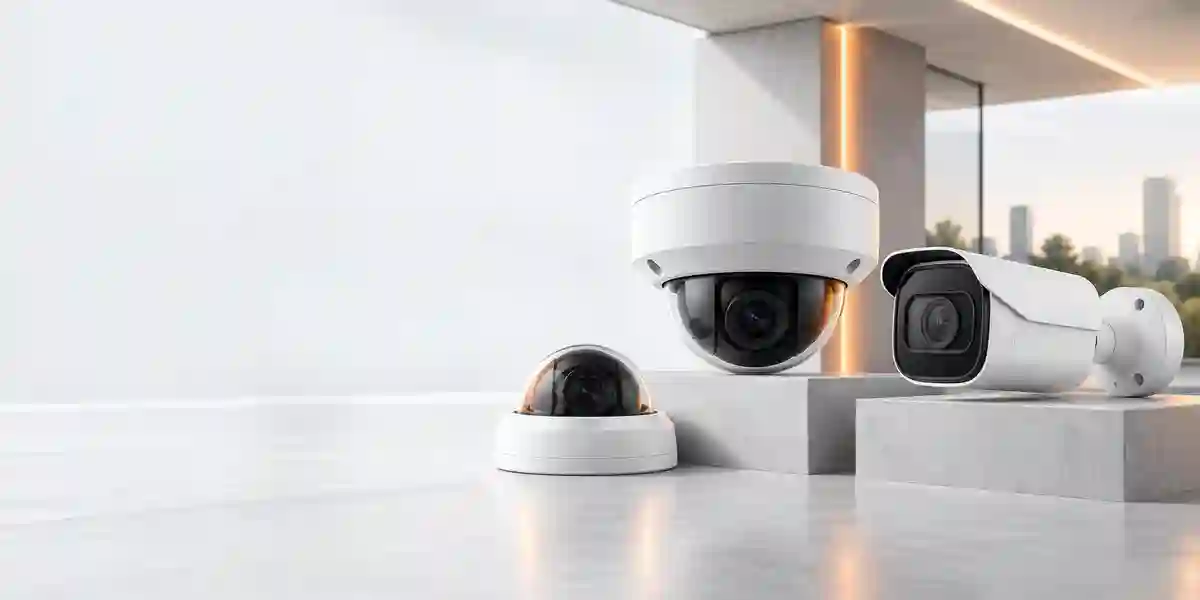
Quick Product Summary
Indoor AI IR dome network camera
Up to 5MP, 2592 × 1944
3.0 mm fixed, F1.6
IR illumination up to 25 m
IEEE 802.3af PoE, Class 3
microSD / SDHC / SDXC up to 256 GB
Product Overview and Buyer Fit
The QND-C8013R is intended for buyers who need a compact indoor dome camera with higher-than-1080p resolution, useful low-light performance and embedded analytics without moving to a more complex multi-sensor or PTZ platform. The 5MP sensor records up to 2592 × 1944, giving security teams more image detail than a standard 2MP camera while remaining practical for common office, retail and institutional deployments. The fixed 3.0 mm lens gives a broad 100° horizontal view, making the camera well suited to reception areas, corridors, customer-facing spaces, classrooms, meeting areas, shop floors, indoor access points and other locations where wide scene coverage is more important than optical zoom.
Hanwha equips the model with 25 m infrared illumination, automatic day/night switching and 120 dB wide dynamic range. These features are valuable in interiors that experience strong contrast, such as glass-fronted entrances, lobby doors, loading-office windows or hallways where bright daylight enters from one direction. AI-assisted WiseNR and WiseStream are designed to improve image efficiency by focusing processing and bandwidth on meaningful scene content. The camera also includes AI-based object detection for people and vehicles, plus event logic for line crossing, directional movement, loitering, intrusion, entry and exit. This can help reduce unnecessary alarms compared with basic motion-only workflows when the surrounding recorder or VMS is configured to use the camera’s event metadata.
For Dubai buyers, the most important fit question is whether the camera will be used indoors. The QND-C8013R uses a plastic indoor dome housing; it should not be selected simply because a dome shape is desired for an exposed outdoor location. Where weather resistance or vandal resistance is required, consider a compatible Hanwha QNV vandal-dome or QNO bullet model instead. Fourteck can help review the intended mounting area, view width, lighting, NVR or VMS platform, PoE capacity, retention period and local project requirements before quotation.
Key Features and Business Benefits
5MP detail
Up to 2592 × 1944 resolution supports detailed indoor surveillance for entrances, corridors, retail aisles and shared work areas, helping operators retain more scene information when reviewing recorded footage.
Wide 3.0 mm view
The fixed lens provides approximately 100° horizontal, 73° vertical and 129° diagonal fields of view, making it useful where one camera needs to cover a broad indoor scene.
AI event filtering
Person and vehicle detection can support more targeted security events. Virtual line and area analytics add options for crossing, direction, loitering, intrusion, enter and exit scenarios.
25 m infrared
Integrated IR extends visibility in dark indoor spaces and supports zero-lux operation when IR LEDs are active, useful for after-hours monitoring in offices, stock rooms and internal circulation areas.
120 dB WDR
Wide dynamic range helps balance scenes containing both bright and dark areas, such as glazed entrances, shop doors and reception points where daylight can otherwise create silhouettes.
Network and storage flexibility
H.265, H.264, MJPEG, multiple streaming profiles, ONVIF support, PoE and a microSD slot give integrators several choices for recording, viewing and system integration.
Verified Technical Specifications
| Specification | Hanwha QND-C8013R |
|---|---|
| Image sensor | 1/2.8 inch CMOS |
| Maximum resolution | 2592 × 1944 (5MP) |
| Maximum frame rate | Up to 30 fps / 25 fps with H.265 or H.264 depending on 60 Hz / 50 Hz configuration |
| Lens | 3.0 mm fixed focal, F1.6, M12 |
| Field of view | Horizontal 100°, vertical 73°, diagonal 129° |
| Minimum illumination | Color 0.05 lux; B/W 0.005 lux; 0 lux with IR on |
| IR distance | Up to 25 m |
| WDR | 120 dB |
| Compression | H.265, H.264, MJPEG; WiseStream III |
| Analytics | AI person/vehicle detection, color attribute, BestShot, motion detection, virtual line and virtual area events |
| Privacy | Up to 32 privacy masks; dynamic privacy masking for person/vehicle |
| Edge storage | microSD / SDHC / SDXC, up to 256 GB, 1 slot |
| ONVIF | Profiles S, G, T and M |
| Power | PoE IEEE 802.3af Class 3; maximum 8.1 W, typical 4.0 W |
| Operating temperature | -10°C to +45°C |
| Dimensions / weight | Ø110 × 90 mm; 317 g |
Compatibility, Configuration and Deployment Guidance
The QND-C8013R is an IP camera and should be planned as part of the wider surveillance network rather than treated as an isolated device. The camera supports common IP protocols and ONVIF profiles S, G, T and M, plus Hanwha SUNAPI. For a new deployment, confirm that the selected NVR or VMS supports the required video streams, resolution, AI events and metadata. ONVIF can improve interoperability, but individual features may depend on the recorder, software version and integration method. Where AI event search or advanced metadata is important, verify support on the exact recording platform before placing a project order.
Power is supplied by IEEE 802.3af PoE. This can simplify installation because the camera can receive both network connectivity and electrical power through one Ethernet cable from a suitable PoE switch or PoE-capable recorder. Check total PoE budget, switch port count, cable length, VLAN design and uplink capacity for multi-camera deployments. Although the camera’s typical power consumption is about 4 W and its published maximum is 8.1 W, system designers should size PoE infrastructure with appropriate overhead rather than adding camera maximums with no contingency.
Storage planning depends on recording resolution, frame rate, codec, scene activity, retention period and whether recording is continuous, event based or scheduled. The built-in microSD slot can support edge recording, but it should not automatically be treated as a replacement for centralized recording where longer retention, redundancy or multi-user investigation is needed. For business sites, calculate storage at the project level and decide whether edge storage will be primary, failover, event-only or supplemental. Hanwha WiseStream III can help reduce bandwidth and storage consumption, but real savings depend on the scene and configuration.
For installation, the fixed 3.0 mm lens means view width is determined mainly by camera position and distance to the subject. There is no optical zoom for field adjustment after installation. Before drilling or final mounting, test the view using the actual ceiling height and target area. The camera supports pan, tilt and rotate adjustment inside the dome, but these are installation adjustments rather than motorized PTZ functions. Use hallway view where a vertical scene such as a corridor benefits from 90° or 270° rotation.
Ideal Customers and Use Cases
Offices
Reception desks, internal entrances, lift lobbies, corridors, shared workspaces and server-room approaches where wide indoor coverage is required.
Retail
Shop floors, payment approaches, entrances and stock-access areas where person detection and wide-angle visibility can help support incident review.
Education
Corridors, administrative areas, common spaces and internal entrances where clear daytime and after-hours monitoring are part of the security plan.
Healthcare and clinics
Reception and non-clinical public areas where camera placement can be designed around security needs and applicable privacy policies.
Hotels
Indoor entrances, back-of-house corridors, service areas and circulation zones where a compact dome appearance is preferred.
Warehouses
Indoor dispatch offices, inventory rooms, staff entrances and internal handling zones, provided the camera remains within its environmental limits.
What to Confirm Before Ordering
- Confirm the camera will be installed indoors and within its published operating environment.
- Confirm that the 3.0 mm fixed lens and approximately 100° horizontal view suit the required scene.
- Check NVR or VMS support for 5MP streams, H.265/H.264, ONVIF and any required AI metadata.
- Calculate PoE switch capacity, total power budget, cable distance and network bandwidth.
- Define required recording days and calculate centralized or edge storage accordingly.
- Confirm whether alarm I/O is required and whether the optional cable is needed.
- Review mounting surface, cable route, ceiling access and camera angle before installation.
- Confirm any local privacy, compliance or project-approval requirements for the intended site.
- Ask Fourteck to confirm current product availability, project quantity and commercial terms at quotation stage.
Related Model Guidance
The QND-C8013R belongs to a family that also includes related indoor, vandal-resistant and bullet form factors. If a project needs a different lens or housing type, compare the application rather than choosing solely by megapixel count. The QND-C8023R is a closely related 5MP AI IR dome option in the same family and should be compared by lens and scene requirements. For exposed or vandal-risk areas, the QNV-C8013R or QNV-C8023R vandal-dome family may be more appropriate because those variants are designed for more demanding housings. For a bullet form factor, QNO-C8013R and QNO-C8023R are related options. Final model selection should be made from the latest Hanwha datasheet and the actual site requirement.
Fourteck’s CCTV planning resource can help buyers think through camera type, NVR capacity, storage, PoE switching, installation and remote-viewing requirements before selecting the exact model. See CCTV installation and surveillance planning in Dubai and CCTV and access control systems in the UAE.
Hanwha QND-C8013R Dubai
Dubai buyers looking for the Hanwha QND-C8013R usually need more than a camera model number. The practical question is whether the 5MP indoor dome fits the exact security zone, network design and recording target. In Dubai offices, retail sites, commercial towers, clinics, schools, hospitality properties and warehouse administration areas, indoor surveillance often needs to cope with strong daylight from glass façades, bright entrance doors and darker internal corridors in the same scene. The QND-C8013R addresses this type of contrast with 120 dB WDR and automatic day/night operation. Its 25 m IR illumination is also useful for internal areas that become unlit after closing hours, though the camera should still be positioned so reflective surfaces and nearby walls do not cause excessive IR bounce.
The 3.0 mm fixed lens gives roughly 100° horizontal coverage. For a Dubai reception, shop entrance or office corridor intersection, that wide view can reduce the number of cameras needed for scene awareness, but buyers should not assume it provides close identification at every distance. Camera height, subject distance and required pixels on target all matter. A security layout should identify whether the objective is general detection, observation, recognition or identification, then position the camera accordingly. The published DORI figures can help with planning, but real-world results depend on lighting, motion, viewing angle and installation quality.
Many Dubai projects also need recorder integration and remote monitoring. The camera supports H.265, H.264, MJPEG, ONVIF and Hanwha interfaces, giving system designers several integration paths. PoE can simplify ceiling installations by reducing separate power cabling, while microSD support can provide local edge recording. Before ordering, confirm the NVR or VMS model, PoE switch capacity, retention period, network segmentation, user permissions and cybersecurity policy. For regulated or compliance-sensitive projects, camera placement and recording practices should also be reviewed against the site’s applicable rules rather than assumed from a generic installation template.
For a Dubai quotation, provide Fourteck with the number of cameras, intended indoor locations, floor plan or photos if available, required recording days, current recorder or VMS details and whether installation is included. This allows the commercial discussion to focus on a correct configuration rather than a standalone unit price. Visit Fourteck UAE technology support or contact Fourteck sales for project guidance.
Hanwha QND-C8013R UAE
Across the UAE, the QND-C8013R can suit organizations standardizing indoor video surveillance across multiple branches, offices or customer-facing facilities. A multi-emirate project may include sites in Abu Dhabi, Sharjah, Ajman, Ras Al Khaimah, Fujairah or other locations, and those sites may differ in ceiling construction, network design, lighting and recorder infrastructure. Because the QND-C8013R uses a fixed 3.0 mm lens, standardization works best when similar scene widths and mounting distances are expected. Where some branches have narrower corridors or need a different focal length, a related Hanwha model may be more suitable than forcing one model into every location.
For UAE procurement teams, system compatibility should be documented before quantity orders. Confirm firmware policy, NVR or VMS versions, ONVIF requirements, PoE class, storage targets and whether AI events need to be searchable in the central platform. The camera can generate person and vehicle detection plus virtual line and area events, but event handling depends on how the receiving platform consumes metadata. If analytics are part of an operational workflow, such as after-hours intrusion alerts or restricted-area monitoring, test the required event type on the actual recorder or VMS rather than relying only on general protocol compatibility.
UAE projects also benefit from disciplined network planning. A camera deployment can share switching infrastructure with other business systems, but surveillance traffic, PoE demand and security controls should be considered from the start. VLAN separation, controlled administrative access, HTTPS, strong authentication, firmware management and restricted remote exposure are sensible topics for an IP CCTV design. The QND-C8013R includes modern security functions such as secure boot, signed and encrypted firmware, IEEE 802.1X support, HTTPS and access-control features; these capabilities are most useful when they are enabled as part of a broader network-security policy.
When requesting a UAE quotation, share total camera quantity, each site location, recorder model, retention days, installation scope and any requirement for centralized viewing. Fourteck can help assess the overall requirement and coordinate a product discussion without making assumptions about stock or delivery before confirmation. See Fourteck technology solutions and Fourteck UAE IT services for related infrastructure support.
Hanwha QND-C8013R Kenya
For Kenya-based businesses, the Hanwha QND-C8013R is relevant where indoor security teams need a compact 5MP dome camera with AI event filtering and network-based recording. Offices, schools, retail stores, hotels, clinics, financial-service branches and logistics facilities can all have internal locations where a wide fixed view is useful. The 100° horizontal field of view can cover reception areas and corridors efficiently, while 25 m IR supports after-hours visibility in spaces where lighting is reduced or switched off. As with any infrared dome camera, mounting position should avoid close reflective surfaces that can wash out the image at night.
Kenya buyers commonly need to balance image quality with storage, bandwidth and power reliability. H.265 and WiseStream III can help manage bitrate, but storage should still be calculated from real project settings. A 5MP stream at full frame rate requires more capacity than lower-resolution recording, particularly when many cameras record continuously. Define the required retention period first, then size the NVR, hard disks and network accordingly. Where branch connectivity is limited, local recording may be preferable to sending full-resolution streams over a WAN. The microSD slot can support edge storage, but important sites should define how footage is protected, backed up and accessed if the network is unavailable.
Power design is another important consideration. The QND-C8013R uses PoE, which can simplify deployments and make UPS protection easier because cameras and switches can be backed up centrally. Check PoE switch budget, UPS runtime, rack ventilation and cable quality. For a larger Nairobi or multi-branch deployment, a managed network design with camera VLANs, documented IP addressing and controlled remote administration can reduce support problems later. If analytics are required, confirm that the chosen Hanwha recorder or third-party VMS supports the events that the security team intends to use.
For procurement in Kenya, contact Fourteck Kenya with the site type, camera count, indoor viewing objectives, recorder details, storage period and installation scope. Current availability, commercial terms and logistics should be confirmed in the quotation rather than assumed from another market.
Hanwha QND-C8013R Kuwait
Kuwait organizations considering the Hanwha QND-C8013R should first separate indoor surveillance requirements from outdoor environmental needs. This model is an indoor dome camera, making it suitable for offices, customer-service areas, corridors, retail interiors, education facilities, medical reception zones and controlled indoor spaces. It should not be chosen for exposed exterior locations simply because the project wants a dome appearance. For outdoor or vandal-prone areas, a different Hanwha housing family should be reviewed.
The QND-C8013R’s 5MP resolution and wide 3.0 mm lens make it useful for scene overview while still providing more pixel detail than 2MP cameras. This can be valuable for business interiors where the security team wants both general movement context and better recorded detail. The model’s 120 dB WDR can help at entrances where bright exterior light contrasts with a darker lobby, while the 25 m IR system supports monitoring after lights are dimmed. AI-based person and vehicle detection can reduce dependence on raw motion events, especially in scenes where lighting changes or background movement might otherwise create frequent triggers.
For Kuwait projects, the camera’s PoE design simplifies structured cabling, but switch and UPS planning should be part of the bill of materials. Network cameras rely on stable power and data paths, so the surveillance rack, PoE switching, recorder, storage and internet or WAN connection should be designed together. If a central monitoring team will view multiple facilities, confirm WAN bandwidth and whether streams will be viewed live continuously or only on demand. H.265 can reduce bandwidth compared with older codecs, but actual usage depends on frame rate, scene activity and quality settings.
Before issuing a purchase order, verify NVR/VMS compatibility, AI event support, storage days, mounting location and required camera quantity. For Kuwait enquiries, use Fourteck Kuwait and provide project information so the configuration and current commercial position can be checked for the local requirement.
Hanwha QND-C8013R Ghana
In Ghana, the QND-C8013R can fit indoor security projects that require a professional network camera with 5MP resolution, infrared night viewing and AI-supported analytics. Typical use cases include administrative offices, banks and financial offices, educational campuses, healthcare reception areas, retail shops, hotels and logistics sites. Its broad field of view makes it practical for internal entrances and circulation zones, while the hard-coated dome bubble provides a clean indoor appearance. Buyers should still review mounting height and scene depth because a wide-angle lens spreads available pixels across a larger field than a narrow lens.
For Accra and other business locations, network and power continuity may be as important as camera specifications. PoE allows the camera to receive power from the network switch, which can simplify centralized backup using a UPS. If the surveillance system is expected to keep recording through short power interruptions, size the UPS for the NVR, PoE switches, network equipment and any required display or storage devices. For sites with unstable connectivity, keep primary recording local unless there is a clear reason to depend on cloud or remote WAN recording. The camera supports local microSD storage, which can be useful as part of an edge-recording or failover strategy when supported by the deployment design.
AI analytics can be helpful for event-driven monitoring, but they should be configured according to the actual scene. Virtual lines and areas work best when installers define meaningful boundaries around entrances, restricted zones or movement paths. Person and vehicle classification can help filter alerts, while BestShot and metadata can assist compatible investigation workflows. Confirm feature support on the recorder or VMS and tune rules after installation rather than relying on factory defaults.
Ghana procurement teams should specify quantities, required retention, viewing objectives, indoor locations, existing network equipment and installation responsibility. Current stock, delivery and warranty terms should be confirmed on the actual quotation. Contact Fourteck Ghana for regional product and project discussions.
Hanwha QND-C8013R Uganda
Uganda businesses evaluating the Hanwha QND-C8013R can use it for indoor surveillance where wide coverage, 5MP detail and modern IP integration are important. Offices, universities, schools, clinics, retail premises, hotels, warehouses and institutional buildings often have reception points, corridors and internal entrances that benefit from a compact dome camera. The 3.0 mm fixed lens gives a wide 100° horizontal field, which can reduce blind areas in smaller rooms, but buyers should confirm whether the target requires identification at a distance. If a narrow field or optical zoom is needed, a different lens option or model may be better.
Kampala deployments and multi-site projects should pay close attention to recording design. The QND-C8013R supports H.265 and H.264 and can stream multiple profiles. A high-resolution profile can be recorded for evidence while a lower-resolution profile is used for remote viewing, depending on recorder capability. This can help organizations conserve WAN bandwidth when branch offices connect to a central monitoring location. Edge storage up to 256 GB can add local recording capability, but retention expectations and failure recovery should be designed at the system level rather than left to the camera alone.
The camera’s PoE support enables clean structured cabling and can simplify power backup. For sites where power interruptions are a concern, central UPS protection for switches and recorders can keep the surveillance network stable for a defined period. Network security should include controlled administrator accounts, strong passwords, firmware maintenance and restricted exposure to the public internet. Hanwha provides secure communication and authentication functions, but the installer or IT team needs to configure the overall environment correctly.
Before ordering for Uganda, identify the camera count, planned locations, NVR or VMS, number of recording days, PoE switch capacity and installation scope. For regional assistance, use Fourteck Uganda. Availability, delivery options and warranty route should be confirmed for the specific order and destination.
Hanwha QND-C8013R Nigeria
Nigeria-based organizations can consider the Hanwha QND-C8013R for indoor CCTV deployments that require 5MP network video, infrared illumination and AI-supported event classification. Corporate offices, banking and financial environments, retail chains, educational institutions, hotels, healthcare reception areas and logistics businesses may use cameras of this type for indoor entrances, corridors, common areas and operational zones. The camera’s 100° horizontal view is useful for broad coverage, while 120 dB WDR helps when entrances contain both bright outdoor light and darker interior areas.
For Lagos, Abuja and multi-branch environments, recording architecture should be planned around connectivity and resilience. A branch can record locally to an NVR and provide selected remote viewing to a central team, reducing dependence on constant high-bitrate WAN transmission. H.265 and WiseStream III can help control bandwidth, but the design should still account for the number of cameras, selected frame rate, retention period and typical scene activity. Where an organization needs continuous recording through short power interruptions, PoE switches, NVRs, storage and network devices should be connected to appropriately sized backup power.
AI person and vehicle detection can help operations teams focus on relevant events, and virtual line or area rules can support use cases such as restricted-entry monitoring or movement across defined boundaries. These functions require careful placement and tuning. A rule placed over a high-traffic background or reflective glass may produce different results than expected. Test analytics in the actual scene and verify that the chosen VMS or NVR can receive and search the metadata required by the operator.
Nigeria buyers should also confirm procurement details such as model, quantity, mounting accessories, PoE infrastructure and warranty route on the quotation. Contact Fourteck Nigeria for regional enquiries and configuration discussion. Product availability and logistics can vary, so they should be verified for each project rather than inferred from another country.
Hanwha QND-C8013R Seychelles
For Seychelles businesses and institutions, the Hanwha QND-C8013R is most suitable for indoor surveillance locations protected from direct weather exposure. Hotels, resorts, offices, retail spaces, administrative facilities, clinics and educational sites can use indoor dome cameras for receptions, corridors, indoor entrances and staff circulation areas. Because island projects may involve different environmental conditions from mainland installations, it is especially important not to confuse an indoor dome with an outdoor-rated vandal dome. For exposed, humid or semi-outdoor areas, verify the required environmental rating and select a suitable alternative if needed.
The camera’s 5MP resolution, 25 m IR and 120 dB WDR provide a balanced specification for indoor monitoring. In hospitality environments, the wide 3.0 mm view can cover lobby access points and service corridors while maintaining a discreet dome appearance. In offices and institutional buildings, AI person detection and virtual-area rules can support event-based monitoring. Camera placement should always respect privacy-sensitive areas, and security objectives should be documented before installation so that lenses are aimed only where monitoring is appropriate and necessary.
Seychelles deployments can benefit from PoE because network and power can be delivered over one Ethernet run, reducing separate cabling to ceiling locations. For remote islands or facilities where maintenance access is less frequent, good installation practice becomes especially important: use quality structured cabling, label ports, document IP addresses, protect switches and recorders with suitable backup power, and maintain current firmware. If remote viewing is required across limited internet links, use appropriate secondary streams and avoid pushing full-resolution feeds continuously when not necessary.
Before ordering, share the number of cameras, building type, required retention days, NVR/VMS platform, indoor mounting locations and logistics destination. For Seychelles enquiries, Fourteck Africa is the appropriate regional resource unless a project-specific contact route is provided. Commercial terms, delivery options and warranty handling should be confirmed for the exact destination.
Related Fourteck Resources
The indexed Fourteck site currently provides broader CCTV and infrastructure resources that can help buyers plan the QND-C8013R within a complete system. For camera placement, recorder sizing and storage planning, review CCTV installation planning for Dubai and the UAE. For projects combining cameras with physical access systems, see CCTV and access control system guidance. For wider business infrastructure, Fourteck.com covers networking, telecom, security and IT project support.
UAE business technology and project enquiries.
Fourteck Kenya
Kenya regional product and project support.
Fourteck Uganda
Uganda regional technology enquiries.
Fourteck Kuwait
Kuwait sourcing and project discussions.
Fourteck Ghana
Ghana business technology support.
Fourteck Nigeria
Nigeria product and project enquiries.
Fourteck Africa
Regional support for Seychelles and Africa enquiries.
Why Contact Fourteck
A network camera is only one part of a working CCTV system. Fourteck can help customers structure the requirement around camera suitability, viewing angle, PoE switching, recorder capacity, storage days, network connectivity, installation and integration with wider business infrastructure. The goal of the enquiry should be to confirm the correct configuration for the site rather than assume that one model will fit every location. Fourteck can also coordinate regional discussions through its UAE, Kenya, Uganda, Kuwait, Ghana, Nigeria and Africa channels. Current stock, commercial terms, delivery options and warranty route should always be confirmed in the final quotation for the specific project.
Hanwha QND-C8013R FAQs
What resolution does the Hanwha QND-C8013R support?
The QND-C8013R supports a maximum resolution of 2592 × 1944, which is approximately 5 megapixels. It can stream lower resolutions as required for different recording or remote-viewing profiles. Maximum H.265/H.264 frame rate is up to 30 fps in 60 Hz environments or 25 fps in 50 Hz environments. Actual recorder settings should be chosen according to storage, bandwidth and scene requirements.
Is the QND-C8013R an outdoor camera?
No. The QND-C8013R is an indoor dome camera and should be used in protected indoor environments within its published operating limits. Buyers who need an outdoor or vandal-resistant Hanwha camera should compare related QNV vandal-dome or QNO bullet models and verify the environmental and impact ratings required by the site before ordering.
How far can the infrared illumination reach?
Hanwha specifies an IR viewable length of up to 25 metres. Real-world night image quality depends on the scene, camera angle, reflective surfaces, subject position and ambient lighting. Installers should avoid placing the camera where nearby walls or glossy surfaces can reflect too much infrared back into the lens.
Does the QND-C8013R include AI analytics?
Yes. The camera uses an AI engine for person and vehicle object detection and supports event functions such as motion detection, virtual line crossing and direction, plus virtual-area loitering, intrusion, enter and exit events. Color attribute and BestShot functions are also listed by Hanwha. Recorder or VMS support should be verified if these analytics need to be searched or managed centrally.
Does the camera support PoE?
Yes. The QND-C8013R supports IEEE 802.3af PoE Class 3. Hanwha lists maximum PoE consumption at 8.1 W and typical consumption around 4.0 W. Project designers should calculate the total PoE budget for all cameras and include sufficient overhead in the switch and UPS design.
Can the QND-C8013R record to a memory card?
Yes. It has one microSD/SDHC/SDXC slot supporting cards up to 256 GB. Edge storage can be useful for local recording, event capture or resilience, depending on system design. For longer retention or multi-camera investigations, a suitable NVR, server or VMS storage platform is normally planned alongside the cameras.
What field of view does the 3.0 mm lens provide?
The fixed 3.0 mm lens provides approximately 100° horizontal, 73° vertical and 129° diagonal field of view. This is a wide-angle view suited to many indoor rooms, entrances and corridors. Because the lens is fixed, the final framing depends on where the camera is mounted, so the view should be tested before permanent installation.
Does it support ONVIF?
Yes. Hanwha lists ONVIF Profiles S, G, T and M for the QND-C8013R, along with SUNAPI and other network protocols. ONVIF can support integration with compatible recorders and VMS platforms, but advanced analytics and metadata behavior may differ between systems. Confirm compatibility on the exact recorder and software version required for the project.
Is 5MP suitable for office and retail surveillance?
Yes, 5MP can be a strong fit for office and retail interiors where buyers want more recorded detail than standard 2MP video. The correct result still depends on lens angle, mounting height, distance to the subject and lighting. A wide 3.0 mm lens gives broad scene coverage, so sites that need close identification at longer distances may require a different camera position or lens.
How do I request a Hanwha QND-C8013R quote in Dubai?
Send Fourteck the required quantity, Dubai delivery or installation location, intended indoor areas, recorder or VMS model, storage-retention target and whether installation is required. If available, include a floor plan or site photos. Fourteck can then review the model fit and provide current quotation information without relying on unverified online stock or pricing assumptions.
Plan Your Hanwha QND-C8013R Deployment
Share your camera quantity, indoor coverage points, recorder platform, storage target and installation scope. Fourteck can help review the configuration and prepare a project-specific commercial response for Dubai or the relevant regional market.

Reviews
There are no reviews yet.