

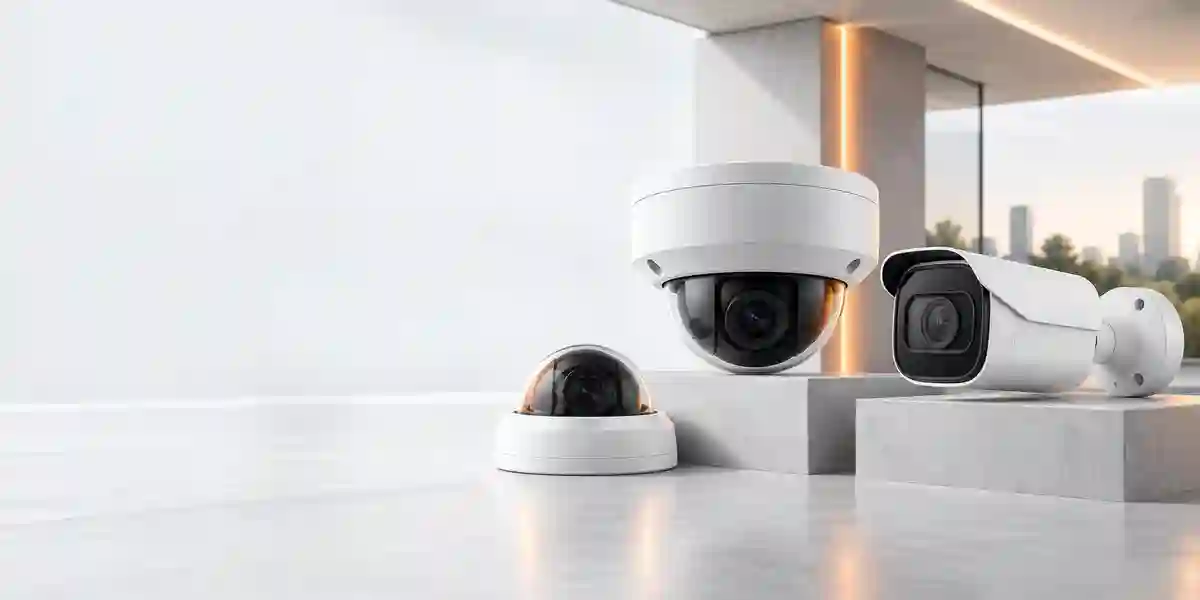
Quick Product Summary
Up to 1920 × 1080 resolution at 30 frames per second for general business surveillance and evidence review.
A 3.1x motorized varifocal range helps installers adjust framing after mounting without relying on a single fixed field of view.
Integrated infrared illumination supports night viewing in dark areas, subject to scene reflectivity, angle, weather and mounting conditions.
Weather and impact resistance make the camera suitable for appropriately designed outdoor installations.
Product Overview and Buyer Fit
The QNO-6082RG belongs to Hanwha Vision’s professional network-camera range and is intended for fixed monitoring rather than PTZ operation. The camera is useful when a project needs a visible bullet form factor, an adjustable lens, infrared night support and an IP connection to a recorder or video-management environment. It can be considered for loading bays, perimeter approaches, driveways, gates, external doors, warehouse lanes, parking approaches, service corridors, building exteriors and selected indoor spaces where a bullet camera is appropriate.
A key strength of this model is its motorized 3.2–10mm lens. At the wide end the installer can cover a broader scene; moving toward the telephoto end narrows the field of view and brings a more distant target area into a tighter frame. Published Hanwha material lists an approximate horizontal field of view from 109° at wide angle to 33.2° at telephoto. That makes site planning more flexible than with a fixed-lens camera, but it does not replace correct camera placement. Identification quality still depends on distance, pixel density, angle, lighting, mounting height and the actual target zone.
The model is particularly relevant to buyers who want established network standards. ONVIF documentation for QNO-6082RG lists Profile S, Profile G and Profile T conformance, including H.264 and H.265 video streaming, secure streaming capabilities, local recording functions and analytics-service support. In a practical project, however, ONVIF support should not be treated as a guarantee that every recorder function will work identically across all third-party brands. Recording, audio, events, motion metadata, edge-storage retrieval and configuration functions should be checked against the chosen NVR or VMS before large-scale procurement.
Key Features and Business Benefits
Flexible Scene Framing
The motorized varifocal lens lets an installer refine the viewing angle after physical mounting. This is useful when entrances, drive lanes or perimeter targets are difficult to size accurately from drawings alone.
Day and Night Monitoring
Integrated IR illumination and day/night operation help maintain usable video after ambient light drops. Night performance should still be tested because reflective walls, number plates, dust and nearby objects can affect exposure.
120dB WDR
Wide dynamic range is useful at gates, entrances and loading areas where bright outdoor light and darker shaded areas can appear in the same scene.
Efficient Video Compression
H.265 and H.264 provide practical options for balancing image quality, storage consumption and compatibility. MJPEG support adds another stream format for selected integration needs.
Edge Recording
A microSD/SDHC/SDXC slot enables local recording options. Edge storage can complement an NVR design, but retention duration depends on card capacity, bitrate, frame rate and recording mode.
Simplified Cabling with PoE
Power over Ethernet can carry data and power on one compatible network cable, helping simplify installation when the switch, cable distance and power budget are correctly designed.
Verified Technical Specifications
| Specification | QNO-6082RG | Buyer Relevance |
|---|---|---|
| Sensor / resolution | 1/2.8-inch CMOS, 2MP, up to 1920 × 1080 | Full HD class video for general surveillance. |
| Frame rate | Up to 30fps at 2MP | Supports smooth general-motion recording when bandwidth and storage are planned accordingly. |
| Lens | 3.2–10mm motorized varifocal, approximately 3.1x | Adjustable framing for wide or tighter target areas. |
| Horizontal field of view | Approx. 109° wide to 33.2° tele | Useful for site-specific view planning. |
| Minimum illumination | Published: 0.03 lux color; 0 lux with IR on | Supports low-light operation and IR-assisted night imaging. |
| IR distance | Up to 30m | Suitable for many entrances, perimeter sections and yard approaches; real scene results vary. |
| WDR | 120dB | Helps in mixed bright/dark scenes. |
| Video codecs | H.265, H.264, MJPEG | Allows storage/compatibility tuning. |
| Special viewing | Hallway view 90° / 270°, lens distortion correction support | Useful for vertically oriented corridors and narrow spaces when configured correctly. |
| Edge storage | microSD/SDHC/SDXC slot; supported capacity should be confirmed against current documentation/firmware | Adds local storage and resilience options. |
| Network interoperability | ONVIF Profile S, G and T documented | Supports standards-based recorder/VMS integration, subject to feature testing. |
| Protection | IP66, IK10 | Designed for weather-exposed and impact-risk locations when installed correctly. |
| Power | PoE or 12VDC | Gives installers flexible power design options. |
Specifications above are based on current Hanwha product-family material and ONVIF documentation available during page preparation. Firmware, regional variants and certification details can change; confirm the exact supplied unit and current manufacturer documentation before final project approval.
Compatibility, Configuration and Deployment Guidance
Before ordering the QNO-6082RG, define the recording environment. If the camera will connect to a Hanwha recorder or Hanwha video-management platform, confirm supported firmware and feature mappings. If it will connect to a third-party NVR or VMS, check ONVIF support plus any vendor-specific integration list. Basic live video may work while event search, edge-storage synchronization, audio, I/O or advanced configuration functions differ. For projects with many cameras, a small proof-of-concept test is a sensible way to confirm the exact workflow before the full quantity is deployed.
Network design matters because video is continuous traffic. Assign an appropriate camera VLAN where required, calculate the aggregate bitrate, size switch uplinks, confirm PoE power budget and keep adequate headroom. Use structured cabling appropriate for the environment and distance, and plan surge protection, earthing and enclosure requirements according to site conditions and local standards. Outdoor camera placement should also consider direct sun, dust, rain paths, reflective walls, vehicle headlights and maintenance access.
Storage must be based on desired retention, not guesswork. Required capacity changes with resolution, frame rate, codec, quality setting, scene activity and whether recording is continuous or event-driven. A warehouse that needs 30 days of 24/7 recording will require a different design from a small office that records on motion. Edge storage can add resilience, but it should not automatically replace centralized recording when business policy requires protected, searchable retention.
For image setup, select the lens position around the target objective. A wide view is useful for situational awareness, but a tighter field may be better when the goal is to identify activity at a gate, loading point or doorway. Corridor view can be considered where a tall, narrow scene would otherwise waste pixels on walls. WDR and IR settings should be validated at the actual site at both daytime and nighttime; commissioning should include recorded playback rather than judging only the live image.
Ideal Customers and Use Cases
Warehouses & Logistics
Monitor loading bays, dispatch approaches, service roads, perimeter doors and yard movement where adjustable framing and night coverage are useful.
Commercial Buildings
Cover external entrances, back-of-house doors, parking approaches and shared service areas within a managed IP surveillance network.
Retail & Hospitality
Use at exterior entrances, delivery points and selected public-facing zones where visible bullet cameras are suitable for the security plan.
Industrial Sites
Support fixed monitoring around gates, equipment approaches and building perimeters, subject to environment, mounting and compliance requirements.
What to Confirm Before Ordering
- Required viewing distance, target width and whether wide situational coverage or tighter identification is the priority.
- NVR or VMS brand, model, software version and required camera functions.
- PoE switch model, available PoE budget, uplink bandwidth and cable length.
- Required recording days, continuous or event recording, expected bitrate and storage redundancy.
- Mounting surface, bracket or junction-box requirement, cable entry method and outdoor sealing plan.
- Night-lighting conditions, reflective objects, vehicle headlights and expected IR target distance.
- Need for audio, alarm I/O, edge recording or event integration.
- Exact certification, firmware, country variant, warranty route and support terms required by the project.
- Current price, stock position, delivery timing and quantity before commercial approval.
Comparison and Related-Model Guidance
QNO-6082RG is best viewed as a 2MP adjustable-lens bullet camera. A fixed-lens Q-series model may be simpler when the required angle is known and the target is close. A higher-resolution Q-series camera can be more appropriate when additional image detail is needed across a wider scene. An X-series camera may be preferable where the project calls for a higher feature tier, longer IR range or more advanced analytics. Dome variants can be better for locations where a lower-profile shape is preferred, while PTZ cameras are designed for active or preset-driven coverage rather than a fixed scene.
The right alternative therefore depends on the surveillance objective, not just megapixels. Increasing resolution without increasing storage and network capacity can create a poorly balanced system. Likewise, selecting a long-range lens without checking scene geometry can make close objects too narrow. FourTeck can review the target area, recorder platform and project budget before recommending whether QNO-6082RG, another Q-series model or a different camera family is the better fit.
Hanwha QNO-6082RG Dubai
Dubai surveillance projects often combine demanding outdoor light, mixed indoor-outdoor entrances, long operating hours and network infrastructure that may already support access control, Wi-Fi, VoIP and business applications. The Hanwha QNO-6082RG can fit this environment when a project needs a fixed 2MP bullet camera with a motorized 3.2–10mm lens and integrated IR. Typical buyer questions in Dubai include whether the camera is suitable for a warehouse, whether the 30m IR range is enough for a perimeter section, whether PoE can simplify cabling, whether the camera will work with an existing NVR and how much storage is needed for a defined retention period. These questions should be answered at the design stage, because the camera itself is only one part of the surveillance chain.
For warehouses in Jebel Ali, Dubai Investment Park, Dubai South or Al Quoz, the camera can be considered for loading approaches, dispatch gates, service entrances and perimeter walls where a visible bullet housing and adjustable view are appropriate. At office buildings, clinics, schools, hospitality sites and retail premises, it may be useful for external entrances, receiving areas and back-of-house zones. The motorized lens allows the installer to start wide for scene orientation and then tighten the field around a doorway, lane or gate after the physical position is confirmed. This flexibility is valuable where construction drawings do not fully represent the final sight line.
Dubai buyers should also plan for heat, dust, glare and strong contrast. IP66 and IK10 ratings support suitable outdoor installation, but the mounting method, cable entry, sealing, surge protection and maintenance access still need professional attention. WDR can help at entrances facing bright daylight, while IR night imaging should be tested after sunset because white walls, metal surfaces and nearby objects can reflect infrared light back into the scene. A commissioning checklist should include focus at the selected lens position, daylight exposure, nighttime exposure, recorded playback, time synchronization, event behavior and recorder retention.
For procurement, request a quotation that states the exact model, quantity, accessories, recorder compatibility, installation scope, support route and delivery expectation. Avoid basing a project on an assumed online price or unconfirmed stock status. FourTeck can assist through FourTeck UAE and the Dubai CCTV planning service with product selection, camera placement discussion, PoE/network design and recording requirements.
Hanwha QNO-6082RG UAE
Across the UAE, surveillance requirements vary significantly between Dubai commercial sites, Abu Dhabi enterprise facilities, Sharjah industrial zones, Ajman businesses, Ras Al Khaimah hospitality properties, Fujairah sites and smaller branch locations. QNO-6082RG is relevant where organizations want a standardized 2MP fixed bullet camera with adjustable optics, network connectivity, night illumination and outdoor-rated construction. For multi-emirate procurement, consistency can be more important than selecting a different model for every branch. A standardized camera family simplifies spare planning, configuration templates, user training and recorder management, provided each site has compatible scene geometry.
UAE buyers commonly need clarity on compatibility. The camera has documented ONVIF Profile S, G and T support, but third-party NVR behavior should still be verified. If a company already operates a mixed-brand CCTV estate, the project team should list required functions such as live view, continuous recording, motion recording, edge-storage retrieval, audio, digital I/O and remote camera configuration. Testing those functions on one unit before a large rollout can reduce integration surprises. Firmware standards should also be documented so that branches do not end up with unmanaged version differences.
Network preparation is another priority. A centralized UAE organization may transport camera traffic over routed networks or VPN links, while smaller sites may record locally. The design should separate local recording from remote viewing expectations. Sending every high-bitrate stream continuously across a WAN is not always necessary; local recording with centralized management may be more practical depending on the VMS. PoE switches must be sized by total wattage and port count, with headroom for startup and future cameras. Uplinks should be checked against the aggregate video load rather than only the number of switch ports.
Storage requirements can differ by business policy, legal requirement and risk level. A retail branch may retain footage for a different period than an industrial site or corporate campus. FourTeck can help buyers model retention using resolution, frame rate, codec, bitrate and recording schedule, then align the result with NVR capacity. For broader UAE procurement and security infrastructure planning, customers can use FourTeck.com, FourTeck UAE and FourTeck IT Services UAE. Final commercial terms should be confirmed for the exact project and supplied configuration.
Hanwha QNO-6082RG Kenya
Kenya buyers evaluating Hanwha QNO-6082RG may be planning surveillance for Nairobi offices, warehouses, schools, hotels, clinics, retail sites, compounds or regional facilities. In these environments, the practical buying questions usually go beyond the camera model. Teams need to know whether the lens can cover the gate or loading area, whether night performance is adequate, how the camera will be powered, what recorder will be used, how footage will be retained and what happens when connectivity between the site and a central office is interrupted. The QNO-6082RG can support a robust design because it offers motorized varifocal framing, IR illumination, PoE and edge storage, but those capabilities should be connected to a clear architecture.
For a compound or warehouse, consider the distance from the mounting point to the target and the width of the area that matters. A camera mounted high on a wall may see a large yard, but that does not automatically mean it provides useful detail at a distant gate. The 3.2–10mm lens gives installers room to narrow the scene, but final pixel density should be checked against the identification objective. Night commissioning is important because lighting conditions can change dramatically between a well-lit Nairobi commercial street and a darker industrial or peri-urban site.
Power and network resilience should be planned from the start. PoE simplifies device cabling but still depends on stable switch power. Where power conditions are variable, the CCTV rack may benefit from suitable UPS protection, surge protection and controlled shutdown planning. For remote branches, local NVR recording can preserve footage even if the WAN link fails, while central users may access selected streams for monitoring. Edge microSD recording can provide another layer of resilience, but card endurance and retention should be chosen carefully.
Kenya procurement teams should ask for the exact camera SKU, compatible mounts or junction boxes, NVR/VMS requirements, storage calculation, switch specification and implementation scope in one bill of materials. Current stock and commercial terms should be checked at quotation stage rather than assumed. FourTeck supports regional enquiries through FourTeck Kenya and broader FourTeck Africa resources, helping buyers discuss camera selection, network readiness and project coordination for single-site and multi-branch deployments.
Hanwha QNO-6082RG Kuwait
Kuwait surveillance projects can expose cameras to intense sunlight, dust, outdoor heat and high-contrast scenes, so model selection should be supported by careful placement and installation design. The Hanwha QNO-6082RG provides IP66 and IK10 protection ratings, integrated IR, WDR and a motorized varifocal lens, giving installers a useful platform for fixed monitoring around entrances, service roads, warehouses, compounds, retail back areas and commercial buildings. The environmental rating is important, but it should never be treated as permission to ignore sealing, cable entry, junction boxes, mounting hardware or maintenance access.
For Kuwait warehouses and logistics operations, camera angles should be planned around actual movement: trucks entering gates, goods arriving at loading docks, staff using service doors and vehicles crossing perimeter approaches. If the goal is only general awareness, a wide lens position may be enough. If the requirement is to see more detail at a specific barrier or gate, a narrower lens position may work better. The QNO-6082RG motorized lens allows this adjustment after installation, reducing the risk of committing to the wrong fixed focal length at purchase.
Night operation deserves a separate test. Published IR reach is up to 30m, but the effective image depends on target reflectivity, dust, ambient light, camera angle and objects close to the lens. A nearby wall can cause infrared reflection and reduce detail deeper in the scene. Similarly, strong headlamps can affect vehicle capture. Commissioning should include live and recorded playback in representative nighttime conditions, with WDR, exposure and IR settings tuned for the site objective.
Kuwait buyers should also define how the system is managed. A small location may use a local NVR, while a multi-branch business may require centralized VMS access. ONVIF support helps interoperability, but exact functions should be tested with the chosen recorder. Storage, PoE budget, switch uplinks and cybersecurity settings should be documented before deployment. For Kuwait enquiries, buyers can use FourTeck Kuwait for regional procurement discussion and FourTeck.com for wider CCTV and infrastructure planning. Ask the quotation to state the exact supplied model, quantity, accessories, warranty route and delivery conditions.
Hanwha QNO-6082RG Ghana
Ghana organizations considering QNO-6082RG may be planning surveillance for Accra offices, retail branches, schools, hotels, warehouses, gated facilities, logistics yards, clinics or industrial locations. A recurring challenge in CCTV procurement is focusing on camera resolution while underestimating networking, storage and power. The QNO-6082RG provides a balanced 2MP platform with a motorized lens, PoE, IR and outdoor-rated construction, but its value depends on how well those features match the site. A good proposal should show where each camera is mounted, what scene it covers, the target distance, expected nighttime conditions, how video reaches the recorder and how many days of footage must be retained.
For perimeter or gate coverage, the 3.2–10mm lens can be a major advantage. The installer can start with a wider angle for orientation and then zoom toward the important zone. This helps when a gate, doorway or lane is farther from the mounting point than expected. However, zooming also reduces scene width, so the camera should not be expected to cover both a large yard and provide close identification of a distant face at the same time. Multiple cameras may be the correct answer when objectives differ.
Power continuity deserves attention in branch and remote-site projects. PoE centralizes power at the switch, which makes UPS protection easier because the camera can remain powered when the network cabinet is backed up. The UPS capacity should be calculated for the switch, recorder, router and any other critical devices, not only the camera. Where remote access is required, bandwidth should be reserved carefully; substreams can reduce viewing load while the recorder keeps the main stream for evidence quality.
Ghana procurement teams should confirm current firmware, recorder compatibility, accessories, storage, cabling and mounting hardware before ordering. For project standardization across multiple sites, a consistent camera and recorder template can simplify support. FourTeck supports enquiries through FourTeck Ghana and FourTeck Africa. These channels can help buyers discuss the required quantity, project city, network environment, retention policy and installation scope so the quotation reflects a complete surveillance system rather than an isolated camera.
Hanwha QNO-6082RG Uganda
Uganda buyers may consider Hanwha QNO-6082RG for Kampala offices, schools, healthcare sites, warehouses, hospitality properties, NGOs, retail operations and compounds requiring fixed outdoor surveillance. The camera’s 2MP resolution and motorized varifocal lens make it suitable where the project prioritizes dependable Full HD monitoring and flexible framing rather than very high megapixel counts. In practice, the success of the installation depends on coverage planning. A camera at a gate should be configured around the gate objective; a camera along a warehouse wall should be configured around movement routes and entrances; a camera in a corridor may benefit from hallway view so more pixels are used vertically.
For Uganda projects, power and connectivity planning are especially important when sites are distributed or when remote monitoring is required. PoE allows the camera to receive power from a centralized switch, simplifying cabling and making it easier to place the switching equipment and recorder behind UPS protection. If the internet link becomes unavailable, a local NVR should continue recording independently of cloud or head-office viewing. Edge storage can add another recording layer, but the project should define how footage is retrieved and how the card is monitored for health.
Night surveillance should be designed rather than assumed. The camera supports IR illumination up to a published 30m, but real results depend on target distance, lighting, dust, rain, reflective surfaces and mounting orientation. A loading yard with floodlights may need different exposure settings from a darker perimeter lane. Commissioning should be carried out after normal business hours as well as in daylight, and the team should review recorded clips at the NVR to verify that time stamps, motion events and image quality are correct.
When requesting a quote, Uganda organizations should provide the number of cameras, site type, approximate distances, current recorder if any, required retention days, remote viewing needs and preferred installation scope. This helps avoid a quote that omits PoE switching, storage disks, UPS, mounting boxes or network work. FourTeck supports regional project discussion through FourTeck Uganda and FourTeck Africa, with wider IT and CCTV planning available through FourTeck.com. Final availability and commercial terms should be confirmed for the exact order.
Hanwha QNO-6082RG Nigeria
Nigeria surveillance deployments range from corporate offices and retail branches to warehouses, schools, hotels, residential compounds, logistics yards and industrial facilities. The Hanwha QNO-6082RG can suit projects that need a robust fixed bullet camera with an adjustable lens and IR illumination, but Nigerian buyers should frame the decision around the full operating environment. Camera quantity, target areas, power reliability, network design, recording location and remote-access bandwidth all influence whether a CCTV system performs consistently after installation.
The motorized varifocal lens is useful in Lagos commercial properties, Abuja offices and other sites where cameras may be mounted before final scene tuning. A 3.2mm wide view can cover a broad area, while moving toward 10mm narrows the view for a more specific target. The installation team should document the final focal position and capture sample images after commissioning. This is particularly important when multiple branches are intended to follow the same design standard; without documentation, later replacement cameras may be configured differently and create inconsistent evidence quality.
Power protection should be considered part of the CCTV architecture. PoE makes centralized power management practical, but the switch and NVR still require stable supply. A suitable UPS can support short interruptions and controlled continuity, while surge protection and proper earthing can help protect infrastructure. For large sites, separate camera VLANs and managed switches can improve troubleshooting and traffic control. Remote viewing should use secure accounts, strong credentials and updated firmware; unnecessary exposure of camera interfaces to the public internet should be avoided.
Storage planning should reflect the actual retention policy. Thirty cameras recording continuously create a very different capacity requirement from eight cameras recording primarily on events. H.265 can reduce storage use compared with older compression under suitable conditions, but bitrate still depends on scene complexity and quality settings. Nigeria buyers should request a calculation rather than a generic disk size. FourTeck supports regional enquiries through FourTeck Nigeria and FourTeck Africa. Share site type, city, camera count, viewing distances, recorder platform and required storage days so the proposal can include appropriate cameras, switching, recording and implementation support.
Hanwha QNO-6082RG Seychelles
Seychelles CCTV projects often need careful attention to outdoor exposure, coastal conditions, distributed properties and remote-support practicality. The Hanwha QNO-6082RG offers IP66 weather protection, IK10 impact resistance, IR night imaging and a motorized varifocal lens, which can make it suitable for selected hotel, resort, office, warehouse, retail and property-security applications. However, a coastal installation should be planned around the real environment rather than relying only on the standard ingress rating. Mounting hardware, enclosure materials, cable glands, connectors and maintenance schedules should be selected with humidity and corrosive exposure in mind.
For hospitality and resort sites, camera placement must balance security objectives with guest experience and privacy. Suitable exterior positions may include service entrances, loading areas, perimeter access points, staff-only approaches and selected public circulation zones where monitoring is justified. The motorized lens helps the installer frame the intended area without excessively capturing unrelated space. If a corridor or narrow walkway needs monitoring, hallway view can help orient the image vertically and use resolution more efficiently.
Connectivity between buildings can also shape the design. A property spread across multiple structures may require fiber uplinks, managed PoE switches or carefully planned wireless bridging depending on distance and site conditions. The camera itself uses standard IP networking, but the total CCTV system should be designed around bandwidth, fault isolation and future expansion. Local recording is usually important where internet connectivity is not guaranteed; remote access should be treated as a viewing and management layer rather than the only path to stored video.
Seychelles buyers should ask for a complete bill of materials covering cameras, recorder/VMS, storage, PoE switching, mounting accessories, UPS and network links. It is also sensible to confirm spare strategy and support processes for island locations so that an accessory mismatch does not delay commissioning. FourTeck supports Seychelles and regional Africa enquiries through FourTeck Africa and the wider FourTeck technology platform. Current product availability, shipment arrangements, warranty route and installation responsibilities should be stated in the final quotation rather than assumed.
Related FourTeck Products and Infrastructure
The following verified FourTeck product pages are supporting infrastructure options rather than direct Hanwha camera substitutes. They can be relevant when a CCTV project also needs PoE switching, firewall security or server capacity for VMS, analytics, management or storage-related workloads. Suitability must be confirmed for the final design.
FortiSwitch 348G-FPOE
High-density PoE switching option for larger camera and powered-device access layers, with multigig and higher-power capabilities depending on port configuration.
FortiGate 100F
Business firewall for sites that need secure VLAN routing, VPN, SD-WAN and controlled access between CCTV, users and wider networks.
Dell PowerEdge R360
Compact 1U server suitable for selected surveillance back-end, light VMS, management or branch infrastructure workloads when correctly configured.
Dell PowerEdge R570
2U server platform that can be configured for virtualized management, storage-adjacent workloads or larger application environments.
Dell PowerEdge R660
Dense 1U enterprise compute option for organizations consolidating infrastructure and requiring stronger CPU and memory resources.
Dell PowerEdge R760xs
Balanced 2U dual-socket platform for virtualisation, business applications and software-defined infrastructure that may support larger security environments.
Dell PowerEdge R7625
High-density AMD EPYC 2U server for enterprise virtualisation, analytics and compute-heavy workloads where substantial back-end resources are required.
Regional FourTeck Resources
Why Contact FourTeck
A surveillance project works best when camera choice, recorder capacity, networking, power, storage and installation are planned together. FourTeck can help buyers review the target area, camera quantity, recorder or VMS platform, PoE switching, storage period and regional procurement needs before the bill of materials is finalized. This is particularly useful for companies operating multiple branches, because a repeatable configuration can simplify support and reduce model mismatch across sites.
FourTeck does not need buyers to know every technical detail before making contact. A site layout, photos, camera count estimate, existing recorder model and desired retention period can provide a practical starting point. Final price, availability, warranty coverage, delivery and installation responsibility are confirmed through the relevant quotation and should not be inferred from this information page.
Hanwha QNO-6082RG FAQ
1. What resolution does the Hanwha QNO-6082RG support?
QNO-6082RG is a 2MP network camera with up to 1920 × 1080 video at up to 30 frames per second. This Full HD resolution is suitable for many general surveillance tasks, but the amount of useful detail at a target depends on field of view, distance, mounting height and lens position. For a gate or doorway that needs more detail, the motorized lens can be narrowed within its range.
2. Does QNO-6082RG have a motorized zoom lens?
Yes. It uses a 3.2–10mm motorized varifocal lens, approximately 3.1x. This allows installers to adjust framing remotely or during configuration rather than physically replacing a fixed lens. It is useful when the final viewing angle is not known precisely before mounting.
3. How far can the infrared illumination reach?
Hanwha material lists IR viewing up to 30m. Real usable distance varies with the target, scene reflectivity, dust, weather, ambient lighting, lens position and camera angle. For an important nighttime target, test the actual scene after installation instead of relying only on the maximum published number.
4. Is the Hanwha QNO-6082RG suitable for outdoor use?
The camera is specified with IP66 ingress protection and IK10 impact resistance, supporting properly designed outdoor installations. The complete installation still needs suitable mounting, cable sealing, junction boxes where required, surge protection, earthing and maintenance access. Coastal or harsh environments may need additional material and corrosion planning.
5. Can QNO-6082RG be powered by PoE?
Yes. The camera supports Power over Ethernet as well as 12VDC. PoE can simplify installation because data and power travel over the same compatible Ethernet cable. The switch must have adequate PoE budget, and the cable distance, quality, uplink capacity and UPS design should be checked for the complete camera count.
6. Will it work with a third-party NVR?
QNO-6082RG has documented ONVIF Profile S, G and T conformance, which supports standards-based integration. However, exact NVR functionality can vary. Live view and recording may work while events, edge-storage retrieval, audio, I/O or configuration features differ. Confirm the chosen NVR/VMS and test required functions before a large deployment.
7. Does the camera support microSD recording?
Yes, the camera includes a microSD/SDHC/SDXC memory slot for edge recording. Card capacity support can depend on current product documentation and firmware, so confirm the supported card size and endurance before ordering. Edge storage can complement an NVR but should be designed around retention, health monitoring and retrieval workflow.
8. What is hallway view used for?
Hallway view rotates the image 90° or 270° to match tall, narrow scenes such as corridors, aisles or passageways. Instead of spending many pixels on side walls, the rotated image can use more of the sensor for the direction people move. The recorder or VMS should be checked for correct display orientation.
9. How much storage does QNO-6082RG need?
There is no single storage number. Capacity depends on bitrate, H.265 or H.264, frame rate, image quality, scene activity, number of cameras, continuous versus event recording and retention days. FourTeck can calculate a storage estimate after those variables are defined. For evidence systems, include headroom and appropriate disk redundancy.
10. How do I request Hanwha QNO-6082RG Dubai pricing?
Contact FourTeck with the required quantity, Dubai delivery location, existing or planned recorder, camera count, storage period and installation requirement. The team can review current availability and prepare a quotation. Because pricing, stock and supply terms can change, this page does not publish a fixed price or promise immediate availability.
Need Help Planning Your Hanwha QNO-6082RG Project?
Share your site type, camera quantity, target areas, existing NVR or VMS, required storage days and location. FourTeck can help you review whether QNO-6082RG is the right camera, identify supporting network and recording requirements, and prepare a project-specific quotation.
Reviews
There are no reviews yet.