

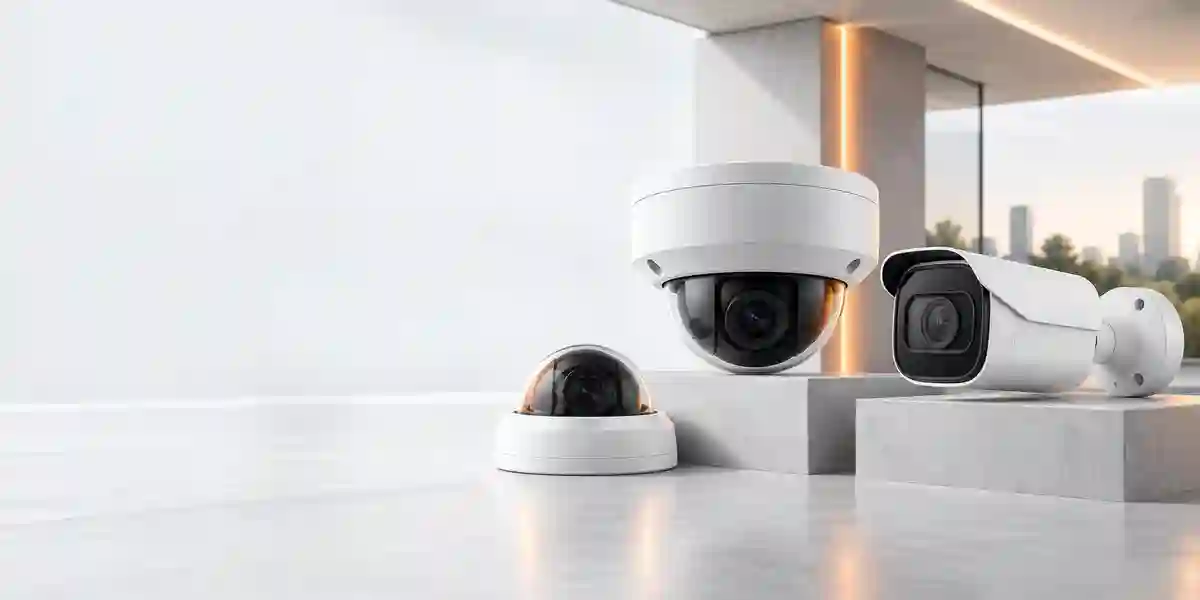
Quick product summary
4MP 1/3-inch CMOS imaging with up to 20fps at 4MP and up to 30fps at 2MP.
3.6mm fixed F2.2 lens with approximately 81° horizontal, 45° vertical and 95° diagonal viewing angles.
IP66 weather resistance and IK10 impact protection for exposed commercial locations.
H.265, H.264 and MJPEG compression, multiple streaming profiles, PoE and ONVIF Profile S/G support.
Product overview and buyer-fit guidance
For a buyer evaluating the Hanwha QNO-7020R in Dubai, the most important question is whether a fixed 3.6mm bullet camera matches the viewing distance and scene width. This model is not a motorized varifocal camera, so its final framing depends on physical placement and mounting angle. That makes it a practical choice for repeatable fixed views such as doors, service entrances, loading bays, corridors opening to outdoor areas, parking access lanes and perimeter points where the desired scene is known in advance.
The 4MP resolution gives more detail than a standard 2MP Full HD camera while keeping bandwidth and storage requirements more manageable than many higher-resolution alternatives. Its 120dB WDR is useful where entrances face bright daylight, vehicle approaches pass between shade and sun, or glazing and reflective surfaces create high-contrast conditions. Infrared illumination supports night monitoring to approximately 25 metres, but real-world usable detail still depends on subject distance, mounting height, reflective surfaces and ambient light.
The camera supports H.265, H.264 and MJPEG, which gives system designers flexibility when integrating with compatible recorders or video-management systems. It also supports ONVIF Profile S/G and Hanwha SUNAPI, but integration should always be confirmed against the exact NVR or VMS version before purchase. For new projects, buyers should also compare current Hanwha Q-series alternatives if they need newer-generation functionality or a currently active replacement model.
Key features and business benefits
4MP surveillance detail
Useful for reviewing people, activity and operational events with more scene detail than basic 1080p cameras, subject to correct distance and lens selection.
25m IR night coverage
Built-in infrared illumination supports black-and-white night viewing in dark scenes without needing continuous visible lighting.
120dB WDR
Helps balance bright and dark parts of the image, particularly useful at entrances, loading doors and other high-contrast locations.
PoE installation
Power over Ethernet can carry power and network data through one compatible Ethernet cable, simplifying many camera runs and switch designs.
Outdoor durability
IP66 and IK10 ratings make the housing appropriate for many exposed commercial surveillance positions when mounted and sealed correctly.
Edge recording options
MicroSD/SDHC/SDXC and NAS support can provide local or network edge-storage options, subject to capacity and system design.
Verified technical specifications
| Specification | Hanwha QNO-7020R |
|---|---|
| Camera type | 4MP network IR bullet camera |
| Image sensor | 1/3-inch 4MP CMOS |
| Maximum frame rate | 4MP up to 20fps; 2MP up to 30fps |
| Lens | 3.6mm fixed, F2.2 |
| Field of view | Approx. H 81° / V 45° / D 95° |
| IR distance | Up to 25m |
| Day / night | True day/night with ICR |
| WDR | 120dB |
| Compression | H.265, H.264, MJPEG |
| Protocols / integration | ONVIF Profile S/G, SUNAPI |
| Edge storage | MicroSD/SDHC/SDXC, NAS |
| Analytics | Motion detection with metadata, tampering, defocus detection |
| Environmental protection | IP66, IK10 |
| Operating temperature | -30°C to +55°C; startup above -20°C |
| Power | PoE or 12V DC |
Compatibility, configuration and deployment guidance
Before deploying the QNO-7020R, confirm that the recording platform supports the required stream type, resolution, frame rate and event functions. ONVIF can simplify third-party integration, but ONVIF compliance does not guarantee that every camera feature will be exposed in every NVR or VMS. For Hanwha-centric systems, confirm the supported firmware and recorder/VMS version. For mixed-brand systems, test critical functions such as live view, recording, playback, motion events, time synchronization and user permissions.
Network design matters just as much as camera selection. Calculate PoE budget, switch-port count, uplink capacity and VLAN design for the total camera load. Use appropriately rated outdoor or protected cabling paths, surge protection where required, and UPS backup for recorders, switches and core network equipment if recording continuity is important. Storage retention depends on resolution, frame rate, codec, scene complexity, recording schedule and motion activity, so retention should be calculated rather than guessed.
Because the lens is fixed, installation teams should verify the required field of view before drilling or final cable termination. A 3.6mm lens gives a medium-wide scene compared with the wider QNO-7010R and narrower QNO-7030R variants. If the project needs post-installation optical adjustment, a varifocal alternative may be a better fit.
Ideal customers and use cases
Monitor loading doors, yard approaches, dispatch areas and fixed perimeter points where a weather-resistant bullet camera is suitable.
Cover service entrances, external corridors, access points and building approaches with a defined fixed view.
Use exterior positions for storefront approaches, back-of-house entrances, loading points and delivery areas where night coverage is required.
Support fixed observation of gates, utility areas, equipment zones and perimeter movement subject to site risk and distance requirements.
What to confirm before ordering
- Confirm current QNO-7020R availability and whether a newer Hanwha model is preferable for a new project.
- Verify that the 3.6mm fixed lens gives the required scene width at the planned mounting distance.
- Check NVR or VMS compatibility, firmware support and required event integration.
- Calculate storage retention based on camera count, codec, frame rate and recording schedule.
- Confirm PoE budget, switch capacity, VLAN design and uplink bandwidth.
- Review mounting height, sun angle, IR reflections, weather exposure and cable protection.
- Confirm local compliance, privacy and approval requirements for the specific site.
- Check required accessories, junction boxes, poles, brackets, surge protection and UPS backup.
Related-model guidance
Within the original QNO-70xxR fixed-lens family, the QNO-7010R uses a wider 2.8mm lens, the QNO-7020R uses a 3.6mm lens, and the QNO-7030R uses a narrower 6.0mm lens. The core decision is therefore the field of view required at the mounting position. Buyers considering the QNO-7020R for a new installation should also ask about newer Q-series successors such as the QNO-7022R where available, because a current-generation model may offer lifecycle advantages for long-term deployments. Fourteck can help compare the required viewing angle, recorder support and project timeline before the final model is selected.
Hanwha QNO-7020R Dubai
Dubai buyers looking for the Hanwha QNO-7020R usually need more than a camera specification sheet. Commercial projects in areas such as Business Bay, Jebel Ali, Dubai Investment Park, Al Quoz, Dubai South, Deira and mixed-use business districts can involve harsh daylight, shaded loading zones, dust, heat, long cable runs and 24-hour operational requirements. The QNO-7020R’s combination of 4MP imaging, 120dB WDR, 25m IR and outdoor-rated housing can fit many fixed-view points, but the scene should still be checked carefully before selection. A 3.6mm lens is a balanced option for medium-wide coverage, yet it may be too wide for long-distance identification or too narrow for very close, broad entrances.
For Dubai warehouses and logistics operations, the camera can be considered for loading bays, delivery approaches, service doors and selected perimeter positions. For offices, retail sites and commercial buildings, it can support exterior entrances, rear access points and parking approaches. In hospitality or property-management environments, fixed bullet cameras can provide a clear visual deterrent and simple directional coverage, but installation should avoid private areas and unnecessary views into neighbouring property.
Project planning should include the NVR or VMS, surveillance storage, PoE switching, network segmentation, rack placement, UPS protection and remote-access policy. Strong passwords, limited user permissions and secure remote connectivity are important because an IP camera is part of the business network, not an isolated appliance. The 4MP stream must also be included in bandwidth and retention calculations rather than assuming a generic number of recording days.
Because QNO-7020R belongs to an older Hanwha Q-series generation, Dubai buyers should request a current availability check before designing a new system around it. If an existing estate already uses this camera, replacement consistency may be the priority; for a greenfield deployment, a newer Hanwha alternative can be compared. Fourteck can assist with model selection, recorder matching, storage planning and CCTV deployment guidance through Fourteck sales assistance and broader Fourteck UAE resources.
Hanwha QNO-7020R UAE
Across the UAE, surveillance projects can span offices in Abu Dhabi, retail branches in Sharjah, industrial areas in Ajman, hospitality sites in Ras Al Khaimah, logistics operations near major ports and business facilities across several emirates. A single camera model can only be useful when its lens, environmental protection, night performance and system compatibility match each location. The Hanwha QNO-7020R offers a 4MP fixed view with a 3.6mm lens, 120dB WDR, infrared illumination and IP66/IK10 construction, making it relevant to many outdoor fixed-position requirements.
For multi-emirate deployments, standardization can reduce support complexity, but it should not force the wrong lens into every scene. A wide entrance, narrow driveway, long perimeter and indoor doorway have different viewing requirements. The QNO-7020R can sit in the middle of the fixed-lens QNO-70xxR family, with wider and narrower alternatives available in the original series. A site drawing or sample camera position helps determine whether 3.6mm is suitable.
UAE buyers also need to consider recording architecture. A branch network may record locally to an NVR while sending selected streams to a central monitoring platform. Bandwidth limitations between sites can make multiple stream profiles useful: a high-quality stream can be recorded locally while a lower-bandwidth stream supports remote viewing where the VMS architecture allows. Edge storage can add resilience for selected designs, but card capacity and retention requirements should be planned rather than treated as a substitute for the main recorder.
When procuring an older camera generation, ask whether the requirement is for a like-for-like replacement or a new project. For replacements, maintaining lens angle, mounting position and NVR compatibility may be valuable. For new builds, compare current Hanwha models, cybersecurity support and lifecycle expectations. Fourteck can help with UAE-wide camera selection, network planning and project guidance through Fourteck UAE and CCTV deployment guidance.
Hanwha QNO-7020R Kenya
Kenya businesses evaluating the Hanwha QNO-7020R often need a surveillance camera that fits offices, warehouses, retail locations, schools, hotels, compounds and industrial premises while remaining practical to support over time. The QNO-7020R provides 4MP network video, a 3.6mm fixed lens, infrared illumination, 120dB WDR and IP66/IK10 protection. These specifications make it relevant to exterior points where a fixed field of view is acceptable and where the installation team can position the camera accurately during commissioning.
In Nairobi business districts, Mombasa logistics environments and regional branch operations, network reliability and power continuity can be as important as the camera itself. PoE simplifies many installations by carrying power and data on one Ethernet run, but the PoE switch must have enough wattage and port capacity for the full surveillance system. UPS backup for the recorder, switching and network core can help maintain recording through short interruptions when continuity is a project requirement.
For sites with limited WAN bandwidth, remote viewing should be designed carefully. The camera supports multiple stream profiles, allowing the system designer to balance live-view bandwidth and recording quality where the selected recorder or VMS supports that workflow. H.265 can reduce bandwidth and storage compared with older compression methods in many scenes, but actual storage usage depends heavily on motion, image complexity, frame rate and recording schedule. A retention calculation should therefore be completed before selecting NVR disk capacity.
Kenya buyers sourcing the QNO-7020R should verify model availability before finalizing project documents, especially because it belongs to an earlier Hanwha Q-series generation. Existing systems may need a matching replacement, while new installations may benefit from comparison with current Hanwha models. For Kenya-specific project discussions, visit Fourteck Kenya. Fourteck can assist with camera selection, recorder compatibility, PoE and storage planning without assuming fixed stock or delivery timing before the requirement is checked.
Hanwha QNO-7020R Kuwait
Kuwait surveillance projects frequently need cameras for bright outdoor approaches, shaded building entrances, parking areas, compounds, warehouses, retail back-of-house zones and commercial facilities that operate across long daily schedules. The Hanwha QNO-7020R combines 4MP imaging, a 3.6mm fixed lens, 120dB WDR, IR illumination and an outdoor-rated housing, so it can suit fixed viewpoints where the scene has been surveyed and the required field of view is known.
Strong sunlight and deep shade can occur within the same frame, especially near entrances, loading doors and covered parking. The camera’s 120dB WDR is designed for these contrast-heavy scenes, but correct mounting still matters. A camera aimed directly toward intense light or reflective surfaces may need angle adjustment during commissioning. At night, the stated IR reach is up to 25 metres, yet usable identification distance can vary with target size, mounting height, scene reflectivity and environmental conditions.
For Kuwait commercial installations, outdoor rating is only one part of deployment quality. Cable pathways, junction sealing, network cabinets, switch ventilation, surge protection and power backup all influence long-term reliability. The camera supports PoE, which simplifies cabling when used with a suitable PoE switch or injector, but total switch power budget should be calculated for the entire camera count. Storage must also be sized for the requested retention period and recording policy.
If the QNO-7020R is specified for a new project, ask whether a newer Hanwha Q-series model should be considered. If the objective is replacing an existing camera, confirm that the 3.6mm field of view and mounting geometry match the original installation. Kuwait buyers can use Fourteck Kuwait for regional enquiries and Fourteck sales assistance for configuration discussions. Availability, exact accessories and procurement timing should be confirmed against the final project requirement.
Hanwha QNO-7020R Ghana
Ghana organizations considering the Hanwha QNO-7020R may be planning surveillance for offices, educational facilities, warehouses, retail outlets, hospitality properties, gated business premises or industrial operations. The camera’s 4MP resolution and fixed 3.6mm lens suit defined observation zones where a medium-wide view is required. Its infrared illumination supports night monitoring, while 120dB WDR can help at doorways and exterior scenes where daylight and shade exist in the same image.
For Accra and other urban business areas, project success depends on more than camera resolution. Cable routes, PoE switching, recorder capacity, secure remote access and backup power should all be included in the design. A PoE network can reduce the number of separate power adapters at camera points, but each switch must be checked for total PoE budget. If cameras are distributed across buildings, uplinks and network segmentation should be designed so video traffic does not interfere unnecessarily with normal business applications.
The QNO-7020R supports H.265 and H.264, allowing compatible systems to choose the compression mode that best fits their recorder and storage strategy. It also supports edge storage and NAS options. These can be useful in selected designs, but they need proper capacity planning, card maintenance and recording policies. Remote viewing should use strong passwords, controlled user roles and secure network methods rather than exposing camera interfaces directly to the public internet.
Because the model belongs to an earlier Hanwha Q-series generation, Ghana buyers should confirm current supply before committing to a project bill of materials. Existing installations may still need compatible replacements, while new systems can compare newer equivalents. For local procurement and project guidance, visit Fourteck Ghana. Fourteck can assist with lens selection, NVR compatibility, storage calculations and deployment planning based on the actual site rather than a generic camera count.
Hanwha QNO-7020R Uganda
Uganda buyers evaluating the Hanwha QNO-7020R are often balancing image quality, outdoor durability, night coverage, network simplicity and long-term maintenance. The QNO-7020R provides a 4MP image, 3.6mm fixed lens, infrared illumination, 120dB WDR, PoE and IP66/IK10 protection. That combination can suit exterior entrances, service areas, compound gates, warehouse approaches and other fixed viewpoints where the required field of view has been checked before installation.
For Kampala offices, retail sites, schools, hospitality locations and logistics facilities, power and network planning should be treated as part of the surveillance system. The camera can be powered by PoE, which is convenient for structured Ethernet deployments. However, camera uptime depends on the PoE switch, upstream network equipment and recorder remaining operational. Where continuity is important, UPS backup and proper cabinet design should protect these shared components.
Storage planning deserves special attention. Four megapixel video can create significant data over days or weeks of continuous recording. The actual requirement depends on frame rate, codec, scene activity, recording schedule and retention target. H.265 can improve efficiency on compatible systems, but no fixed storage-day promise should be made without a calculation. If bandwidth to a remote monitoring location is constrained, secondary streams can be used where the recording platform supports them.
For replacement projects, match the old camera’s physical position and lens angle before substituting hardware. For new projects, compare the QNO-7020R with newer Hanwha options so lifecycle, firmware and support expectations are clear. Uganda customers can visit Fourteck Uganda for regional project enquiries. Fourteck can help review camera quantity, recording platform, PoE switch requirements, storage and installation accessories while confirming availability only after the exact model and quantity are known.
Hanwha QNO-7020R Nigeria
Nigeria projects can range from compact offices and retail stores to warehouses, estates, industrial facilities and multi-branch enterprises. The Hanwha QNO-7020R can be considered when a 4MP outdoor bullet camera with a fixed 3.6mm field of view is appropriate. Its 120dB WDR can help with high-contrast entrances and exterior scenes, while infrared illumination supports dark conditions. IP66 and IK10 protection are useful for many exposed mounting positions, provided the complete installation—including cable entries and mounting hardware—is correctly weather-protected.
For Lagos, Abuja, Port Harcourt and regional operations, the camera network should be designed for local conditions and business priorities. Where power continuity is a concern, UPS and backup-power strategy for NVRs, PoE switches and network equipment can be more important than adding extra cameras. When sites are linked over WAN connections, remote-view bandwidth should be controlled so video traffic does not overwhelm business connectivity. Multiple streams can help where the selected VMS supports separate recording and viewing profiles.
The QNO-7020R supports ONVIF Profile S/G, but buyers should still verify compatibility with the exact recorder or software platform. Core functions such as live view, recording and playback may work while certain events or metadata features differ between platforms. Testing is especially important in mixed-brand installations. Storage should be calculated using the expected number of cameras, recording hours, frame rate, codec and retention target.
For a new Nigeria project, current model availability should be confirmed because QNO-7020R is from an older Q-series generation. A newer equivalent may be preferable when lifecycle is a major factor. For replacement requirements, lens angle and mounting fit can make the older model relevant if it remains obtainable. Visit Fourteck Nigeria for regional enquiries, or use Fourteck contact to discuss recorder matching, PoE design and project quantities.
Hanwha QNO-7020R Seychelles
Seychelles surveillance projects can involve hotels, guest properties, offices, retail areas, warehouses, marine-adjacent facilities and commercial sites where outdoor exposure and remote support considerations are important. The Hanwha QNO-7020R offers a 4MP fixed view, 3.6mm lens, 120dB WDR, infrared night coverage and IP66/IK10 protection. These characteristics can suit selected exterior points, but the mounting environment should always be assessed for salt exposure, moisture, wind-driven rain and suitable cable protection.
For island deployments, maintenance access and spare-parts planning can influence model choice. A camera that is technically suitable may still be a poor choice if replacement units, compatible mounting accessories or recorder support are difficult to maintain over the project lifecycle. Because the QNO-7020R is part of an earlier Q-series generation, buyers should confirm whether the requirement is to maintain an existing installed base or build a new system. New projects can compare current Hanwha alternatives before the final bill of materials is locked.
Network and storage planning are equally important. PoE can simplify camera installation and centralize power through the network switch, making UPS protection easier, but the switch needs enough PoE budget for every connected device. For properties with limited external bandwidth, local recording can reduce reliance on remote links. Remote access should be secured with strong authentication, controlled user permissions and firewall/VPN practices suited to the organization.
The QNO-7020R’s 25m stated IR range does not automatically mean 25m of identification-quality detail in every scene. Final results depend on distance, lens angle, subject size, ambient lighting and reflective surfaces. A site-specific check is therefore essential. Seychelles customers can use Fourteck Africa for regional project discussions and Fourteck sales assistance for configuration review. Fourteck can help define the camera mix, NVR, storage, PoE switching and accessories without making unverified stock or delivery claims.
Related Fourteck products and solutions
The main Fourteck website currently exposes broader CCTV, network and infrastructure pages more reliably than seven individually indexed Hanwha product pages. The following verified internal resources are useful when planning a QNO-7020R deployment; individual same-site Hanwha product-page links should be added when they are available and verified.
Overview of CCTV camera types, recording platforms, access-control options and business security planning.
Deployment guidance covering camera placement, storage, PoE networks, recording and UAE project planning.
Useful when designing PoE switching, VLAN separation, secure remote access and surveillance network infrastructure.
PoE and managed-switch planning for CCTV cameras, access points, IP phones and other connected devices.
Broader LAN, WAN, cabling and network architecture guidance for camera projects and multi-site environments.
Main Fourteck resource for integrated IT, telecom, security and infrastructure project requirements.
Regional Fourteck resources
Use the location that best matches your procurement or project requirement: Fourteck UAE for UAE enquiries, Fourteck Kenya, Fourteck Kuwait, Fourteck Ghana, Fourteck Uganda, Fourteck Nigeria and Fourteck Africa for wider regional requirements. For a Dubai CCTV project that also needs structured network design, Fourteck can review camera count, recorder sizing, PoE switching, storage and remote-access considerations as one integrated requirement.
Why contact Fourteck?
A camera specification alone does not confirm that a model will produce the required view or integrate correctly with an existing system. Fourteck can help customers compare the QNO-7020R with current alternatives, review the required viewing angle, plan PoE switching, estimate recording storage, check compatibility requirements and discuss deployment accessories. Availability, pricing, warranty route and delivery timing should be confirmed for the specific quantity and destination before an order is placed.
Hanwha QNO-7020R FAQs
What resolution does the Hanwha QNO-7020R support?
The QNO-7020R is a 4MP network camera. Hanwha documentation lists up to 20 frames per second at 4MP and up to 30 frames per second at 2MP. The selected frame rate affects storage and bandwidth, so the recording profile should be chosen around the site’s monitoring and retention requirements.
What lens is fitted to the QNO-7020R?
It uses a fixed 3.6mm F2.2 lens. Hanwha lists an approximate 81° horizontal field of view, 45° vertical and 95° diagonal. Because the lens is fixed, installers should verify the planned scene width before final mounting.
How far can the infrared illumination reach?
Hanwha documentation specifies up to 25 metres of IR viewing distance for the QNO-7020R. Real-world identification detail can be shorter depending on the lens, target size, scene reflectivity, mounting height and environmental light, so IR range should not be treated as a guaranteed identification distance.
Is the QNO-7020R suitable for outdoor use?
Yes. The camera is listed with IP66 weather protection and IK10 impact resistance. Correct installation remains important: cable entries, junction points, mounting hardware and network equipment need suitable protection for the actual outdoor environment.
Does it support PoE?
Yes. The QNO-7020R supports Power over Ethernet as well as 12V DC. PoE can simplify camera cabling by carrying power and data over one Ethernet connection, but the PoE switch or injector must have sufficient capacity for the full installation.
Can the camera work with third-party NVRs?
The camera supports ONVIF Profile S/G, which can enable interoperability with compatible third-party recorders and video-management systems. However, not every feature is guaranteed across every platform. Verify live view, recording, playback, motion events, time sync and any analytics needed by the project.
Does the QNO-7020R support local storage?
Yes. Hanwha documentation lists MicroSD/SDHC/SDXC and NAS edge-storage support. Capacity and recording behavior depend on the selected media, firmware and system configuration. Edge storage can complement a central recorder but should be planned around retention and maintenance needs.
What is the difference between QNO-7010R, QNO-7020R and QNO-7030R?
The three fixed-lens 4MP bullet cameras mainly differ in lens angle: QNO-7010R uses 2.8mm for a wider view, QNO-7020R uses 3.6mm for a balanced medium-wide view, and QNO-7030R uses 6.0mm for a narrower view. Choose based on scene width and mounting distance.
Is the QNO-7020R still a good choice for a new project?
It can be appropriate where the exact model is required, especially for replacement consistency, but it belongs to an earlier Q-series generation. For a new system, compare current Hanwha models as well as availability, firmware support, lifecycle and compatibility before finalizing the bill of materials.
What should I send Fourteck for a quotation?
Share the required quantity, project country and city, whether the request is for replacement or a new installation, planned camera locations, NVR/VMS model if already selected, recording-retention target and any mounting accessories needed. This helps the sales and technical team review the correct configuration and current availability.
Need help specifying the Hanwha QNO-7020R?
Send Fourteck your camera quantity, site type, target viewing areas, recorder or VMS details and required retention period. We can help review the configuration and confirm current product availability for your market.
Reviews
There are no reviews yet.