

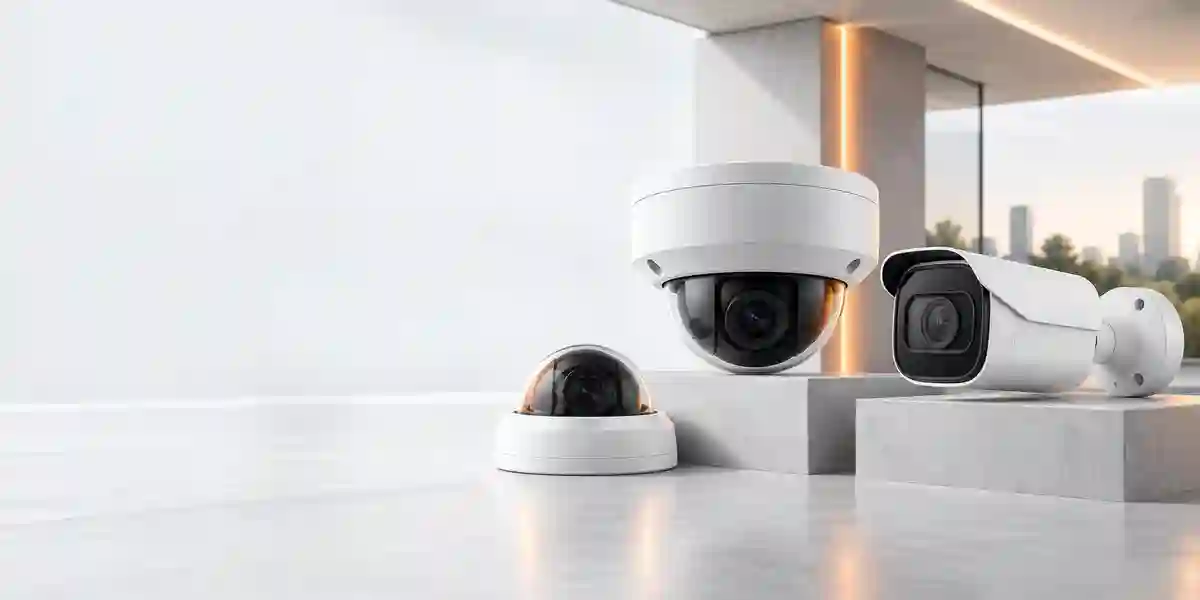
Quick product summary
Up to 5MP resolution at up to 30fps with H.265 and H.264 support for detailed network video.
A 3.2–10mm motorized varifocal lens helps installers tune scene width and subject detail after mounting.
IP66 weather protection and IK10 impact protection support exposed commercial installations when correctly mounted.
PoE simplifies power and data cabling, while ONVIF profiles and Hanwha interfaces support integration planning.
Product overview and buyer-fit guidance
The QNO-8080RG is positioned as a professional network bullet camera for sites where a visible, directional camera form factor is preferred. Its 5MP sensor gives more scene detail than a basic 1080p camera, while the motorized varifocal lens gives the installer flexibility to frame a gate, driveway, entrance lane, perimeter segment or loading area without relying on a single fixed focal length. This matters in projects where mounting distance is known only after a site survey or where the final field of view must be tuned during commissioning.
For buyers, the key decision is not resolution alone. Camera selection should consider target distance, expected lighting, backlight from doors or vehicle headlights, required retention period, recorder capacity, network bandwidth, mounting height, cabling route and the level of detail needed for the operational purpose. The QNO-8080RG supports 120dB WDR for difficult contrast, day/night operation with IR assistance, multiple streams and H.265/H.264 compression. Edge storage can provide local recording options, but storage design should still be calculated against frame rate, bitrate, activity level and retention policy.
This model is most appropriate when the project needs a rugged bullet camera with adjustable coverage rather than a discreet dome. For exposed mounting points, the IP66 and IK10 ratings are useful selection factors; however, the full installation still needs suitable junction boxes, cable glands, surge protection and network design appropriate to the site. FourTeck can help buyers compare the QNO-8080RG with other Hanwha bullet, dome, turret or PTZ options before procurement.
Key features and business benefits
5MP network video
Provides up to 2592×1944 resolution, giving security teams additional image detail for reviewing people, vehicles and scene activity compared with lower-resolution cameras.
Motorized varifocal lens
The 3.2–10mm optical range lets installers adjust framing to match the monitored zone, useful when camera-to-target distance varies across a project.
120dB WDR
Wide dynamic range is designed to preserve useful detail in scenes containing both bright and dark areas, such as entrances facing daylight or shaded loading bays.
Efficient compression
H.265, H.264 and MJPEG support enables system designers to balance image quality, compatibility, network load and recording storage.
Event analytics
Motion, tampering, defocus and virtual area or line events can support more focused monitoring and recording workflows when correctly configured.
PoE and edge storage
Power over Ethernet can reduce separate power-cable requirements, while the microSD slot can support local recording strategies where required.
Verified technical specifications
| Specification | QNO-8080RG |
|---|---|
| Camera type | 5MP IR network bullet camera |
| Imaging device | 1/2.8-inch CMOS |
| Maximum resolution | 2592 × 1944 |
| Maximum frame rate | Up to 30fps / 25fps for H.265/H.264 depending on 60Hz/50Hz operation |
| Lens | 3.2–10mm motorized varifocal, 3.1× optical range |
| Wide dynamic range | 120dB |
| Compression | H.265, H.264, MJPEG |
| Streaming | Multiple streaming, up to 3 profiles |
| Edge storage | microSD / SDHC / SDXC, up to 128GB |
| Network | 10/100BASE-T Ethernet, ONVIF S/G/T, SUNAPI |
| Power | PoE IEEE 802.3af Class 3; max. 9.5W |
| Environmental | IP66 weather protection; IK10 impact protection |
| Operating temperature | -30°C to +55°C; startup above -20°C |
Specifications should be confirmed against the exact regional product documentation and firmware baseline selected for the project before ordering.
Compatibility, configuration and deployment guidance
A camera project should be designed as a system rather than as an isolated device purchase. Before deploying the QNO-8080RG, confirm recorder compatibility, ONVIF requirements, switch PoE capacity, VLAN or network segmentation, IP addressing, cybersecurity policy, storage retention, remote-viewing requirements and the physical mounting method. Where a Hanwha NVR or VMS is used, confirm the supported firmware and feature set for the intended analytics and event workflow.
The motorized varifocal lens is valuable during commissioning because the installer can adapt the field of view to the real scene. A wide view covers more area but reduces pixel density on distant subjects; a narrower telephoto view covers less area but gives more pixels to the target zone. For entrances and vehicle approaches, determine whether the operational need is general observation, recognition or identification and position the camera accordingly. IR performance can also be affected by nearby walls, reflective surfaces, dust, insects and physical obstructions, so nighttime testing is part of good commissioning practice.
The camera supports PoE, simplifying cabling where an appropriate network switch is available. For outdoor runs, use suitable structured cabling, weatherproof terminations and surge/lightning protection based on site conditions. Edge storage should not be treated as a substitute for a properly sized recording platform when long retention, centralized monitoring or redundancy is required.
Ideal customers and use cases
The QNO-8080RG is a practical choice for commercial buildings, warehouses, logistics yards, education campuses, hospitality properties, industrial facilities, retail back-of-house areas, residential compounds and multi-site businesses that need a visible outdoor network camera. It can be considered for gates, building approaches, service roads, parking access, loading zones, boundary walls, delivery areas and other fixed scenes where a rugged bullet form factor is appropriate.
It may be less suitable where a discreet aesthetic is the priority, where very long-range optical zoom is required, or where operators need continuous pan-tilt-zoom control. In those cases, a dome, compact turret or PTZ camera may fit the application better. Buyers should compare camera type, lens, scene lighting and integration requirements rather than selecting by megapixel count alone.
What to confirm before ordering
- Required field of view and target distance at each camera position.
- Indoor or outdoor mounting conditions and suitable brackets or back boxes.
- PoE switch port count, power budget and network topology.
- NVR/VMS compatibility, channel licensing and desired analytics workflow.
- Recording resolution, frame rate, bitrate, retention days and storage capacity.
- Night lighting, reflective surfaces and whether built-in IR is sufficient.
- Local cyber-security requirements, firmware policy and remote-access method.
- Whether edge storage, alarms, audio or additional I/O are required.
Comparison and related-model guidance
Within Hanwha’s Q-series family, fixed-lens models may be suitable where the field of view is known and installation simplicity is preferred, while the QNO-8080RG’s varifocal lens is more flexible for projects with variable mounting distances. Dome versions can be chosen for a less directional appearance, and higher-tier Hanwha camera families may add more advanced imaging, analytics or environmental capabilities. For long-distance active tracking or operator-controlled viewing, a PTZ platform should be evaluated instead of forcing a fixed bullet camera into the role.
For system design, compare complete project cost rather than the camera alone. Lens suitability, mounting accessories, PoE switching, recording hardware, storage disks, licences where applicable, installation labour, testing and future maintenance all contribute to the final solution.
Hanwha QNO-8080RG Dubai
Dubai buyers typically evaluate CCTV cameras in the context of a complete commercial security system rather than as standalone hardware. For offices, warehouses, logistics compounds, workshops, retail properties, hospitality sites and mixed-use developments, the QNO-8080RG is relevant when an outdoor bullet camera needs adjustable framing and a rugged enclosure. Its 5MP resolution and 3.2–10mm motorized varifocal lens make it possible to commission a camera for a specific gate, driveway, loading approach or perimeter section after the final mounting point is established. This is useful on projects where architectural constraints, vehicle lanes or cabling routes can change the practical viewing angle from the original drawing.
Dubai’s strong daylight and shaded entrances can create high-contrast scenes, so the camera’s 120dB WDR is an important factor for doors, parking ramps and building approaches. Night performance should still be checked on site because walls, reflective cladding, nearby lighting and environmental conditions can influence IR results. When the camera is used outdoors, the IP66 and IK10 ratings support resilient deployment, but installers should also select weatherproof terminations, appropriate mounting hardware and surge protection for the location.
Procurement teams often ask about recorder compatibility, PoE switch requirements, storage retention and whether one lens setting can cover both an entry lane and a wider overview. These questions should be answered from the site plan and target distance. FourTeck can assist with configuration discussions covering the camera, network, recorder, storage and mounting method without assuming a fixed stock position or delivery time. For Dubai project assistance, use the FourTeck sales contact route or review broader FourTeck UAE technology solutions. The goal is to specify the correct scene coverage and integration path before ordering, reducing the risk of choosing a camera based only on megapixels or headline IR distance.
Hanwha QNO-8080RG UAE
Across the UAE, organisations may need a consistent surveillance design across sites in Dubai, Abu Dhabi, Sharjah and other emirates. The QNO-8080RG can fit multi-site standards where a 5MP outdoor bullet camera with a motorized varifocal lens, PoE and standard network-video integration is required. Standardisation can simplify configuration templates, spares planning, recorder profiles and maintenance procedures, but each site still needs an individual field-of-view review. A camera installed over a short entrance approach may require a different lens setting from one mounted on a warehouse wall facing a longer perimeter line.
For UAE deployments, system designers should confirm environmental exposure, cable routes, switch locations, network-security requirements and recording retention at the planning stage. Outdoor electronics can be affected by direct sun, enclosed mounting spaces and poor cable termination even when the camera itself is rated for demanding conditions. The QNO-8080RG’s PoE support can simplify distributed camera runs where compliant network switches and structured cabling are available, while H.265/H.264 support provides flexibility for balancing image quality and bandwidth.
For multi-emirate procurement, buyers should also decide whether cameras will record locally to individual NVRs, centrally across a WAN, or through a hybrid architecture. This decision influences bandwidth and storage more than the camera model alone. If edge storage is used, the microSD configuration and retention objective should be documented as part of the commissioning plan. FourTeck can help review these choices and align the camera with switching, NVR/VMS and storage requirements. For broader UAE enquiries, visit FourTeck UAE or FourTeck technology infrastructure services. Availability, project quantities and any regional variant should be confirmed at quotation stage.
Hanwha QNO-8080RG Kenya
Kenyan buyers considering the Hanwha QNO-8080RG are often planning surveillance for office compounds, schools, warehouses, hospitality properties, logistics yards, retail sites and light-industrial premises. In these environments, a motorized varifocal camera can be more adaptable than a fixed-lens camera because mounting distance and boundary geometry vary from site to site. The 3.2–10mm lens range allows installers to adjust the scene after mounting, while 5MP video provides additional detail for incident review when the target occupies a useful portion of the frame.
Project design in Kenya should include network reliability, PoE switching, cable quality, lightning and surge protection, recorder location and storage capacity. For sites with intermittent WAN connectivity, the recording architecture should not depend solely on remote access. Local NVR recording can provide a more resilient primary path, with remote viewing used as an operational convenience. Edge storage can be considered as an additional layer where suitable, but retention expectations should be calculated rather than assumed.
Outdoor camera placement should also account for rain exposure, dust, insects around IR emitters, backlighting and physical tampering risks. IP66 and IK10 are helpful camera-level protections, while correct installation details remain essential to overall reliability. Buyers comparing suppliers should ask for the exact model/variant, recorder compatibility, mounting accessories, storage calculation and commissioning scope rather than only a unit price. FourTeck can support configuration discussions for organisations sourcing security and network infrastructure for Kenya. Visit FourTeck Kenya for the relevant regional route, or use the main sales assistance page to discuss quantities and technical requirements. Final availability, lead time and warranty terms should be confirmed in the quotation supplied for the specific project.
Hanwha QNO-8080RG Kuwait
In Kuwait, the QNO-8080RG can be considered for commercial compounds, warehouses, industrial premises, parking zones, service entrances and external building approaches where a directional bullet camera is suitable. The camera’s 5MP imaging and motorized 3.2–10mm varifocal lens support a range of fixed scenes, from wider doorway coverage to tighter framing on a lane or gate. This flexibility is valuable when the final camera position is dictated by the building, poles or cable routes rather than an ideal drawing location.
Environmental planning is particularly important in hot, dusty outdoor conditions. The camera has an IP66 enclosure and a specified operating temperature range, but site design must also consider direct solar exposure, enclosure ventilation, cable quality, junction boxes and the thermal conditions of PoE switches or NVRs installed in cabinets. Dust on the front glass can affect image quality and IR performance, so routine inspection and cleaning should be part of the maintenance plan where the environment demands it.
For Kuwait procurement, confirm whether the project requires stand-alone NVR recording, a central VMS, remote monitoring, event notifications or integration with existing ONVIF-compatible infrastructure. The camera supports H.265/H.264, multiple streams and standard network protocols, allowing designers to create separate profiles for recording and live viewing. Storage should be sized using the chosen resolution, frame rate, bitrate and retention days rather than a generic per-camera assumption. FourTeck can assist with pre-order checks for camera coverage, PoE, recording and accessories. Use FourTeck Kuwait for regional enquiries or contact FourTeck sales for a project discussion. Any stock, delivery, warranty or exact regional model status should be confirmed on the project quotation.
Hanwha QNO-8080RG Ghana
Ghanaian organisations looking at the Hanwha QNO-8080RG may be addressing security around offices, warehouses, schools, compounds, retail sites, hospitality properties or industrial facilities. The camera’s combination of 5MP resolution and a motorized varifocal lens supports projects where a fixed camera needs to be tuned for a specific target zone rather than simply providing a broad overview. This can be useful at gates, external corridors, loading areas and property boundaries where the subject distance differs across each camera position.
A successful deployment should start with a scene plan: identify the operational purpose of each camera, estimate target distance, determine whether observation or identification-level detail is needed, and then select the lens setting and mounting height. At night, evaluate available lighting and reflective surfaces rather than relying only on an IR specification. For outdoor positions, weather resistance and impact resistance are useful, while correct cable sealing, mounting hardware and surge protection remain part of installation quality.
Network and recording architecture should be planned with local site conditions in mind. PoE can simplify installation where switches have adequate power budgets. H.265 can reduce bandwidth and storage compared with less efficient compression when configured appropriately, but actual storage still depends on scene complexity, bitrate, frame rate and retention. For multi-site organisations, decide whether each site records locally or feeds a central monitoring platform over the WAN. FourTeck can assist Ghana buyers with the technical scoping needed before a quotation is finalised, including compatibility with NVR/VMS platforms and accessory requirements. Visit FourTeck Ghana for the regional route or FourTeck Africa for wider regional technology enquiries. Final product availability and commercial terms should be confirmed for the specific project.
Hanwha QNO-8080RG Uganda
For Uganda, the Hanwha QNO-8080RG is relevant to buyers planning fixed outdoor surveillance at commercial properties, campuses, warehouses, logistics sites, hotels, retail environments and residential compounds. A bullet camera makes the monitoring direction visually clear, which can be desirable at perimeter and entrance locations. The QNO-8080RG adds a 3.2–10mm motorized varifocal lens, allowing an installer to adjust coverage after mounting instead of being locked to a single lens angle.
Ugandan projects should consider power and network resilience as part of the CCTV design. Where sites use backup power or UPS systems, PoE switches, NVRs, storage and network equipment should be included in the power calculation rather than protecting only the camera. If remote viewing is required across variable internet links, a local recording system can keep primary evidence on site while remote streams are configured separately for manageable bandwidth. Multiple camera streams make it possible to separate high-quality recording from lighter live-view profiles where the system supports that approach.
Outdoor performance also depends on installation quality. Rain exposure, cable entry points, lightning risk, vegetation, insects and IR reflection should be assessed at each position. The camera’s IP66 and IK10 ratings help with weather and physical exposure, but they do not replace good mounting and maintenance practice. Before purchasing, buyers should confirm exact coverage, recorder compatibility, storage days, PoE budget and whether additional brackets or junction boxes are required. FourTeck can support this pre-order configuration process for Ugandan organisations. Use FourTeck Uganda for regional enquiries or the FourTeck contact page for sales assistance. Stock, lead time and warranty conditions should be treated as quotation-specific rather than assumed from the product description.
Hanwha QNO-8080RG Nigeria
Nigerian buyers may consider the QNO-8080RG for corporate premises, warehouses, logistics facilities, education sites, hospitality properties, residential estates, retail compounds and industrial projects. Its 5MP network video and motorized 3.2–10mm lens can help standardise fixed outdoor coverage while still giving installers flexibility at individual camera points. A wider lens setting can monitor a broader entrance or yard, while a tighter setting can concentrate pixels on a gate, driveway or loading lane.
For Nigerian deployments, power continuity and network design are often central parts of the CCTV specification. A PoE camera simplifies the field connection but the PoE switch, NVR, storage and upstream network should be sized and protected as a complete chain. Where generators, UPS systems or inverter-backed circuits are used, designers should confirm total power draw and expected backup duration. Remote access should also be planned securely, with local recording retained as appropriate to the site’s operational and connectivity conditions.
Outdoor camera performance can be affected by strong sun, heavy rain, dust, insects, vibration and lightning exposure. IP66 and IK10 support the camera’s physical resilience, while installation details such as bracket selection, earthing, surge protection, cable routing and sealing determine the reliability of the finished system. Buyers should ask for an explicit bill of materials including cameras, mounts, PoE equipment, recorder channels and storage rather than comparing only the camera price. FourTeck can help review the proposed scene coverage, recording architecture and compatibility before procurement. Visit FourTeck Nigeria for regional enquiries or FourTeck Africa for multi-country requirements. Product availability, quantities, lead times and commercial terms should be confirmed through the quotation process.
Hanwha QNO-8080RG Seychelles
In Seychelles, CCTV projects can involve hotels, resorts, offices, retail premises, warehouses, marina-related facilities, residences and service compounds where cameras may face humid, coastal or exposed outdoor conditions. The QNO-8080RG offers a rugged fixed bullet format with 5MP video and a motorized varifocal lens, making it useful where installers need to adjust the field of view after final placement. That flexibility can help when mounting opportunities are restricted by architecture, landscaping or site access.
Coastal projects require careful attention to the complete installation environment. An IP66 camera rating supports weather exposure, but mounting hardware, fasteners, junction boxes and cable entries also need to be selected for the site’s conditions. Where salt-laden air or high humidity is a concern, maintenance planning should include inspection of external fittings, connectors and camera surfaces. Night performance should be checked for reflections from walls, glazing, water surfaces or nearby objects that can reduce useful IR imagery.
Network design can also be important on properties spread across multiple buildings. PoE switching may simplify cabling, but copper link limits, fibre uplinks, outdoor pathways and electrical separation should be assessed by the installer. Recording retention should be calculated from the selected stream settings and operational requirements. If remote monitoring is used over internet links, separate live-view stream profiles can help manage bandwidth while preserving a higher-quality local recording stream. FourTeck can assist Seychelles buyers with configuration and procurement planning through its wider African route. Visit FourTeck Africa or use the FourTeck sales contact page to discuss camera quantities, coverage and system components. Final availability, shipping arrangements, lead time and warranty terms should be confirmed specifically for the project rather than assumed in advance.
Regional FourTeck resources
Why contact FourTeck
CCTV performance depends on camera selection, lens framing, networking, recording, storage and installation working together. FourTeck can help customers discuss the intended site, target areas, camera count, PoE switching, NVR/VMS needs, retention period and deployment constraints before a quotation is prepared. This supports a more useful bill of materials and reduces the chance of selecting cameras without considering the rest of the surveillance system.
Frequently asked questions
What resolution does the Hanwha QNO-8080RG support?
The QNO-8080RG supports up to 5MP resolution, including 2592×1944, with H.265/H.264 network video at up to 30fps or 25fps depending on system frequency. Select the actual recording profile according to evidence needs, storage capacity and bandwidth.
Is the lens fixed or adjustable?
It uses a 3.2–10mm motorized varifocal lens with approximately 3.1× optical range. This allows the installer to adjust coverage to suit the camera’s mounting distance and target zone during commissioning.
Can the QNO-8080RG be installed outdoors?
The camera carries IP66 weather protection and IK10 impact protection. Outdoor reliability still depends on correct mounting, sealed cable entries, suitable accessories, surge protection and maintenance appropriate to the site environment.
Does it support PoE?
Yes. The camera supports IEEE 802.3af PoE Class 3, allowing power and Ethernet data to use the network connection when the upstream switch or injector provides an adequate PoE budget.
What video codecs are supported?
The camera supports H.265, H.264 and MJPEG. H.265 can be useful for reducing bandwidth and storage compared with older compression approaches when the recorder and client environment support it.
Does the camera have WDR?
Yes. The QNO-8080RG supports 120dB wide dynamic range, intended to improve usable detail in high-contrast scenes such as doorways, parking entrances and locations with bright background light.
Can it record to a memory card?
The camera supports microSD, SDHC and SDXC edge storage up to 128GB. Whether edge recording is used as primary, backup or event storage should be decided as part of the overall recording design.
Will it work with an existing NVR?
Compatibility depends on the recorder, firmware and required functions. The camera supports ONVIF profiles S, G and T as well as Hanwha’s own interfaces, but buyers should confirm recording, event and configuration support with the exact NVR or VMS before purchase.
How much storage will I need?
Storage cannot be determined from the camera model alone. It depends on camera count, resolution, bitrate, frame rate, codec, scene activity, recording schedule and retention days. FourTeck can help calculate a recorder and disk configuration from the project requirements.
How do I request a Dubai quote?
Send FourTeck the camera quantity, site type, desired recording period, approximate target distances and any existing NVR or network details. The sales and technical team can then discuss the configuration and prepare a project-specific quotation without assuming stock or delivery dates in advance.
Discuss your Hanwha QNO-8080RG configuration
Share your site type, camera quantity, target distances, NVR/VMS platform and retention requirement. FourTeck can help align the camera, lens coverage, PoE switching, recording and storage before procurement.

Reviews
There are no reviews yet.