

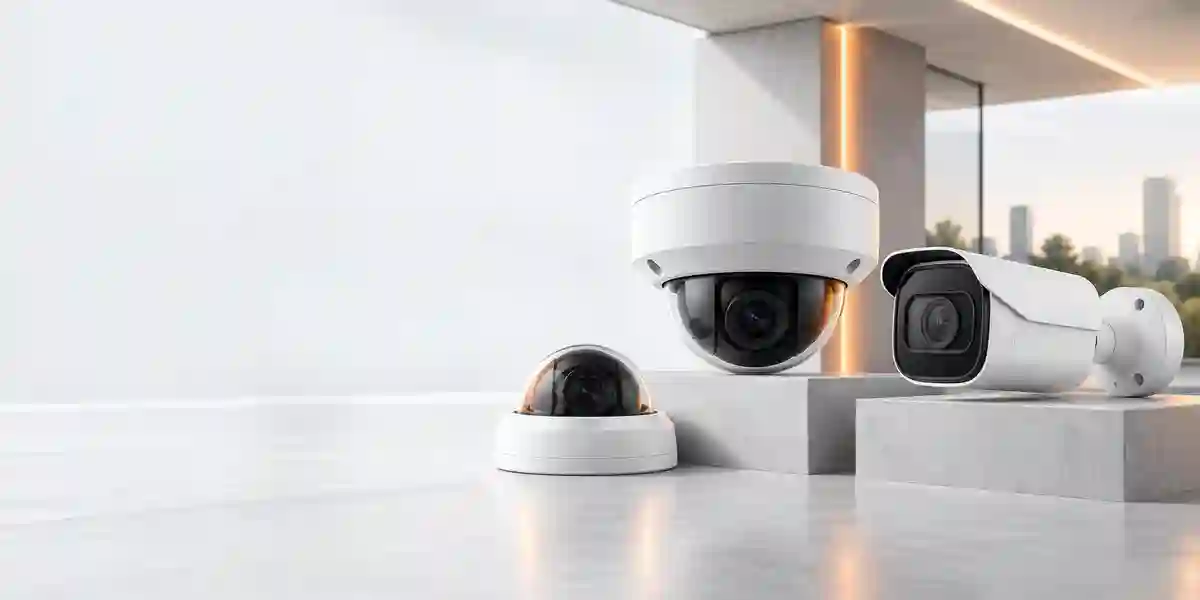
Quick Product Summary
Commercial IP surveillance where a vandal-resistant dome and adjustable field of view are needed.
2MP 1920×1080 video, up to 30fps with H.265/H.264 and 120dB WDR.
3.2–10mm 3.1x manual varifocal lens with integrated IR up to 30m.
IP66, IK10, PoE or 12VDC, ONVIF S/G/T, microSD up to 128GB.
Hanwha QNV-6072R Overview and Buyer Fit
The QNV-6072R sits in Hanwha Vision’s Q-series network-camera range and is designed for buyers who need dependable 1080p monitoring rather than maximum pixel count. The practical advantage is the combination of an adjustable varifocal lens, vandal-resistant dome enclosure, infrared illumination and mainstream network-video standards. This makes the model relevant to office entrances, school corridors, retail back-of-house areas, warehouses, building lobbies, stairwells, covered parking approaches, service passages and other locations where camera placement may require field-of-view adjustment during installation.
The 3.2–10mm lens covers a wide-to-tele range, so an installer can choose a wider scene for a lobby or corridor junction or narrow the view for a doorway, gate approach or focused operational zone. Because focus is manual, commissioning should include physical lens adjustment, focus confirmation under daytime and low-light conditions, and verification that the selected framing gives enough subject detail for the intended security objective. A camera can have the correct resolution yet still deliver weak evidential value if it is mounted too high, pointed into strong glare or configured with an unsuitable field of view.
For Dubai and wider UAE projects, the QNV-6072R also provides useful environmental protection. IP66 indicates protection against dust and powerful water jets, while IK10 indicates strong resistance to mechanical impact. These ratings make the enclosure suitable for many exposed or semi-exposed installations, but they do not replace correct mounting, weather sealing, cable-gland practice or site-specific environmental assessment. Buyers should confirm installation location, shade, direct sun exposure, mounting surface, cable path and maintenance access before finalising quantity.
Key Features and Business Benefits
2MP at up to 30fps
Full HD 1920×1080 video suits general-purpose monitoring where smooth motion and efficient storage are more important than ultra-high-resolution imaging.
3.2–10mm varifocal lens
The adjustable lens helps installers tune scene width after mounting, reducing the risk of choosing a fixed lens that is too wide or too narrow for the target area.
30m integrated IR
Infrared illumination supports black-and-white monitoring in darkness up to the specified range, subject to scene reflectivity, mounting height and environmental conditions.
120dB WDR
Wide Dynamic Range helps balance bright and dark parts of a scene, useful near glazed entrances, loading doors, reception areas and backlit corridors.
IP66 and IK10
The housing is designed for demanding camera positions where dust, weather and accidental or deliberate impact are realistic project concerns.
H.265 and WiseStream II
Efficient compression helps reduce bandwidth and storage demand compared with less efficient video settings, while actual savings depend on scene activity and configuration.
Verified Technical Specifications
| Specification | Hanwha QNV-6072R |
|---|---|
| Camera type | 2MP H.265 IR dome camera |
| Image sensor | 1/2.8-inch CMOS |
| Maximum resolution | 1920 × 1080 |
| Maximum frame rate | 30fps/25fps at H.265/H.264 depending on 60Hz/50Hz mode |
| Lens | 3.2–10mm, 3.1x manual varifocal, F1.6 wide to F2.9 tele |
| Horizontal field of view | Approximately 109° wide to 33° tele |
| Minimum illumination | 0.03 lux colour; 0 lux with IR LED on |
| IR distance | Up to 30m |
| WDR | 120dB |
| Compression | H.265, H.264, MJPEG; up to three streaming profiles |
| Analytics | Motion, tampering, defocus, virtual area and virtual line events |
| Storage | 1 × microSD/SDHC/SDXC slot, up to 128GB |
| Network / API | 10/100 Ethernet, ONVIF Profile S/G/T, SUNAPI, Hanwha Vision Open Platform |
| Power | PoE or 12VDC |
| Environmental protection | IP66, IK10 |
Compatibility, Configuration and Deployment Guidance
Before ordering the QNV-6072R, confirm how it will record and who will manage it. The camera supports ONVIF Profiles S, G and T along with Hanwha SUNAPI, which helps integration with compatible recorders and video management platforms. ONVIF support improves interoperability, but buyers should still confirm that the chosen NVR or VMS supports the required resolution, codec, event handling, audio input, edge recording and playback functions for this exact model and firmware generation.
For network design, the camera uses 10/100 Ethernet and can be powered with PoE, which reduces cabling complexity by carrying data and power over the same Ethernet connection. A PoE deployment still requires proper switch sizing. Count the number of cameras, confirm the switch power budget, allow headroom, calculate uplink bandwidth and decide whether surveillance should operate on its own VLAN. Strong unique passwords, HTTPS where practical, restricted management access, firmware management and controlled remote access should be part of commissioning rather than afterthoughts.
Edge storage supports microSD/SDHC/SDXC media up to 128GB. Local storage can be useful for event buffering or resilience, but it should not automatically be treated as the only recording method for sites that need longer retention, central investigation or multi-camera review. Retention planning should consider camera count, recording hours, motion levels, bitrate, frame rate, codec, resolution, scene complexity and the number of days the business needs to retain footage.
The QNV-6072R also provides an alarm input/output and selectable audio input. If a project requires door contacts, alarm integration, microphones or event-triggered workflows, confirm local regulations, privacy requirements and VMS support before enabling them. For mounting, check the installation surface and the required Hanwha bracket or tilt accessory. Hanwha lists the SBV-138TMW tilt mount as compatible with this camera family. Do not select brackets by appearance alone; confirm the exact supported accessory and mounting geometry.
Ideal Customers and Use Cases
The QNV-6072R is suitable for buyers who need a professional fixed dome camera with flexible framing rather than PTZ movement. Typical projects include corporate entrances, reception areas, indoor corridors, retail stores, warehouse aisles, school common areas, clinics, hotel service corridors, office towers, storage rooms, loading-area approaches and covered exterior locations. Its IK10 enclosure is especially useful where a camera may be physically accessible, while IP66 protection broadens possible placement beyond fully controlled indoor rooms.
For a narrow corridor, hallway view can rotate video 90° or 270° so more pixels are used on the vertical scene instead of recording large unused wall areas. At a lobby door with bright exterior light behind a subject, 120dB WDR can help balance exposure. At night, integrated IR supports monochrome monitoring where ambient lighting is insufficient. These features are most effective when camera placement, exposure settings and lens adjustment are commissioned for the real scene rather than left at defaults.
What to Confirm Before Ordering
- Required camera quantity and exact coverage points.
- Whether 2MP resolution is sufficient for the identification objective at the planned distance.
- Whether the 3.2–10mm lens range provides the required scene width.
- Indoor, outdoor, shaded or exposed installation conditions.
- PoE switch capacity, network ports, VLAN and uplink bandwidth.
- NVR or VMS compatibility with QNV-6072R streams and events.
- Required retention days and central storage capacity.
- Whether local 128GB microSD recording is needed.
- Mounting surface, bracket, back-box and cable-entry requirements.
- Whether alarm I/O or audio input will be used and is permitted.
- Current product availability, lead time and commercial terms for the destination market.
QNV-6072R Compared with Related Q-Series Choices
Within Hanwha’s Q-series, the QNV-6072R is a 2MP varifocal vandal dome. A fixed-lens model such as QNV-6022R can make sense when the required angle is known in advance and installation simplicity matters more than zoom flexibility. A motorized-varifocal model such as QNV-6082R can be preferable when remote focal adjustment is important. Higher-resolution Q-series domes can provide more pixels on target where identification or digital zoom requirements justify the additional bandwidth and storage. The correct alternative should be selected from the viewing objective rather than from model number alone.
Buyers replacing an older camera should also verify physical mounting, cable location, NVR channel capability, codec support and retention impact before substituting models. A newer or higher-resolution camera may not be a direct drop-in replacement if it changes lens behaviour, power consumption, accessory compatibility or recorder load.
Hanwha QNV-6072R Dubai
Dubai buyers evaluating the Hanwha QNV-6072R commonly need more than a datasheet match. Commercial surveillance projects in the city often combine bright exterior light, shaded entrances, reflective glazing, underground parking, service corridors and long operating hours. The QNV-6072R addresses several of those practical conditions with 120dB WDR, integrated IR and a varifocal lens that can be adjusted during installation. For an office entrance, for example, the installer can narrow the frame to concentrate on the doorway rather than recording a large amount of unused wall space. For a corridor junction, the lens can be widened, while hallway view can improve coverage in long vertical scenes.
The camera also appears on Dubai SIRA approved-camera listings, which is relevant for regulated surveillance projects. However, an approved model number does not remove the need to follow the latest site, installer, design and authority requirements applicable to the specific project. Buyers should confirm the current compliance path for the premises before procurement, especially where a building, retail operation, hospitality site or other regulated environment has specific approval conditions.
Dubai procurement teams should confirm the full bill of materials rather than requesting only a camera price. A working system may require a compatible NVR or VMS, PoE switching, surveillance storage, Cat6 cabling, patching, rack space, UPS backup, monitor outputs, mounting hardware and secure remote access. The camera’s 2MP stream is efficient for many general-monitoring applications, but retention still depends on bitrate, recording schedule, scene activity and the number of cameras. FourTeck can help review these inputs before quotation.
For projects in Business Bay, Jebel Ali, Dubai Investment Park, Deira, Al Quoz, Dubai Marina or other commercial zones, buyers should share the site type, camera count, required viewing distance and recorder environment. Contact FourTeck UAE or the FourTeck sales team to discuss current model availability, compatibility and deployment scope without assuming fixed stock or delivery time.
Hanwha QNV-6072R UAE
Across the UAE, the QNV-6072R is relevant to organisations standardising surveillance across multiple emirates or branch locations. A company operating offices in Dubai, Abu Dhabi and Sharjah may prefer to use a common camera family so configuration, spare planning and user training remain consistent. The QNV-6072R supports standard network-video protocols and up to three streaming profiles, which can help when one stream is used for recording and another for lower-bandwidth remote viewing. Final settings should be chosen around the recorder, WAN connectivity and evidence requirement.
Multi-site procurement should begin with a consistent camera-position schedule. Not every location needs a varifocal dome, but it is useful where viewing distances differ from branch to branch. One site may require a wide reception view; another may need a tighter service-door scene. The 3.2–10mm lens gives installers room to tune both situations while keeping a common model. Where a wider fixed lens or higher resolution is needed, another Hanwha Q-series model may be more suitable, so standardisation should not override the actual security objective.
UAE environmental conditions also make installation workmanship important. An IP66 camera should still use appropriate weatherproof cable entry, sealed mounting and suitable location planning. Direct sun, roof-level heat, dust accumulation and reflective surfaces can affect image quality and maintenance frequency. Indoor cameras near glass façades may need careful WDR tuning. IR reflection can occur if the dome is dirty, mounted too close to a surface or facing reflective material, so night testing should be part of handover.
For UAE procurement, share whether the system will use Hanwha recorders, an existing third-party NVR or a VMS platform. Confirm channel count, codec, storage, cybersecurity policy and retention expectations before ordering. FourTeck can support project discussions through FourTeck UAE, FourTeck IT Services and the main FourTeck regional technology site.
Hanwha QNV-6072R Kenya
Kenya-based buyers considering the Hanwha QNV-6072R are often planning surveillance for offices, logistics operations, schools, retail premises, hospitality properties or industrial facilities. In these projects, the camera’s 2MP resolution can be a practical choice where the objective is dependable general monitoring and the network or storage budget needs to stay controlled. The H.265 option helps reduce bitrate compared with less efficient compression, but storage should still be calculated rather than estimated from camera count alone.
The varifocal lens is useful for projects where camera mounting distances are not identical. A warehouse passage may need a narrower field of view than a reception area, while a loading door may benefit from a focused frame that excludes irrelevant wall or ceiling space. Because the lens is manually adjusted, installers should allow commissioning time for focal length and focus. They should also test the IR image after dark, especially around walls, columns, reflective signs or nearby surfaces that can create IR bounce.
For branch networks in Nairobi, Mombasa or other locations, buyers should confirm network topology and remote viewing design before deployment. A camera being ONVIF compatible does not automatically mean every event and analytic function will work identically on every third-party recorder. Confirm live view, recording, playback, event handling and health monitoring on the selected platform. If WAN links between branches are limited, use local recording with appropriately designed central access rather than forcing continuous high-bitrate traffic over a constrained connection.
Procurement teams should also decide how spares, storage drives, PoE switches, brackets and surge protection will be handled. For project discussions in Kenya, use FourTeck Kenya. Share the number of cameras, site type, preferred recorder, retention days and whether the cameras are for a new system or an expansion. Availability and lead time should be confirmed for the requested quantity before a purchase decision.
Hanwha QNV-6072R Kuwait
In Kuwait, CCTV buyers frequently need equipment that can support long operating hours, strong indoor/outdoor temperature differences, dust exposure and mixed lighting around building entrances and parking zones. The Hanwha QNV-6072R combines IP66 and IK10 housing protection with a 3.2–10mm lens and integrated 30m IR, giving system designers flexibility for many fixed-camera positions. Site conditions still matter: weather protection is only one part of a reliable installation, and outdoor cable entries, junction points and mounting surfaces must be selected carefully.
For offices and commercial buildings, 120dB WDR is relevant at entrances where bright daylight appears behind visitors. In warehouses or service areas, the vandal dome form factor can be useful where the camera is within reach. In corridors, hallway view may use the image area more efficiently. Buyers should map each camera position to a purpose such as detection, observation, recognition or identification, then check whether the 2MP resolution and selected focal length provide enough pixel density at the required subject distance.
Kuwait projects that use central monitoring should pay close attention to bandwidth. A multi-camera H.265 system can be efficient, but continuous remote viewing of many streams can still consume significant network capacity. Use main and substreams appropriately, keep recording local where suitable and design remote access around real operational needs. Network security should include controlled administrative access, unique credentials, firmware management and separation of surveillance devices from general user traffic where practical.
Before ordering, confirm recorder compatibility, PoE budget, storage days, mounting accessories and the required project documentation. Contact FourTeck Kuwait with the site type and camera schedule so the quotation can reflect the real configuration. Current stock, shipment timing and commercial terms should be checked at the time of enquiry rather than assumed from a generic web listing.
Hanwha QNV-6072R Ghana
Ghana organisations looking for the Hanwha QNV-6072R may be planning security for corporate offices, retail stores, schools, logistics facilities, clinics, hospitality sites or multi-branch operations. A key strength of this model is deployment flexibility: the camera combines a vandal-resistant dome enclosure with a lens that can be adjusted between wide and tele framing. This helps when one project contains several different viewing distances but the buyer wants to standardise on a single 2MP dome model.
For Accra offices, the camera can cover reception entrances, corridors and service doors. For warehouses or distribution sites, it can monitor internal aisles, dispatch zones or protected exterior points where the 30m IR range is appropriate. The stated IR distance should not be treated as a guaranteed identification distance. Real night performance depends on lens position, target reflectivity, angle, surrounding light and image settings. If identification at a gate or long distance is critical, the project should be tested against the actual scene and may require a different focal length or higher-resolution model.
Businesses with limited or variable WAN capacity should design remote access carefully. Recording can remain on a local NVR while authorised users view selected streams remotely. The QNV-6072R supports multiple streaming profiles, allowing lower-resolution or lower-bitrate viewing streams to be configured separately from the recording stream. Storage planning should take account of motion levels, frame rate and retention policy, especially when the project expands across multiple branches.
For procurement in Ghana, also confirm power continuity. PoE simplifies camera cabling, but the PoE switch and recorder should be included in the UPS strategy if the system must continue through short outages. Contact FourTeck Ghana with the required quantity, installation environment, recorder platform and storage expectation for a configuration-based quotation and current availability check.
Hanwha QNV-6072R Uganda
Uganda buyers considering the QNV-6072R should start with the scene requirement rather than simply asking for a 2MP dome camera. A reception desk, school corridor, warehouse aisle and outdoor entry point each create different framing and lighting demands. The QNV-6072R’s 3.2–10mm varifocal lens is useful because the installer can adapt the angle after the camera is physically positioned. This can reduce the number of different fixed-lens variants required across a site, although each position still needs commissioning.
The camera supports 120dB WDR for high-contrast scenes and integrated IR for low-light monitoring. At a Kampala office entrance, WDR can help where daylight behind a visitor would otherwise make faces too dark. In a dim service corridor, IR can provide monochrome visibility without separate lighting. For outdoor or semi-outdoor placement, IP66 and IK10 provide environmental and impact protection, but installers should still use suitable junction boxes, sealed entries and robust mounting methods.
For organisations deploying cameras across branches, networking and user access need structured planning. Assign consistent device names, IP address schemes, administrator roles and recording profiles. Avoid exposing camera web interfaces directly to the public internet. Remote viewing should be implemented through the approved recorder/VMS architecture with secure authentication. If edge microSD is used, decide whether it is for failover, event clips or primary local recording and confirm how footage will be retrieved and protected.
A quotation should include all required infrastructure: cameras, mounting accessories, recorder channels, surveillance hard drives, PoE switching, rack components, cabling and UPS where necessary. Contact FourTeck Uganda and provide the site type, camera count, coverage objective and expected retention days. FourTeck can then help determine whether the QNV-6072R or another Hanwha model better matches the installation.
Hanwha QNV-6072R Nigeria
Nigeria-based projects often involve a mix of corporate offices, warehouses, retail chains, estates, education facilities, hotels and industrial sites. The Hanwha QNV-6072R is suited to fixed monitoring points where a vandal-resistant dome, adjustable lens and efficient network video are required. For businesses with many cameras, H.265 can help control recording bandwidth, but the overall design still needs accurate storage calculations and a network capable of carrying camera traffic without affecting other business services.
The camera’s 3.2–10mm lens is particularly useful in installations where mounting geometry differs between locations. A wide setting can cover a lobby or corridor junction, while the tele end can concentrate more pixels on a narrower doorway or protected zone. The installer should confirm framing at the actual mount height because lens selection based only on floor-plan drawings can miss obstructions, signage, ceiling features or blind spots. Night testing is also important to check IR reflection and subject exposure.
Power resilience deserves special attention. PoE centralises camera power at the network switch, making it easier to protect cameras through a UPS serving the PoE switch and NVR. The required UPS capacity depends on total load and target runtime. For large sites, separate network closets may each need their own backup and surge-protection approach. Recording retention should be matched to operational or compliance needs rather than set arbitrarily.
When integrating with an existing system, confirm ONVIF behaviour, firmware compatibility and available NVR resources before purchasing a large quantity. Test a representative camera if the recorder is from another manufacturer and event integration is important. For Nigeria enquiries, contact FourTeck Nigeria. Provide the recorder make/model, required quantity, deployment city, coverage goal and storage duration so the configuration can be reviewed before commercial quotation.
Hanwha QNV-6072R Seychelles
Seychelles surveillance projects can include hotels, resorts, offices, retail properties, storage areas and infrastructure sites where humidity, salt-laden air, strong sunlight and outdoor exposure may influence equipment selection. The QNV-6072R carries IP66 and IK10 ratings and can suit many sheltered or exposed fixed-camera positions, but coastal conditions require careful installation practice. Buyers should discuss mounting material, cable protection, junction sealing and maintenance intervals with the installer rather than relying only on the camera’s enclosure rating.
For hospitality and commercial sites, the varifocal lens helps adapt one model to different spaces. Entrances may need a tighter frame, corridors may need a wider angle or hallway view, and loading/service areas may need controlled night coverage. Privacy-sensitive areas must be excluded from camera views, and audio input should only be used where lawful and appropriate. The project should define who can view footage, how long it is kept and how user accounts are managed.
Because island deployments can make replacement logistics more important, system designers may also consider spare strategy. Standardising camera families, brackets and PoE infrastructure can simplify maintenance, but the standard should still fit each scene. Keeping configuration backups, documenting IP addresses and preserving firmware/version records can reduce service time if a device is replaced later. Local microSD can add resilience for selected events, while central NVR or VMS recording remains the normal approach for multi-camera investigations.
For a Seychelles project, share the installation environment, camera count, recorder preference and expected support model with FourTeck Africa. Current availability, shipment arrangements and accessory compatibility should be confirmed for the exact project quantity. Where a camera will face strong tropical daylight or reflective water, ask the installer to verify WDR settings and actual test footage before final acceptance.
Related FourTeck Security Resources
For broader surveillance planning, FourTeck maintains resources covering CCTV installation and integrated physical-security design. These pages can help procurement teams think beyond the camera itself and account for recording, switching, storage, cabling and access-control integration.
CCTV Installation Dubai & UAE
Planning guidance for IP cameras, NVRs, storage, PoE, cabling, remote access and deployment scope.
CCTV and Access Control Systems UAE
Overview of surveillance and access-control components for integrated business security projects.
Regional FourTeck Resources
Regional buyers can use the relevant FourTeck channel for project-specific discussions: UAE technology projects, Kenya enquiries, Kuwait enquiries, Ghana enquiries, Uganda enquiries, Nigeria enquiries and Africa regional project support. Availability, shipping, warranty path and commercial terms should always be confirmed for the requested market and quantity.
Why Contact FourTeck
FourTeck can help buyers translate a camera model into a complete deployment requirement. That includes reviewing the intended scene, camera count, lens suitability, recorder compatibility, PoE capacity, storage days, network design, remote viewing, brackets and related infrastructure. The objective is to avoid ordering a camera that looks correct on paper but does not match the viewing distance, recorder environment or project workflow.
FourTeck does not need to assume stock, fixed pricing or delivery times to give useful pre-sales guidance. Share the model, quantity, destination, recorder/VMS platform and expected retention period so the sales team can check the current commercial position and prepare a relevant quotation.
Hanwha QNV-6072R FAQs
What resolution does the Hanwha QNV-6072R provide?
The QNV-6072R provides up to 2MP resolution at 1920×1080. It can stream H.265 or H.264 at up to 30fps in 60Hz mode or 25fps in 50Hz mode. This is suitable for many general surveillance tasks, but buyers should confirm that 2MP provides enough subject detail for the required distance and identification objective.
Is the QNV-6072R suitable for outdoor use?
The camera is rated IP66 for dust and water resistance and IK10 for impact protection, so it is designed for demanding indoor or outdoor positions. Correct outdoor installation still requires suitable cable sealing, mounting accessories and environmental assessment. Exposure to direct sun, coastal conditions or unusual heat should be considered during site design.
How far can the IR illumination reach?
Hanwha specifies an IR viewable distance of up to 30m. Real usable detail depends on the selected focal length, scene reflectivity, subject size, mounting angle and surrounding lighting. The specified IR range should not be confused with a guaranteed identification distance, so critical night scenes should be tested during commissioning.
Does the QNV-6072R support PoE?
Yes. The camera can be powered by Power over Ethernet or 12VDC. PoE is convenient because power and data share one network cable, but the switch must have enough PoE budget for all connected cameras. The network design should also provide adequate uplink bandwidth and appropriate resilience for the surveillance system.
What storage does the camera support?
The QNV-6072R has one microSD/SDHC/SDXC slot supporting up to 128GB. Edge storage can be used for selected local recording or resilience. For multi-camera systems and longer retention, buyers usually need an NVR, VMS server or network storage strategy sized around bitrate, camera count and retention days.
Will it work with a third-party NVR?
The camera supports ONVIF Profiles S, G and T, which helps third-party interoperability. However, not every NVR exposes every analytic, audio, alarm or edge-storage function in the same way. Before a large deployment, confirm live view, recording, playback, event handling and supported codec/resolution on the exact recorder model and firmware.
Is the 3.2–10mm lens motorized?
No. The QNV-6072R uses a 3.2–10mm manual varifocal lens. The installer adjusts focal length and focus during commissioning. If remote motorized focal adjustment is important, compare the requirement with another compatible Hanwha model such as a motorized-varifocal Q-series variant.
Does the camera support corridor or hallway view?
Yes. The QNV-6072R supports 90° and 270° hallway view. This is useful in tall, narrow scenes such as corridors and aisles because it can orient the video vertically and reduce wasted image area. Recorder and VMS display behaviour should be checked so rotated video is presented correctly to operators.
Is the Hanwha QNV-6072R SIRA approved in Dubai?
The QNV-6072R appears on published Dubai SIRA approved-camera listings. Buyers should still verify the current approval status and all project-specific requirements before procurement because camera approval is only one part of a compliant surveillance deployment. Installer, design, recording and site requirements may also apply.
What should I provide when requesting a quote?
Provide the required quantity, destination, site type, expected viewing distance, existing or proposed NVR/VMS, storage-retention requirement, PoE environment and mounting conditions. This helps FourTeck check whether the QNV-6072R is the correct model and identify any recorder, storage, switch or mounting items that should be quoted with it.
Discuss Your Hanwha QNV-6072R Requirement
Send FourTeck your camera quantity, destination, site type, recorder platform and storage requirement. The team can help check the current commercial availability and build the supporting surveillance configuration around the camera.
Reviews
There are no reviews yet.