

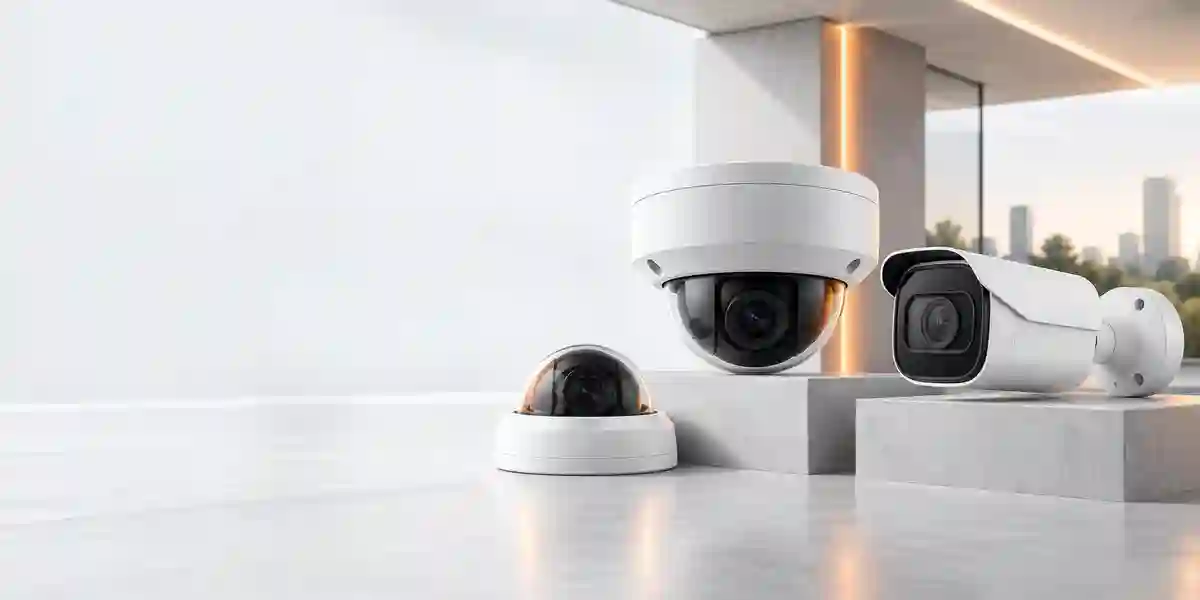
Records up to 1920 × 1080 at up to 30 fps with H.265 or H.264.
3.2–10mm 3.1x manual varifocal lens helps installers tune scene width and subject detail.
Integrated 850nm infrared illumination supports surveillance in low-light and dark scenes.
Weather and impact resistance make the vandal dome suitable for exposed or public-facing locations.
Quick product summary
The QNV-6072R1 sits in Hanwha Vision’s Q series and is designed for buyers who want a practical 2MP vandal-resistant network dome with a manually adjustable varifocal lens. Compared with a fixed-lens camera, the 3.2–10mm range offers useful commissioning flexibility: installers can start wide for area coverage or narrow the field of view when more detail is needed on a doorway, gate, counter, corridor end or other defined zone. Its dome format and IK10 rating are especially useful where the camera may be mounted within reach or exposed to accidental impact.
For project planning, the key strengths are straightforward networking, PoE support, edge storage, multiple codecs, day/night operation, WDR, IR illumination and a compact vandal-dome housing. It is a no-audio model, so projects that require integrated microphone or two-way audio should select a different camera or add separate approved audio equipment where local law permits. Buyers should also confirm NVR/VMS support, retention requirements, mounting accessories, PoE budget, network bandwidth, firmware policy and the scene’s actual identification requirement before ordering.
Key features and business benefits
3.2–10mm manual varifocal lens
A wide-to-telephoto adjustment range helps installers adapt one camera model to different scene widths. The published horizontal field of view is approximately 109° at wide to 33° at tele, which is useful when a project contains both broad monitoring zones and narrower observation points.
120dB WDR
Wide Dynamic Range helps the camera handle scenes containing bright and dark areas together, such as entrances facing daylight, reception doors, loading bays and shaded outdoor approaches.
H.265, H.264 and MJPEG
Multiple codec options provide flexibility for recorder, VMS and bandwidth planning. H.265 can reduce network and storage demand compared with older compression approaches when the surrounding platform supports it.
Event detection
The camera supports motion, defocus and tampering detection along with virtual-line and virtual-area events. These functions can improve event-driven workflows, but they should not be presented as advanced AI classification.
Verified technical specifications
| Specification | Hanwha QNV-6072R1 |
|---|---|
| Camera type | 2MP IR vandal dome network camera |
| Imaging device | 1/2.8-inch CMOS |
| Maximum resolution | 1920 × 1080 |
| Maximum frame rate | Up to 30 fps / 25 fps at 2MP with H.265/H.264 |
| Lens | 3.2–10mm, 3.1x manual varifocal, DC auto iris |
| Horizontal field of view | Approx. 109° wide to 33° tele |
| Minimum illumination | 0.03 lux colour; 0 lux with IR LED on |
| IR range | Up to 30m |
| WDR | 120dB |
| Codecs | H.265, H.264, MJPEG; multiple streaming |
| Edge storage | microSD/SDHC/SDXC slot, up to 128GB |
| Analytics/events | Defocus, motion, tampering, virtual area and virtual line functions |
| Protection | IP66 weather resistance, IK10 impact resistance |
| Power | PoE or 12VDC |
| Audio | No-audio model |
Compatibility, configuration and deployment guidance
Treat the camera as one component in a complete surveillance system. Before procurement, confirm the recording platform and firmware combination, required retention days, expected frame rate, codec selection, motion/event recording policy and how many simultaneous streams are needed. Hanwha support information lists Q-series compatibility with selected third-party platforms under specific firmware requirements, so integrators should verify the current interoperability information for the exact VMS or cloud platform being deployed.
PoE simplifies installation because power and data can travel over one Ethernet cable, but the switch must have enough per-port and total power budget for the planned camera count. Network design should also account for uplink capacity, VLAN strategy, recorder traffic, remote viewing, cybersecurity and any redundant paths required by the project. For outdoor work, use suitable weatherproof cable entries, junction boxes and mounting hardware rather than relying on the camera’s IP rating alone.
The QNV-6072R1 uses manual focus control, so commissioning requires physical adjustment of the lens to achieve the intended field of view and focus. That makes pre-installation planning important where cameras will be mounted at height. Establish the target scene first, then choose mounting height, tilt, focal length and lighting so installers do not need repeated access after handover.
Ideal customers and use cases
- Commercial offices: entrances, service corridors, reception approaches and building access zones where a vandal-resistant dome is preferred.
- Retail: storefronts, back-of-house passages, loading entrances and selected sales-floor positions where varifocal adjustment is useful.
- Warehousing and logistics: dispatch areas, dock doors, perimeter-facing walls and controlled internal routes.
- Education: covered walkways, gates, corridors and shared areas where impact resistance can reduce physical damage risk.
- Hospitality and residential common areas: parking entrances, lobbies, service entrances and exterior approaches subject to local privacy rules.
What to confirm before ordering
- Required scene width and identification distance
- Camera quantity and installation locations
- NVR or VMS model and current firmware
- Recording retention period and storage capacity
- PoE switch power budget and uplink capacity
- Mounting surface and required brackets/junction boxes
- Outdoor cable protection and weather sealing
- Need for audio, because this model has no audio
- Local privacy and surveillance compliance obligations
- Cybersecurity and firmware maintenance process
Comparison and related-model guidance
Within the Q-series vandal-dome family, fixed-lens models can be preferable when the exact field of view is already known and quick repeatable installation matters. For example, Hanwha’s QNV-6012R1 uses a 2.8mm fixed lens and the QNV-6022R1 uses a 4mm fixed lens. The QNV-6072R1 is more suitable when an installer needs a manually adjustable 3.2–10mm view. Buyers who want a closely related varifocal model should also evaluate the QNV-6082R1 and compare focus behaviour, project requirements and platform compatibility rather than choosing solely on a similar model number.
For exposed external walls where a bullet form factor offers easier pointing or a more visible deterrent, a corresponding Hanwha Q-series bullet model may fit better. For higher pixel density, advanced AI analytics, larger dynamic range requirements or specialist low-light performance, consider moving to a higher Hanwha camera series after defining the surveillance objective. The correct camera is the one that produces useful evidential detail at the required location, not simply the model with the highest headline resolution.
Hanwha QNV-6072R1 Dubai
Dubai surveillance projects often combine busy entrances, reflective glass, shaded driveways, indoor corridors and outdoor service areas within the same site. The Hanwha QNV-6072R1 can suit these mixed commercial environments when the project calls for a 2MP vandal dome with flexible lens adjustment rather than a fixed-view camera. The 3.2–10mm manual varifocal lens is particularly useful for offices, warehouses, hotels, schools, retail locations and mixed-use properties where installers may need to tune framing during commissioning. Its IP66 and IK10 ratings make it relevant for exposed or public-facing areas, while 120dB WDR can help at doors and gates where bright external light competes with darker interior zones.
Buyers searching in Dubai frequently need more than a camera model. They need confirmation of NVR compatibility, PoE switching, recording storage, mounting accessories and project quantity. Fourteck can help structure this requirement before quotation. For example, a camera positioned above a lobby entrance may use a wider setting, while one focused on a controlled doorway can use a narrower field of view. The appropriate selection should be based on the subject distance, scene width and required level of detail rather than a generic coverage assumption.
For outdoor Dubai installations, cable routing, junction boxes, weather sealing and mounting substrate should be reviewed alongside the camera rating. Heat exposure, dust accumulation and maintenance access also influence long-term reliability. If the camera is mounted high on a facade or warehouse wall, the manual lens and focus setup should be completed carefully at commissioning so unnecessary repeat access is avoided.
Organisations planning a new or expanded CCTV system can contact Fourteck technology solutions for system-level guidance and use the sales route to discuss camera count, NVR/VMS platform, retention period, PoE capacity and installation scope. No fixed price, stock level or delivery promise is assumed; these should be confirmed for the actual Dubai project.
Hanwha QNV-6072R1 UAE
Across the UAE, surveillance requirements vary by emirate, building type and operational risk. A camera chosen for a small office in Sharjah may be used very differently from one deployed at a logistics facility in Jebel Ali, a hospitality property in Ras Al Khaimah or a commercial building in Abu Dhabi. The Hanwha QNV-6072R1 provides a useful common specification for projects that need 2MP video, integrated IR, impact resistance and an adjustable lens. Its PoE capability supports structured IP deployments, while microSD storage can provide edge recording for selected workflows when configured appropriately.
UAE buyers should define the complete recording design before placing an order. Start with camera locations and the required scene outcomes, then calculate recorder channel count, retention, frame rate and storage. A 2MP camera can be appropriate when the required detail is achievable at the planned distance, but buyers should not assume that 2MP is sufficient for every identification task. Where the target is farther away or a wider scene must retain fine detail, another model or additional camera may be required.
Infrastructure planning is equally important. PoE switches should be sized for total camera load and network uplinks must carry recording traffic without congestion. Outdoor installation requires appropriate cabling, surge considerations, sealed terminations and maintenance access. Organisations with multiple UAE branches may also want consistent firmware, naming, passwords, VLAN design and recorder policy across sites so ongoing support is simpler.
For UAE-wide enquiries, Fourteck UAE can be used as a regional route for technology projects, while the main Fourteck contact page is available for configuration discussions. Share the emirate, camera count, existing NVR/VMS, retention requirement and installation environment to obtain a project-specific recommendation.
Hanwha QNV-6072R1 Kenya
Kenyan buyers evaluating the Hanwha QNV-6072R1 are often planning CCTV for offices, warehouses, education sites, hospitality properties, retail locations and commercial compounds. In these environments, the adjustable lens can be valuable because camera mounting distances are rarely identical across a site. One unit can be set wider for an entrance lobby while another can be narrowed toward a gate or corridor. The vandal-resistant dome design also makes sense in positions where the camera is reachable or exposed to accidental impact.
A Kenya project should be designed around network and power reliability as well as image quality. PoE allows simplified cabling, but switch selection should include sufficient power headroom and should be matched to any UPS or backup-power plan. Recording storage should be calculated from camera count, frame rate, codec, activity pattern and retention days. Edge storage up to 128GB can support selected camera-side recording functions, but it is not a substitute for correctly sized central storage where long retention is required.
Installers should also verify mounting accessories and weather protection. IP66 and IK10 are useful ratings, yet cable glands, junction boxes and exposed Ethernet runs still need correct installation. For large compounds, fibre uplinks or distributed PoE switching may be appropriate depending on distance. Where remote viewing is important, internet bandwidth and cybersecurity policy should be considered before commissioning.
Kenya buyers can use Fourteck Kenya to discuss regional technology requirements. When requesting assistance, provide the project city, quantity, recorder platform, target retention and whether installation support or supply-only procurement is required. This produces a more useful recommendation than requesting a generic camera price without the system context.
Hanwha QNV-6072R1 Kuwait
Kuwait projects can place demanding environmental and operational requirements on outdoor surveillance equipment, especially where cameras face heat, dust and bright contrast between sunlit and shaded areas. The Hanwha QNV-6072R1 combines IP66 weather resistance, an IK10 vandal-resistant dome and 120dB WDR, making it a candidate for protected outdoor positions, entrances, loading zones and exposed commercial areas when the overall installation is designed correctly.
The camera’s 3.2–10mm manual varifocal lens gives project teams flexibility during installation. A wide setting can cover a broad doorway or corridor intersection, while a narrower setting can concentrate pixels on a smaller target area. Because focus adjustment is manual, access planning matters. Cameras mounted on high walls, canopies or difficult-to-reach structures should be framed and focused carefully during commissioning, with final images checked from the recording platform rather than only at the camera position.
For a Kuwait CCTV project, buyers should confirm NVR/VMS compatibility, firmware, storage and network design before purchase. PoE switches require the correct port count and power budget. Outdoor cable routes should use suitable containment and weather-sealed terminations, and maintenance plans should include lens-cover cleaning where dust buildup could degrade image clarity or IR performance.
Business buyers can use Fourteck Kuwait for regional enquiries. A useful request should include site type, number of cameras, indoor/outdoor mix, expected retention days, existing recorder details and whether the project needs replacement cameras or a complete surveillance design. Stock, lead time, warranty route and final commercial terms should be confirmed against the actual quotation.
Hanwha QNV-6072R1 Ghana
For organisations in Ghana, the Hanwha QNV-6072R1 can fit surveillance projects where a rugged dome, flexible viewing angle and network recording are required. Typical planning scenarios include office entrances, warehouses, education campuses, hospitality facilities, retail spaces, gated compounds and operational corridors. The camera’s 2MP resolution should be evaluated against the specific distance and detail requirement for each position, while the 3.2–10mm lens gives an installer room to adjust framing rather than commit to one fixed angle.
Power and network architecture are central to a stable deployment. PoE can simplify branch and campus installations, but designers should account for switch power, UPS backup, cable length and uplink bandwidth. Where sites include separate buildings or long runs, network topology may need fibre links or distributed switching. The chosen NVR or VMS should be checked for current compatibility and firmware requirements before finalising quantities.
Outdoor camera reliability depends on more than the camera housing. Junction boxes, glands, cable protection, mounting strength and grounding practices should suit the location. Integrated IR can support dark areas up to the camera’s stated 30m range, but actual usable detail depends on scene reflectivity, lens setting, target size and environmental conditions. Additional lighting may still improve evidence quality for critical zones.
Ghana-based buyers can consult Fourteck Ghana for regional product and project enquiries. Include the city, application, camera count, retention target, current recorder and whether the requirement is new deployment, extension or replacement. This allows the camera choice to be reviewed alongside storage, switching, mounting and support needs rather than treated as an isolated item.
Hanwha QNV-6072R1 Uganda
Ugandan businesses and institutions may consider the QNV-6072R1 for network surveillance where durability and adaptable coverage are more important than premium analytics. The camera can be positioned at office entries, warehouses, schools, hotels, retail premises and mixed indoor/outdoor commercial spaces. Its IK10 rating is useful where equipment may be within reach, while IP66 supports suitable outdoor deployment when cabling and mounting are properly weather protected.
The 3.2–10mm manual varifocal lens is a practical advantage during commissioning because installers can balance a broad scene against the need for more subject detail. However, camera layout should still be designed before equipment is purchased. Mapping entrances, choke points, perimeter routes and high-value areas makes it easier to decide where a 2MP camera is sufficient and where higher resolution or a different lens is justified.
PoE simplifies camera power distribution and central UPS support, but power budgets and cable distances must be checked. Recorder storage should reflect the required retention period rather than an arbitrary disk size. When bandwidth is limited between sites, H.265 and substreams can be useful, subject to recorder support and the required remote-viewing experience. Cybersecurity configuration, firmware updates and password management should be included in handover.
For Uganda requirements, buyers can visit Fourteck Uganda. Share the installation town, number of cameras, existing infrastructure and target use case. If the requirement includes PoE switches, NVR storage or structured cabling, provide those details at the same time so the overall design can be checked for capacity and compatibility.
Hanwha QNV-6072R1 Nigeria
Nigeria-based CCTV projects range from individual business premises to large multi-building sites, and the right camera choice depends on scene, distance, network conditions and recording goals. The Hanwha QNV-6072R1 is suited to projects needing a 2MP vandal dome with an adjustable lens, integrated IR and PoE. Warehouses, corporate offices, schools, hospitality facilities, retail branches and gated commercial properties are examples where its combination of flexible framing and rugged housing may be appropriate.
System designers should evaluate power resilience from the start. Central PoE switching makes it possible to support cameras through UPS-backed network equipment, but runtime targets and total switch load should be calculated. For multi-building sites, fibre and distributed network cabinets may be more practical than long copper runs. Recording servers or NVRs should be sized from desired retention, camera count, resolution, frame rate and codec settings.
The built-in IR capability is useful for dark corridors, entrances and perimeter areas, but a 30m published IR range should not be interpreted as guaranteed identification at 30m. The achievable detail depends on focal length, target size, lighting, scene reflectivity and mounting angle. Critical gates or vehicle approaches may need dedicated scene design, supplemental lighting or a different camera type.
Nigeria customers can use Fourteck Nigeria for local-market enquiries and project planning. A detailed request should state location, camera count, site type, recorder platform, retention days, preferred network design and any installation constraints. This helps separate a suitable QNV-6072R1 application from positions that need another model.
Hanwha QNV-6072R1 Seychelles
Seychelles surveillance projects can involve coastal conditions, hospitality properties, offices, retail environments and multi-building compounds where equipment selection must consider both coverage and installation quality. The Hanwha QNV-6072R1 offers a compact vandal-dome format, IP66 protection, IK10 resistance and a 3.2–10mm lens that can be adjusted during commissioning. These characteristics can suit entrances, covered external areas, service routes and other monitored zones when the site design matches the camera’s capabilities.
In humid or coastal environments, camera installation details deserve special attention. The IP66 rating covers the camera enclosure under defined conditions, but connectors, boxes, cable routes and mounting hardware must also be suitable for the environment. Corrosion-resistant accessories, protected terminations and planned maintenance may be important depending on exact site exposure. Camera placement should avoid unnecessary direct exposure where a more sheltered mounting position can deliver the same scene.
For network design, PoE is convenient because it reduces local power requirements at each camera. The switch, uplink and recorder should be sized together, and UPS support should reflect the site’s outage strategy. Remote viewing from off-island management teams may make efficient codec configuration and internet bandwidth planning particularly important. Recording should remain local where appropriate so temporary WAN interruption does not automatically mean loss of footage.
Seychelles customers can use Fourteck Africa as the regional enquiry route. When asking for a quotation or configuration review, include island/location, camera quantity, site type, indoor/outdoor mix, retention target and existing NVR/VMS details. Commercial availability and logistics should be confirmed case by case rather than assumed.
Related Hanwha camera families and Fourteck solutions
Fourteck’s current public site does not expose enough verifiable, indexed same-site Hanwha model product URLs to safely invent seven model links. Instead of fabricating URLs, use these relevant system resources while the product catalogue is expanded:
Network switching
PoE and managed switching are central to IP-camera power, VLAN segmentation and recorder uplinks.
CCTV recording servers
Larger surveillance deployments may require server-class storage and compute sized for camera count and retention.
Rack infrastructure
NVRs, PoE switches, UPS systems and patching often share a structured equipment rack.
Regional Fourteck resources
Why contact Fourteck
A camera quotation is most useful when it is connected to the rest of the surveillance design. Fourteck can discuss camera selection, switching, storage, recorder/VMS planning, cabling and deployment scope so buyers can identify compatibility or capacity questions before purchase. This does not imply guaranteed stock, a fixed delivery period, manufacturer authorisation or a specific warranty arrangement; those commercial details should be confirmed in the final quotation.
For the QNV-6072R1 specifically, useful pre-sales information includes the number of cameras, target scenes, mounting heights, existing Hanwha or third-party recorder, required retention, PoE switch model and whether audio is required. Because this camera is a no-audio model, stating that requirement early can avoid an unsuitable selection.
Hanwha QNV-6072R1 FAQ
What resolution does the QNV-6072R1 support?
The camera supports a maximum 1920 × 1080 resolution, commonly described as 2MP or Full HD. It can deliver up to 30 fps at 2MP with H.265 or H.264 in 60Hz operation, with corresponding 25 fps operation in 50Hz environments.
Is the lens fixed or varifocal?
It uses a 3.2–10mm 3.1x manual varifocal lens. This means installers can physically adjust the field of view and focus during commissioning, which is useful where the exact scene width is not known until installation.
How far does the infrared illumination reach?
Hanwha specifies an IR viewable length of up to 30 metres. Actual usable detail depends on lens setting, scene reflectivity, target size, mounting position and ambient conditions, so 30 metres should not be treated as a guaranteed identification distance.
Is the QNV-6072R1 suitable outdoors?
The camera carries an IP66 environmental rating and an IK10 impact rating. Outdoor reliability still depends on correct accessories, sealed cable entries, protected terminations, appropriate mounting and site-specific environmental planning.
Does it support PoE?
Yes. The QNV-6072R1 supports PoE as well as 12VDC power. A PoE deployment should confirm switch port count, total power budget, cable distance, UPS capacity and network uplink bandwidth.
Does the camera record to microSD?
Yes. Hanwha lists a microSD/SDHC/SDXC memory slot supporting cards up to 128GB. Edge storage may be used for supported recording functions, but central NVR/VMS storage is normally planned separately for longer retention and multi-camera management.
Does the QNV-6072R1 have audio?
No. Hanwha identifies the QNV-6072R1 as a no-audio model. If integrated audio is required, select another supported camera or design a separate compliant audio solution subject to local privacy and legal requirements.
What analytics are included?
The camera supports conventional event functions including motion detection, defocus detection, tampering, virtual area functions and virtual line functions. These should not be confused with newer AI object-classification features unless specifically confirmed for another model.
Can it work with third-party VMS platforms?
Compatibility depends on the target VMS, supported features and firmware version. Hanwha publishes platform-specific interoperability information for some systems, so the exact VMS and firmware should be confirmed before ordering a project quantity.
How do I request a Dubai quotation?
Send Fourteck the required quantity, installation area, existing recorder or VMS, retention target, preferred mounting location and whether you need PoE switches, storage or installation support. Current price and commercial availability can then be checked for the specific requirement.
Plan your Hanwha QNV-6072R1 deployment
Share your camera quantity, site type, NVR/VMS, retention target, mounting environment and location. Fourteck can help review the surveillance requirement and identify the supporting network, PoE and storage considerations before purchase.
Reviews
There are no reviews yet.