

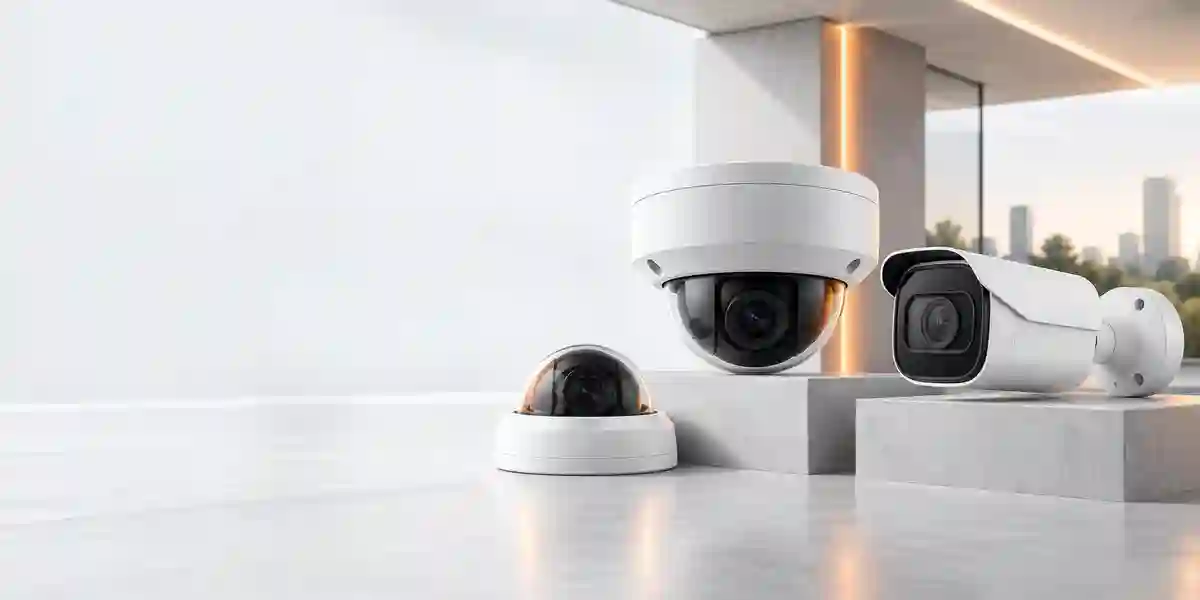
Quick Product Summary
4MP network IR vandal dome
6mm fixed, focused coverage
Infrared up to 30m
IP66 weather, IK10 impact
PoE or 12V DC
microSD up to 128GB
Hanwha QNV-7030R Overview and Buyer Fit
The Hanwha QNV-7030R is designed for surveillance locations where a more focused viewing angle is preferable to a wide overview. Its 6mm fixed lens produces an approximate horizontal field of view of 53 degrees, making it useful for entrances, controlled corridors, loading areas, access lanes, perimeter points and other positions where the camera must concentrate on a narrower scene. Because the lens is fixed, the intended viewing distance and target width should be checked before ordering. If the site needs a broader scene, another QNV model with a shorter focal length may be more suitable.
The camera records up to 4MP and supports H.265, H.264 and MJPEG with multiple streaming. This gives integrators flexibility when balancing picture quality, bandwidth and recording capacity. Day and night operation uses an IR-cut mechanism, while 120dB wide dynamic range helps manage scenes that contain both bright and dark areas. Built-in IR reaches up to 30 metres under suitable conditions, supporting monitoring when ambient light is limited.
For outdoor or exposed installations, the IP66 enclosure helps protect against dust and water ingress while IK10 impact resistance supports deployment in areas where mechanical protection matters. PoE simplifies cabling by carrying power and data over the Ethernet connection, while 12V DC remains available for projects that use a separate power design. A microSD slot supporting cards up to 128GB can provide local recording, buffering or event storage depending on the chosen system design.
Key Features and Business Benefits
4MP detail
Provides more image detail than standard 2MP surveillance while keeping storage and bandwidth requirements practical for many business deployments.
6mm fixed lens
A narrower 53-degree horizontal view helps focus coverage on specific doors, passages and approach points rather than a very wide general scene.
30m infrared
Integrated IR supports night monitoring without requiring visible illumination, subject to scene reflectivity, mounting and environmental conditions.
120dB WDR
Helps preserve usable detail when the camera faces challenging contrast such as bright doorways, windows, vehicle entrances or sunlit backgrounds.
IP66 and IK10
The weather-resistant and vandal-resistant housing is suitable for many exposed commercial locations where ordinary indoor dome cameras would be less appropriate.
Flexible recording path
Network streaming, multiple codecs and local microSD support make the camera easier to integrate into a planned NVR or video-management architecture.
Verified Technical Specifications
| Specification | Hanwha QNV-7030R |
|---|---|
| Camera class | 4MP network IR vandal-resistant dome camera |
| Imaging device | 1/3-inch 4MP CMOS |
| Lens | 6.0mm fixed, F2.2 |
| Field of view | Approx. H 53° / V 31° / D 62° |
| Maximum frame rate | Up to 20fps at 4MP; up to 30fps at 2MP depending on video standard |
| Compression | H.265, H.264, MJPEG; multiple streaming |
| Wide dynamic range | 120dB WDR |
| IR distance | Up to 30m |
| Analytics/events | Motion detection, tampering, defocus detection |
| Local storage | microSD/SDHC/SDXC up to 128GB |
| Power | PoE or 12V DC |
| Environmental protection | IP66 |
| Impact resistance | IK10 |
Compatibility, Configuration and Deployment Guidance
Before specifying the QNV-7030R, confirm that the 6mm lens matches the required identification distance and scene width. For a general lobby overview or small room, a shorter lens may provide better coverage. For a more focused doorway, corridor, gate or perimeter viewpoint, the 6mm lens can be advantageous. Camera placement, mounting height and target distance should be checked using a site plan or field-of-view calculation rather than relying only on megapixel count.
For recording, confirm the NVR or VMS supports the required resolution, codec, stream count and retention period. H.265 can reduce bandwidth and storage compared with older compression methods, but practical savings depend on scene movement and configuration. If the project uses edge storage, select a surveillance-suitable microSD card within the supported capacity. For PoE deployment, confirm switch budget, port availability, cable length and network design. Where 12V DC is used, verify local power distribution and backup requirements.
The camera includes motion detection, tampering and defocus detection, but these features should be tested in the final scene before they are relied upon for operational alerts. WDR, exposure, IR intensity, privacy masking and recording profiles should also be tuned after installation. For remote access, use the supported secure network method selected by the organization and avoid exposing cameras directly to the public internet without appropriate security controls.
Ideal Customers and Use Cases
Commercial entrances
Useful where a focused viewpoint is required at a door, reception access point or controlled building entrance.
Warehouses
Suitable for loading bays, stock access points and perimeter positions where impact protection and infrared monitoring matter.
Retail sites
Can cover back doors, cash-office approaches, delivery entrances and exterior access points requiring a vandal-resistant housing.
Industrial facilities
Appropriate for selected gates, walkways and protected work areas when the fixed lens matches the scene geometry.
What to Confirm Before Ordering
- Required horizontal scene width and viewing distance for the 6mm lens.
- Indoor or outdoor mounting position, weather exposure and vandal-resistance requirement.
- NVR or VMS compatibility with 4MP, H.265/H.264 and the required stream profiles.
- PoE switch capacity, network ports, cabling distance and available bandwidth.
- Required recording retention and whether edge microSD storage is part of the design.
- Night scene characteristics and whether 30m IR is suitable for the actual target area.
- Mounting accessories, junction box requirements and cable-entry method.
- Current product lifecycle, regional availability, warranty route and any suitable replacement model.
QNV-7030R Compared with Related Q-Series Options
The QNV-7030R is one of several fixed-lens 4MP vandal domes in the same family. The important difference is field of view. QNV-7010R uses a 2.8mm fixed lens for a much wider scene, while QNV-7020R uses a 3.6mm lens for a medium-width view. QNV-7030R uses 6mm for a narrower, more focused angle. Buyers should therefore select among these models based primarily on coverage geometry rather than assuming the highest model number is automatically the best fit.
| Model | Lens | Approx. horizontal view | Typical fit |
|---|---|---|---|
| QNV-7010R | 2.8mm | 110° | Wide overview |
| QNV-7020R | 3.6mm | 81° | Balanced coverage |
| QNV-7030R | 6mm | 53° | Focused viewing |
Hanwha QNV-7030R Dubai
Dubai security projects often combine bright exterior sunlight, shaded entrances, reflective glass, covered parking, indoor corridors and long operational hours within a single site. The Hanwha QNV-7030R can fit selected positions in these environments because its 120dB WDR is designed to improve image usability when strong light and shadow exist together, while its integrated infrared supports night viewing where visible lighting is limited. Its IP66 and IK10 ratings make it particularly relevant to exposed or reachable mounting positions, such as warehouse doors, service entrances, loading areas, external passages and building access points. The 6mm fixed lens should, however, be treated as a focused lens rather than a general wide-angle choice.
For Dubai buyers, a practical specification process starts with the required scene width and the distance to the subject. A retail shop may use the QNV-7030R to watch a specific back entrance rather than a whole sales floor. A warehouse may place it on a dispatch doorway, where the narrower angle can concentrate pixels on a defined route. An office building may use it at a controlled entrance or parking access lane. In each case, mounting height, target distance and surrounding lighting should be assessed before purchase. The camera’s 30m IR capability is useful, but real night performance also depends on wall reflections, dark backgrounds, dust, humidity, nearby lighting and the direction of vehicle headlights.
Dubai projects should also check recorder compatibility, PoE capacity, network cabling and storage retention. The QNV-7030R supports H.265, H.264 and MJPEG, and can therefore be integrated into many professional recording designs, but compatibility should be confirmed against the selected NVR or VMS. If a project uses a PoE switch, ensure adequate power budget and network segmentation. If local recording is required, confirm the microSD strategy and card endurance. For regulated or compliance-sensitive sites, camera positioning, retention period and access rights should be reviewed against the applicable local requirements.
FourTeck can assist Dubai buyers with model-fit checks, field-of-view planning, recorder sizing, storage calculations, PoE networking, mounting requirements and current availability enquiries without assuming that every site needs the same camera. For wider scenes, compare the QNV-7010R or QNV-7020R family members before finalizing. For a project quotation or configuration review, use the FourTeck contact route or review broader CCTV installation planning in Dubai.
Hanwha QNV-7030R UAE
Across the UAE, organizations may need one surveillance standard across offices, warehouses, retail branches, educational facilities, hospitality sites and industrial locations in different emirates. The Hanwha QNV-7030R can serve as a focused 4MP vandal dome within such a standardized design, especially where a 6mm lens is appropriate for entrances, service areas and defined approach routes. Its IP66 enclosure and IK10 impact protection support outdoor and reachable installations, while PoE can simplify branch deployment by reducing the need for separate power cabling at every camera point.
Multi-emirate projects should avoid selecting a camera only by resolution. The viewing angle, mounting height, recording duration, network topology and maintenance process are equally important. The QNV-7030R’s 53-degree horizontal view is narrower than related QNV fixed-lens options, so it is best used where more focused coverage is wanted. For reception halls, wide shop floors or broad indoor areas, a shorter focal length may be more appropriate. For a gate lane, loading dock door or perimeter approach, the 6mm lens may provide better subject concentration at distance. A project may therefore use a mix of QNV-7010R, QNV-7020R and QNV-7030R rather than standardizing every position on one lens.
For UAE procurement, confirm the exact model suffix, lifecycle status, available accessories, recorder interoperability and warranty route at the time of purchase. Product availability can vary by region and time, so stock and delivery should be verified rather than assumed. Network design should account for camera count, uplink capacity, storage bandwidth and remote-management requirements. H.265 can reduce storage and network demand, but final capacity planning should use the intended frame rate, bitrate, motion level and retention policy.
FourTeck can help UAE buyers evaluate whether the QNV-7030R fits a specific position and whether other Hanwha models would better suit wide-angle, varifocal, PTZ or higher-detail requirements. Businesses can also review CCTV and access control planning for UAE sites, use FourTeck UAE resources, or contact the sales team with the site type, camera count, required retention days and existing NVR information for a more practical configuration discussion.
Hanwha QNV-7030R Kenya
Kenya-based organizations evaluating the Hanwha QNV-7030R are often planning surveillance for offices, warehouses, education campuses, hospitality sites, retail locations, distribution centres and industrial facilities. The camera’s combination of 4MP resolution, 6mm fixed lens, 30m infrared, IP66 weather protection and IK10 impact resistance can be useful where an installation needs focused monitoring rather than a very wide overview. Exterior doors, loading points, access lanes, guarded entrances and narrow approach routes are typical examples where the lens geometry may fit.
For Kenyan projects, power and network resilience should be treated as part of the camera specification. PoE can simplify installation, but the switch, UPS and upstream network equipment must be sized for the complete camera count. Where power interruptions are a concern, backup design should include the PoE switch, NVR, storage and core network devices rather than only the camera. For remote locations or branch networks, available WAN bandwidth can influence whether remote viewing uses the main stream or a secondary stream. The QNV-7030R supports multiple streaming, giving integrators flexibility to keep a high-quality recording profile while using a lighter stream for remote monitoring.
Night performance should be tested under actual conditions. The specified 30m IR distance is useful for planning, but walls, vegetation, reflective surfaces, rain, dust and other environmental factors can change the result. WDR can help at entrances where daylight and indoor shadow meet. For outdoor installations, cable termination and junction-box sealing remain important even though the camera housing itself is IP66. Correct mounting also matters because a vandal-resistant dome only protects the camera effectively when the entire installation is mechanically secure.
Kenyan buyers should also confirm current availability, lifecycle, recorder compatibility and support route before ordering. FourTeck can help compare the QNV-7030R with wider-lens QNV models, estimate storage, review PoE requirements and identify a practical camera mix for the site. For regional assistance, use FourTeck Kenya and provide the project location, number of cameras, target areas, existing recorder model and expected footage-retention period so the selection can be based on the real site requirement.
Hanwha QNV-7030R Kuwait
Kuwait surveillance projects can involve intense exterior brightness, dust, heat, shaded building approaches and long operating schedules. A camera such as the Hanwha QNV-7030R should therefore be evaluated not only by megapixel rating but also by enclosure protection, lens selection, contrast handling and installation method. The QNV-7030R provides 4MP video, a 6mm fixed lens, 120dB WDR, integrated IR up to 30m, IP66 protection and IK10 impact resistance. These characteristics make it relevant for defined outdoor and semi-outdoor surveillance points when the narrower field of view matches the required scene.
The 6mm lens is especially important in Kuwait projects where a buyer may be choosing between coverage width and pixel concentration. For a broad parking area, a wider or varifocal camera may be more suitable. For a gate approach, loading doorway, side passage or controlled building entrance, a narrower fixed lens can place more image detail on the target zone. Before ordering, calculate the width of the scene at the expected target distance and confirm that the camera can be mounted at a useful angle without excessive tilt or obstruction.
Outdoor deployment should also include good cable management and environmental installation practices. IP66 applies to the camera enclosure, but connectors, junction boxes and mounting surfaces must be installed correctly to protect the system. PoE is convenient for network cameras, yet the total switch power budget, cable quality, distance and UPS support should be planned. H.265 can help manage storage, while the microSD slot can support local recording functions, but central recording requirements should still be defined by camera count and retention policy.
Kuwait buyers should ask for current product availability, recommended accessories, compatible recorder models and any lifecycle guidance before procurement. FourTeck can help compare the QNV-7030R with alternative lenses or newer Hanwha options when necessary. For Kuwait-related enquiries use FourTeck Kuwait. Share the intended camera positions, project quantity, recorder preference and target retention period so the recommendation can account for the complete system rather than the camera alone.
Hanwha QNV-7030R Ghana
In Ghana, the Hanwha QNV-7030R can be considered for business surveillance in offices, warehouses, logistics facilities, retail locations, education sites, hotels and selected industrial environments. Its 4MP imaging and vandal-resistant dome form are useful where a camera needs more detail than standard Full HD and should resist both weather exposure and accidental or deliberate impact. The fixed 6mm lens is best suited to specific coverage zones rather than wide room views, so field-of-view planning should be completed before the order is placed.
A Ghana project may use the QNV-7030R at a main access point, external door, delivery entrance or a corridor where the narrower 53-degree horizontal field of view can help concentrate the image. The camera’s 120dB WDR is relevant to entrances where bright outdoor daylight can otherwise cause faces or objects inside the doorway to appear too dark. Infrared viewing up to 30m supports night monitoring, although actual performance will depend on scene layout, mounting height, surrounding surfaces, dust, rain and available ambient light.
Reliable operation also depends on the wider infrastructure. A PoE camera is only as dependable as the switch, network and backup power supporting it. Projects should confirm switch port capacity, total PoE budget, cable quality and NVR bandwidth. Storage calculations should use the planned bitrate, frame rate, motion level and number of recording days. The QNV-7030R supports H.265, H.264 and MJPEG as well as multiple streaming, which helps organizations create a high-quality recording stream alongside a lower-bandwidth viewing stream where required.
For procurement, Ghana buyers should verify current availability, lifecycle, model suffix, recorder compatibility and support terms at the time of purchase. FourTeck can help assess whether the 6mm lens fits the required distance or whether a wider or varifocal Hanwha model is a better choice. Use FourTeck Ghana for regional product and project enquiries. Providing a simple floor plan or photos of the intended camera locations can make the model-selection discussion much more accurate than choosing by resolution alone.
Hanwha QNV-7030R Uganda
Ugandan businesses and institutions planning CCTV for offices, warehouses, schools, hospitality locations, retail outlets and industrial sites may consider the Hanwha QNV-7030R where a robust, focused 4MP camera is needed. The model uses a 6mm fixed lens, giving a narrower view than the related QNV-7010R and QNV-7020R. This makes it appropriate for selected entrances, narrow access routes, loading points or perimeter positions where the camera should look at a defined area rather than capture a broad overview.
The QNV-7030R’s IP66 weather protection and IK10 impact rating support installation in exposed and reachable areas, but good mounting practice remains essential. Brackets, cable entries and junction boxes should suit the installation surface, while the network cable should be protected against mechanical damage and moisture. PoE can reduce cabling complexity, yet it is important to size the PoE switch for the full system and to include the switching and recording equipment in any UPS plan. A camera that has local power continuity still cannot record centrally if the NVR or network switch has stopped.
For night coverage, integrated IR reaches up to 30m under appropriate conditions. The real scene should be checked for reflective walls, vegetation, dust, rain and nearby lamps, all of which can affect infrared images. During daytime or mixed-light operation, 120dB WDR helps manage entrances that have strong daylight beyond the doorway. Multiple streaming and H.265 support can help optimize remote monitoring where network bandwidth is limited, while a higher-quality stream is retained for recording.
Before placing an order in Uganda, confirm the camera’s current regional availability, recorder support, storage plan, mounting accessories and warranty route. FourTeck can help review a planned camera schedule and identify which positions need QNV-7030R and which would benefit from wider lenses or different camera types. For local enquiry routing, visit FourTeck Uganda. Share the site category, camera quantity, target areas and existing recorder information to receive configuration guidance that is matched to the project.
Hanwha QNV-7030R Nigeria
Nigeria surveillance projects range from small offices and retail outlets to warehouses, estates, logistics locations, industrial sites and multi-branch organizations. The Hanwha QNV-7030R can fit specific positions in these projects when 4MP detail, a vandal-resistant housing and a focused 6mm lens are appropriate. Rather than treating it as a one-camera-for-everywhere solution, the best approach is to select it for scenes where its approximately 53-degree horizontal view is an advantage, such as controlled entrances, delivery points, side passages and defined perimeter approaches.
For Nigerian sites, dependable power and network design are often as important as camera specification. PoE simplifies the camera connection, but PoE switches, NVRs, routers and storage devices should be included in backup-power planning where continuous recording is required. A multi-branch business should also decide whether recording remains local at each branch or is managed centrally through a video platform. Because the QNV-7030R supports multiple streams and H.265, it can be configured with different profiles for local recording and remote monitoring, subject to the selected NVR or VMS.
Outdoor and semi-outdoor installations benefit from the IP66 housing and IK10 impact rating. However, connectors and mounting accessories still need correct weatherproofing. The camera’s 30m IR capability is valuable for low-light operation, while 120dB WDR helps in scenes with strong contrast, but final image settings should be tuned after installation. Motion detection, tampering and defocus events should also be tested under real site activity to reduce unnecessary alarms and improve operational usefulness.
Procurement teams should verify current model availability, lifecycle, accessories, compatible NVR options and warranty route before issuing a purchase order. FourTeck can help compare this model against wider-lens QNV cameras or newer Hanwha alternatives if the site requirement has changed. For Nigeria-specific enquiries use FourTeck Nigeria. Providing the intended camera positions, recording days, site type and existing network information will help determine whether the QNV-7030R is the right fit or one part of a mixed camera design.
Hanwha QNV-7030R Seychelles
Seychelles buyers considering the Hanwha QNV-7030R may be planning surveillance for hotels, commercial buildings, offices, retail locations, logistics facilities, villas or infrastructure sites. The product’s IP66 weather protection and IK10 impact resistance make it suitable for many exposed mounting positions, while its 4MP resolution and 6mm lens support focused viewing. In island environments, however, installation quality is critical: outdoor camera systems should be designed with attention to moisture, salt-laden air, cable sealing, suitable mounting hardware and regular maintenance.
The 6mm fixed lens gives a narrower field of view than wide-angle dome cameras, so it works best when the target area is known in advance. A hotel may use it for a service entrance or delivery gate rather than a wide lobby. A commercial property may place it on a vehicle access route or a defined exterior doorway. A warehouse may use it at a loading point. In each case, the lens should be checked against the expected target distance. If broad coverage is needed, a shorter focal length or varifocal model may reduce the number of cameras required and avoid blind areas.
Night coverage uses integrated IR up to 30m, but the environment can affect the result. Highly reflective surfaces, rain, nearby walls, vegetation and exterior lights can change infrared performance. WDR can help where bright daylight and shaded entrances appear in the same image. PoE allows data and power over one Ethernet cable, but switch capacity, network redundancy and UPS support should be considered as part of the full security system. For remote monitoring between islands or remote sites, bandwidth planning and secondary streams can be especially useful.
Before ordering for Seychelles, confirm regional availability, current product lifecycle, compatible recording equipment, mounting accessories and warranty arrangements. FourTeck can help review the camera schedule, storage requirement and network design and can suggest wider-lens or alternative Hanwha models if the QNV-7030R is too narrow for a particular position. For regional support and Africa-focused project enquiries, use FourTeck Africa or the main FourTeck contact page.
Related FourTeck Resources and Product Planning
A complete surveillance deployment often requires more than the camera. Recorder sizing, storage, PoE switching, structured cabling, mounting hardware, UPS protection and remote access all influence final performance. The following FourTeck resources can help with project planning while exact Hanwha product-page links are confirmed.
Dubai CCTV planning
Review camera placement, recorder sizing, storage, PoE and installation considerations for commercial Dubai projects.
UAE security systems
Consider CCTV and access-control requirements together for integrated site-security planning.
Regional FourTeck Resources
For product, configuration and project enquiries, use the regional route closest to the deployment: FourTeck UAE, FourTeck Kenya, FourTeck Kuwait, FourTeck Ghana, FourTeck Uganda, FourTeck Nigeria, and FourTeck Africa for Seychelles and wider regional enquiries. The main FourTeck website can be used for cross-region product and services information.
Why Contact FourTeck for QNV-7030R Planning?
The most important buying decision is not simply whether the QNV-7030R is a good camera, but whether it is the correct camera for the intended position. FourTeck can assist with field-of-view selection, recorder compatibility, storage calculations, PoE network requirements, mounting considerations, project quantities and alternative-model comparisons. This helps buyers avoid installing a narrow lens where a wide view is needed, undersizing storage, overlooking PoE capacity or selecting a model without confirming lifecycle and regional availability.
Frequently Asked Questions
What resolution does the Hanwha QNV-7030R support?
The QNV-7030R is a 4MP network camera. It supports up to 20 frames per second at 4MP with H.265 or H.264. Lower resolutions can support higher frame rates depending on the selected video standard and configuration.
Is the QNV-7030R suitable for outdoor use?
Yes. The camera carries an IP66 environmental rating for protection against dust and water exposure and an IK10 impact rating. Installation accessories, cable entries and connectors still need appropriate outdoor protection.
How wide is the QNV-7030R view?
Its 6mm fixed lens provides an approximate horizontal field of view of 53 degrees, vertical field of view of 31 degrees and diagonal field of view of 62 degrees. This is more focused than the wider QNV-7010R and QNV-7020R variants.
How far can the infrared illumination reach?
Hanwha specifies an IR viewable distance of up to 30 metres. Actual night performance depends on installation height, target reflectivity, weather, nearby surfaces and ambient lighting, so the scene should be tested after installation.
Does the camera support PoE?
Yes. The QNV-7030R supports Power over Ethernet as well as 12V DC. PoE can simplify installation by using the network cable for both power and data, provided the switch has enough power budget and appropriate port capacity.
Can the QNV-7030R record to a memory card?
Yes. It supports microSD, microSDHC and microSDXC storage up to 128GB. Edge storage can be used as part of the recording design, but final use should be configured to match the selected NVR, VMS and retention policy.
Does the QNV-7030R support H.265?
Yes. The camera supports H.265, H.264 and MJPEG with multiple streaming. H.265 can reduce bandwidth and storage demand compared with older compression, but the exact result varies with bitrate, scene activity and recording settings.
What is the difference between QNV-7010R, QNV-7020R and QNV-7030R?
The main difference is fixed focal length and viewing angle. QNV-7010R uses 2.8mm for a wide view, QNV-7020R uses 3.6mm for a medium view, and QNV-7030R uses 6mm for a narrower, more focused view.
Is the QNV-7030R suitable for entrances with bright backlight?
The camera includes 120dB wide dynamic range, which is designed to help with high-contrast scenes such as entrances with bright daylight beyond a darker interior. Positioning and exposure settings should still be tuned at the site.
How do I request QNV-7030R pricing in Dubai?
Send FourTeck the required quantity, intended camera locations, recorder model if already selected, retention requirement and project location. Current pricing, availability, accessories and any replacement-model guidance should be confirmed at the time of enquiry rather than assumed.
Need Help Confirming the Right Hanwha Camera?
Share the site type, target distance, required scene width, camera quantity, recorder preference and number of recording days. FourTeck can help you determine whether the Hanwha QNV-7030R is the correct 6mm option or whether another lens or camera type is better suited to the project.
Reviews
There are no reviews yet.