

Hanwha XND-6080 Dubai
The Hanwha XND-6080 is a 2MP H.265 indoor network dome camera built for clear, high-frame-rate surveillance in commercial interiors. Its 2.8–12mm motorized varifocal lens supports flexible scene framing, while up to 60fps video, 150dB wide dynamic range, Day & Night operation and WiseStream II help balance image quality with network and storage efficiency.
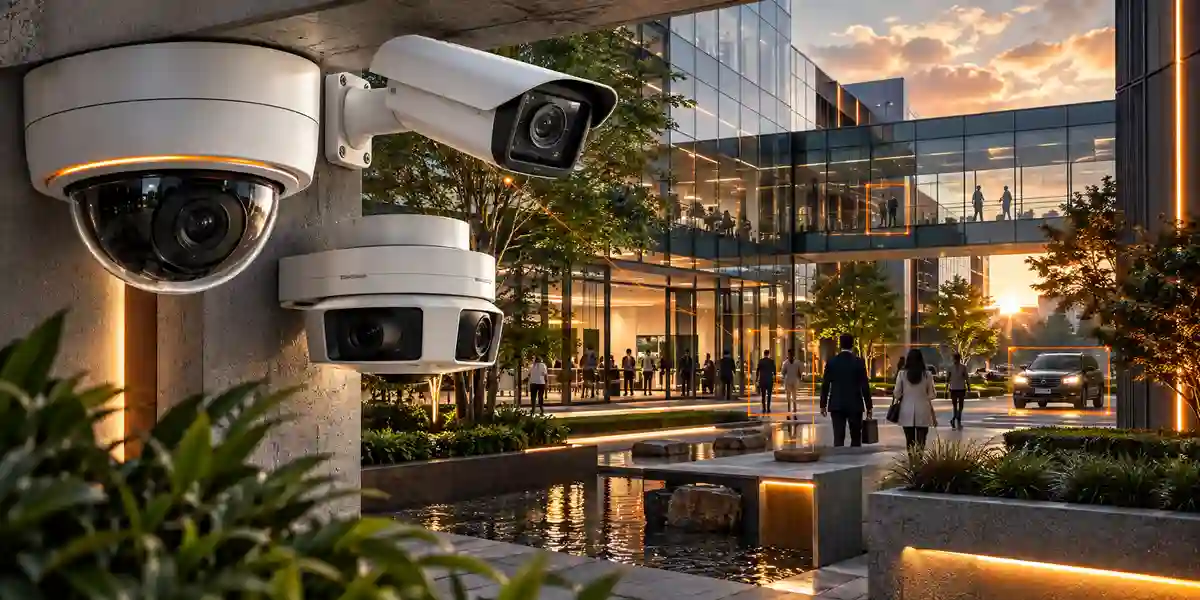
Quick product summary
Indoor network dome camera for professional IP surveillance.
2MP CMOS imaging with resolutions up to 1920 × 1080 and H.265/H.264 at up to 60fps.
2.8–12mm 4.3x motorized varifocal lens for remote framing and focus adjustment.
Interior entrances, corridors, retail, offices, education, hospitality and controlled business spaces.
Overview and buyer-fit guidance
The XND-6080 is most appropriate where a buyer needs a compact indoor dome camera with flexible optical framing rather than a fixed lens. The motorized 2.8–12mm range makes it useful when the final scene must be adjusted after mounting, such as a reception area that needs a wider field of view or a corridor, cash-handling point or doorway that benefits from tighter framing. Its maximum 60fps capability can also be valuable in scenes with frequent movement, although recording settings should be selected according to evidence requirements, available network bandwidth and storage capacity rather than simply using the highest frame rate everywhere.
The camera supports H.265, H.264 and MJPEG, multiple streaming profiles, WiseStream II, Day & Night operation, 150dB WDR, defog, lens distortion correction and a set of video/audio analytics functions. Buyers should treat analytics as part of an overall system design: useful results depend on camera angle, target size, scene lighting, firmware, VMS integration and the way each rule is configured. The XND-6080 is an indoor dome; projects requiring integrated infrared illumination, outdoor weather protection or higher vandal resistance should compare other Hanwha variants rather than assuming this model is interchangeable.
Key features and business benefits
Flexible varifocal coverage
The 2.8–12mm motorized lens lets installers refine the field of view over the network, which is useful when camera positions are fixed but operational priorities change during commissioning.
High-frame-rate video
Up to 60fps at supported H.265/H.264 resolutions can provide smoother motion capture for busy internal areas. Storage and bandwidth should still be engineered around the required retention period.
Wide dynamic range
150dB WDR is designed to help with scenes containing strong differences between bright and dark areas, such as glazed entrances, lobbies and doorways facing exterior daylight.
Storage efficiency
H.265 compression and WiseStream II can reduce unnecessary video data compared with less efficient configurations, supporting more practical network and storage planning.
Edge storage
Dual memory-card slots support local recording strategies, helping designers consider edge recording, event capture and resilience alongside NVR or VMS recording.
Integration options
Support for ONVIF profiles and Hanwha interfaces helps integrate the camera into compatible IP video systems. Always confirm exact VMS feature support before procurement.
Verified technical specifications
| Specification | Hanwha XND-6080 |
|---|---|
| Image sensor | 1/2.8-inch 2MP CMOS |
| Maximum resolution | 1920 × 1080 |
| Maximum frame rate | Up to 60fps with H.265/H.264 |
| Lens | 2.8–12mm, 4.3x motorized varifocal |
| Aperture | F1.4 wide to F3.6 tele |
| Horizontal field of view | Approx. 119.5° to 27.9° |
| Low light | Colour 0.015 lux; B/W 0.0015 lux at stated manufacturer conditions |
| WDR | 150dB |
| Video codecs | H.265, H.264, MJPEG |
| Edge storage | Dual SD slots, up to 512GB total stated by manufacturer |
| Interface / interoperability | ONVIF Profile S/G/T, SUNAPI, Wisenet open platform |
| Impact rating | IK08 |
| Power | PoE or 12V DC; max. 6.5W PoE / 6W DC |
| Operating temperature | -10°C to +55°C |
| Dimensions / weight | Ø140.8 × 113mm / approx. 610g |
Compatibility, configuration and deployment
A successful XND-6080 deployment starts with the surrounding video architecture. Confirm the PoE switch budget, network topology, VLAN design, NVR or VMS compatibility, recording codec, frame rate, bitrate, retention requirement and user-access model. Although ONVIF can simplify interoperability, it does not guarantee that every advanced feature will appear identically in every third-party VMS. Where analytics, audio, event metadata or edge-storage functions are important, verify those functions specifically with the chosen recording platform and current firmware.
For lens selection, the wide end is suited to broader room or lobby coverage, while the tele end narrows the scene for more targeted observation. Mounting height and viewing angle should be selected around the identification or situational-awareness objective. Backlit entrances should be tested with WDR enabled, while scenes with reflective surfaces or highly variable illumination may need additional commissioning. This model does not include integrated IR illumination, so low-light performance depends on available scene lighting. Where zero-light viewing is required, compare an IR-equipped variant such as the XND-6080R or XND-6080RV.
No separate camera licence requirement should be assumed from the product name alone. Licensing can be determined by the selected VMS, analytics application or enterprise management platform. Buyers should therefore budget the complete solution rather than the camera only. Firmware policy, cybersecurity settings, password management, HTTPS configuration, network time synchronization and maintenance access should also be included in the commissioning plan.
Ideal customers and use cases
The XND-6080 can suit offices, reception areas, retail interiors, educational buildings, hotels, clinics, banks, controlled warehouse interiors, service counters, corridors and indoor entrances where a discreet dome form factor and adjustable lens are preferred. It is especially relevant when the designer needs a mix of wide scene coverage and the ability to narrow the view without changing the camera body. The camera’s analytics can support event-driven monitoring, but operational teams should define clear rules and response procedures rather than relying on default settings.
For projects with higher pixel-density requirements, integrated IR, outdoor exposure or stronger vandal/weather protection, a different Hanwha model may be more suitable. FourTeck can help compare the required scene, camera count, recording platform and network design before a final bill of materials is selected.
What to confirm before ordering
- Indoor mounting location and whether integrated IR illumination is required.
- Required field of view, target distance and identification objective.
- PoE switch capacity, network ports and available 12V DC power where relevant.
- NVR or VMS model and required ONVIF/advanced-feature compatibility.
- Recording resolution, frame rate, codec, bitrate and retention period.
- Edge-storage requirement and compatible memory-card capacity.
- Audio, alarm I/O, analytics and event-integration requirements.
- Mounting accessories, ceiling type and service access.
- Current firmware requirements and cybersecurity policy.
- Whether an IR, vandal-resistant, outdoor or higher-resolution alternative is a better fit.
Comparison and alternative-model guidance
The XND-6080 is the standard 2MP indoor dome without integrated IR. The XND-6080R adds integrated IR for dark scenes, while the XND-6080V and XND-6080RV are related dome variants with different mechanical construction. The XND-8080R belongs to the same general dome family but increases resolution and includes IR, making it more appropriate where additional detail is required. Model selection should be based on scene lighting, desired pixel density, environmental exposure, impact risk, mounting constraints and the recording platform rather than model number alone.
Hanwha XND-6080 Dubai
Dubai surveillance projects often combine bright external daylight with controlled indoor lighting, especially in glazed offices, reception areas, retail entrances, hotels and mixed-use buildings. That contrast makes camera placement and WDR performance important. The Hanwha XND-6080’s 150dB WDR can be useful for internal positions facing windows or doors, but commissioning still matters: the installer should test exposure, lens framing and backlight settings at the actual time of day when the scene is most difficult. For buyers searching for a Hanwha XND-6080 Dubai supplier, the more useful question is not simply whether the model is available, but whether it matches the required scene, recording platform and evidence objective.
The 2.8–12mm motorized lens gives Dubai project teams flexibility during fit-out. A camera can be mounted during construction or refurbishment and then optically adjusted once furniture, counters, access-control lanes or display areas are finalized. In a lobby, the wide end can capture situational context; at a controlled door, a narrower setting can dedicate more pixels to the target zone. Up to 60fps may be beneficial for busy interiors, but storage planners should avoid applying maximum frame rate indiscriminately across every camera. H.265 and WiseStream II can help manage data, while final retention calculations should use realistic scene activity and bitrate settings.
Dubai buyers should also confirm whether the indoor, non-IR XND-6080 is the intended variant. Parking areas, unlit rooms or spaces that become dark after closing may justify an IR model. Ceiling construction, PoE availability, cybersecurity standards and NVR/VMS integration should be checked before procurement. FourTeck can assist with solution scoping, model comparison and configuration discussions for commercial projects through its sales assistance route, while broader UAE IT and infrastructure requirements can also be explored through FourTeck UAE resources.
Hanwha XND-6080 UAE
UAE procurement can involve multi-site requirements across different emirates, so standardization is often as important as the individual camera specification. The Hanwha XND-6080 offers a practical 2MP indoor-dome format for organizations that want consistent lens control, PoE connectivity and H.265 recording across offices, service counters, education spaces, hospitality interiors and other controlled environments. For a multi-emirate rollout, buyers should establish a repeatable camera profile covering naming conventions, IP addressing, firmware level, time synchronization, codec, frame rate, bitrate, analytics, user roles and recording retention.
The camera’s motorized 2.8–12mm lens is useful where one standardized model must serve several interior scene types. Even so, standardization should not become forced uniformity. Sites with low ambient light may need integrated IR; exposed external areas need weather-rated models; higher-detail tasks may need greater resolution. A site survey or at least a drawing-based field-of-view review can reduce the risk of buying the correct camera family but the wrong variant for a specific position.
UAE buyers also commonly need to understand compatibility with existing NVR or VMS infrastructure. ONVIF support is helpful, yet advanced analytics, event metadata, audio and edge-recording functions can vary by platform. Confirm the exact features that operations teams intend to use. Network planners should calculate PoE budgets and storage centrally, especially when dozens or hundreds of devices are involved. For UAE projects, FourTeck can discuss the camera alongside switching, recording and deployment requirements through FourTeck UAE and the main FourTeck technology portal. Quotes should be based on the required project configuration rather than an assumed fixed package.
Hanwha XND-6080 Kenya
Kenyan buyers evaluating the Hanwha XND-6080 typically need to align camera choice with site networking, recording capacity and maintenance practicality. In offices, financial-service interiors, schools, hotels and retail premises, the model’s 2MP resolution and adjustable 2.8–12mm lens can cover a useful range of interior scenes. Rather than purchasing only by megapixel count, project teams should define the target: overview monitoring, movement tracking, doorway observation or a tighter operational zone. That target determines lens setting, mounting height and the amount of image detail available where it matters.
Bandwidth and storage planning are particularly important when projects span several branches. H.265 and WiseStream II can improve efficiency, while the actual result still depends on scene activity, frame rate, bitrate controls and retention policy. A head office may choose 25 or 30fps for normal surveillance even though the camera can reach 60fps, reserving higher frame rates for specific high-motion positions. Edge storage can provide an additional recording option, but it should be designed as part of the system rather than treated as a substitute for a properly sized recorder without considering retrieval and resilience requirements.
For Kenya installations, check PoE switch capacity, UPS strategy, network segmentation and remote administration. If locations experience unlit periods, compare the IR-equipped XND-6080R rather than assuming the standard XND-6080 will deliver the same zero-light performance. Buyers can use FourTeck Kenya to discuss regional project needs and FourTeck Africa for broader regional technology requirements. Final selection should confirm VMS interoperability, mounting conditions and current project quantities.
Hanwha XND-6080 Kuwait
For Kuwait commercial surveillance, the Hanwha XND-6080 is best considered as an indoor camera for conditioned or otherwise suitable interior locations. Its stated operating range is -10°C to +55°C, but the model is not positioned as an outdoor weather-rated camera. That distinction matters in a market where cameras may be close to hot entrances, loading areas or transitional spaces. Project designers should verify the actual environmental conditions at each mounting point and move to an appropriate outdoor-rated Hanwha model where exposure demands it.
Inside offices, retail environments, hotels and institutional buildings, the 150dB WDR feature can help manage difficult lighting near doorways or glass façades. The motorized lens also makes commissioning easier when the final layout changes between design and handover. A wide setting may be appropriate for reception context, while a narrower setting can concentrate pixels on a doorway or transaction area. The built-in analytics can support event rules such as loitering or directional detection, although reliable operation requires deliberate scene design and testing.
Kuwait buyers should confirm PoE availability, recorder capacity, storage retention and access-control or alarm integration requirements before ordering. For multi-camera systems, a configuration schedule listing camera name, lens target, stream settings, analytics rules and recording policy can reduce commissioning errors. If night illumination is unavailable, consider an IR variant rather than adding assumptions later. Regional procurement discussions can begin through FourTeck Kuwait. FourTeck can help compare the required Hanwha camera configuration with network and recording requirements, while avoiding unsupported assumptions about stock, fixed pricing or delivery times.
Hanwha XND-6080 Ghana
Organizations in Ghana considering the Hanwha XND-6080 may be planning surveillance for offices, hospitality spaces, education facilities, retail stores, banking interiors or other controlled indoor environments. The camera’s value lies in the combination of professional IP-video features and flexible optical framing. A 2.8–12mm motorized varifocal lens lets the installer adapt the shot after installation, reducing dependence on a single fixed focal length across varied rooms and entrances.
For branch networks or distributed sites, the design should prioritize manageable bandwidth, reliable time synchronization and clear recording policies. H.265 and WiseStream II provide tools for data efficiency, while frame rate and bitrate still need to be chosen per scene. A low-activity corridor can use a different profile from a busy lobby. Edge storage can add local recording capability, but central operations teams should define how footage is monitored, retrieved and protected. PoE simplifies cabling when the switch infrastructure is designed with enough power budget and UPS support.
The standard XND-6080 does not have integrated infrared LEDs, so buyers should confirm ambient lighting after business hours. Where darkness is expected, an IR-equipped sibling may be more appropriate. Also verify VMS compatibility beyond basic live video if the project relies on analytics, audio or event metadata. For Ghana, project enquiries and solution discussions can be routed through FourTeck Ghana, with wider cross-border support information available at FourTeck Africa. A final bill of materials should include camera mounting, PoE/network equipment, recording, storage and any required software licensing rather than treating the camera as an isolated purchase.
Hanwha XND-6080 Uganda
Uganda surveillance projects can range from single-site offices to schools, hotels, retail operations and distributed organizations. The Hanwha XND-6080 is suitable for interior positions where 2MP video, a discreet dome form factor and remote lens adjustment meet the scene objective. The wide 2.8mm end helps cover a broad room, while zooming toward 12mm narrows the field of view for more concentrated observation. That optical flexibility is useful during commissioning, but installers should document the final angle and target so future maintenance does not unintentionally change the evidence objective.
Network design should be considered from the beginning. The camera supports PoE, H.265/H.264 and multiple profiles, allowing a system to separate recording quality from lower-bandwidth live viewing where the VMS supports it. For sites with constrained WAN links, users can keep local recording at appropriate quality while carefully planning remote viewing. Edge storage can supplement resilience, though memory cards, health monitoring and footage-retrieval procedures need operational ownership.
Lighting is another key decision. The XND-6080’s low-light capability and Day & Night function do not replace infrared illumination in completely dark conditions. Buyers expecting zero-light operation should compare the XND-6080R family. VMS compatibility, PoE switch budget, UPS capacity, mounting accessories and retention storage should all be confirmed before purchase. Uganda customers can discuss requirements through FourTeck Uganda and reference broader regional capabilities via FourTeck Africa. The goal should be a maintainable end-to-end camera system rather than a specification-only purchase.
Hanwha XND-6080 Nigeria
Nigeria buyers often evaluate surveillance systems for headquarters, branches, retail outlets, education, hospitality, healthcare and other facilities where centralized monitoring may be important. The Hanwha XND-6080 provides 2MP indoor imaging with a 2.8–12mm motorized lens, 150dB WDR and up to 60fps. For a large deployment, those specifications should be translated into repeatable design standards: which positions need wide overview coverage, which require tighter framing, which need higher frame rates, and which should use IR or outdoor alternatives.
A consistent network and recorder architecture can make multi-site operations easier. Camera VLANs, secure credentials, NTP, firmware governance and role-based access should be part of the deployment plan. PoE simplifies physical installation, but switch power budgets and UPS runtime must account for every device. H.265 and WiseStream II can support storage efficiency, while retention calculations should use actual planned bitrates and activity assumptions rather than optimistic generic estimates.
For internal entrances with strong daylight, WDR can be valuable; for sites that become completely dark, an IR-equipped model should be assessed. If an existing VMS is already deployed, test more than basic ONVIF live viewing when analytics, audio, alarm I/O or metadata workflows matter. Nigeria enquiries can be directed through FourTeck Nigeria, while FourTeck Africa provides a broader regional route. Buyers should request a configuration-specific quotation covering the intended camera variant, accessories, recording and network components rather than assuming a single fixed package for every location.
Hanwha XND-6080 Seychelles
Seychelles projects require careful separation between indoor camera positions and areas exposed to moisture, salt air or outdoor weather. The Hanwha XND-6080 is an indoor dome, so it can suit controlled interior spaces in hotels, offices, retail areas, administrative buildings and similar locations, while exposed exterior positions should be designed with appropriately weather-rated alternatives. A coastal environment also makes installation quality, cable routing, enclosures and hardware selection important beyond the camera specification itself.
Within suitable indoor spaces, the 2.8–12mm motorized lens gives designers useful flexibility. A hotel lobby may need broad situational awareness, while an internal service desk or controlled doorway may benefit from tighter framing. The 150dB WDR capability can help in interiors looking toward bright entrances or windows. Because the standard XND-6080 has no integrated IR, project teams should review lighting conditions after hours and select an IR variant where areas become completely dark.
Distributed island or hospitality operations may also place emphasis on remote monitoring and efficient use of network links. H.265 and WiseStream II can help manage video data, but remote-viewing architecture, local recording, retention, WAN capacity and user permissions should be planned together. Edge storage can contribute to a resilient design when properly monitored. Buyers should verify NVR/VMS interoperability, PoE availability, UPS strategy and current firmware before deployment. For Seychelles requirements, FourTeck uses FourTeck Africa as the regional information route, with additional product and contact support available at FourTeck. Configuration-specific assistance is recommended before finalizing the camera list.
Related Hanwha product guidance
FourTeck’s current publicly indexed pages did not provide seven verifiable same-site individual product URLs for this exact Hanwha family during preparation, so no unverified product URLs are invented here. Buyers can nevertheless compare the XND-6080 with the manufacturer-confirmed XND-6080R for integrated IR, XND-6080V for an alternate dome construction, XND-6080RV for the IR vandal-style variant, and XND-8080R when greater resolution is required. Contact FourTeck for verified product-page links and a configuration-specific shortlist.
XND-6080R
2MP related dome with integrated IR, appropriate when the scene may be dark and zero-light viewing is needed.
XND-6080RV
2MP IR dome variant for projects that need integrated illumination with a different mechanical housing configuration.
XND-8080R
Higher-resolution IR dome from the related family, useful when the design calls for more image detail than 2MP.
Regional FourTeck resources
Why contact FourTeck?
A camera specification is only one part of a working surveillance solution. FourTeck can help discuss the intended scene, model variant, viewing angle, network connectivity, PoE, recording, storage, VMS interoperability and deployment requirements before the final configuration is selected. This approach helps buyers compare like-for-like requirements without relying on unsupported assumptions about stock, price, authorization, delivery times or warranty coverage.
Frequently asked questions
Is the Hanwha XND-6080 a 2MP camera?
Yes. The XND-6080 uses a 1/2.8-inch 2MP CMOS sensor and supports a maximum video resolution of 1920 × 1080. It is designed for professional indoor IP surveillance where 1080p detail is appropriate for the scene and target distance.
Does the XND-6080 have a motorized zoom lens?
It has a 2.8–12mm 4.3x motorized varifocal lens with remote focus control. This allows the installer to adjust framing over the network during commissioning rather than relying on a single fixed focal length.
Does the XND-6080 include infrared illumination?
No. The standard XND-6080 is a Day & Night indoor dome without integrated IR LEDs. If the scene can become completely dark, compare the XND-6080R or another IR-equipped Hanwha model that matches the environment.
What is the maximum frame rate?
Hanwha specifies up to 60fps for H.265/H.264 at supported resolutions. The best operational frame rate depends on movement, evidence requirements, bandwidth and retention storage rather than simply selecting the maximum value.
Does the camera support PoE?
Yes. The XND-6080 can be powered by Power over Ethernet or 12V DC. Manufacturer information lists a maximum of 6.5W on PoE and 6W on 12V DC, which should be included in the switch power-budget calculation.
Can it work with a third-party VMS?
The camera supports ONVIF profiles as well as Hanwha interfaces, which can aid interoperability. However, advanced analytics, audio, metadata and event functions vary between VMS platforms, so the exact required functions should be verified before procurement.
How much edge storage does it support?
Hanwha lists dual card slots with up to 512GB total capacity. Edge storage can support event recording or resilience strategies, but card selection, recording policy and health monitoring should be planned as part of the complete system.
Is the XND-6080 suitable for outdoor use?
It should be treated as an indoor dome camera. Outdoor, exposed, humid or weather-sensitive positions should use a model specifically rated for those conditions. Do not rely on the IK08 impact rating as a substitute for weather protection.
What does 150dB WDR help with?
Wide Dynamic Range helps manage scenes that contain both very bright and darker areas, such as an indoor camera facing a sunlit entrance. Correct placement and commissioning remain important because WDR cannot compensate for every lighting problem.
What should Dubai buyers provide for a quote?
Provide the number of cameras, indoor locations, approximate viewing distances, NVR/VMS details, required retention period, PoE/network availability, lighting conditions and whether analytics or audio are needed. This lets the configuration be checked before pricing is prepared.
Discuss your Hanwha XND-6080 configuration
Share your camera quantity, site type, recording platform, retention requirement and lighting conditions. FourTeck can help you compare the XND-6080 with related Hanwha dome-camera options for your project.
Reviews
There are no reviews yet.