

Hanwha XND-L6080 Dubai
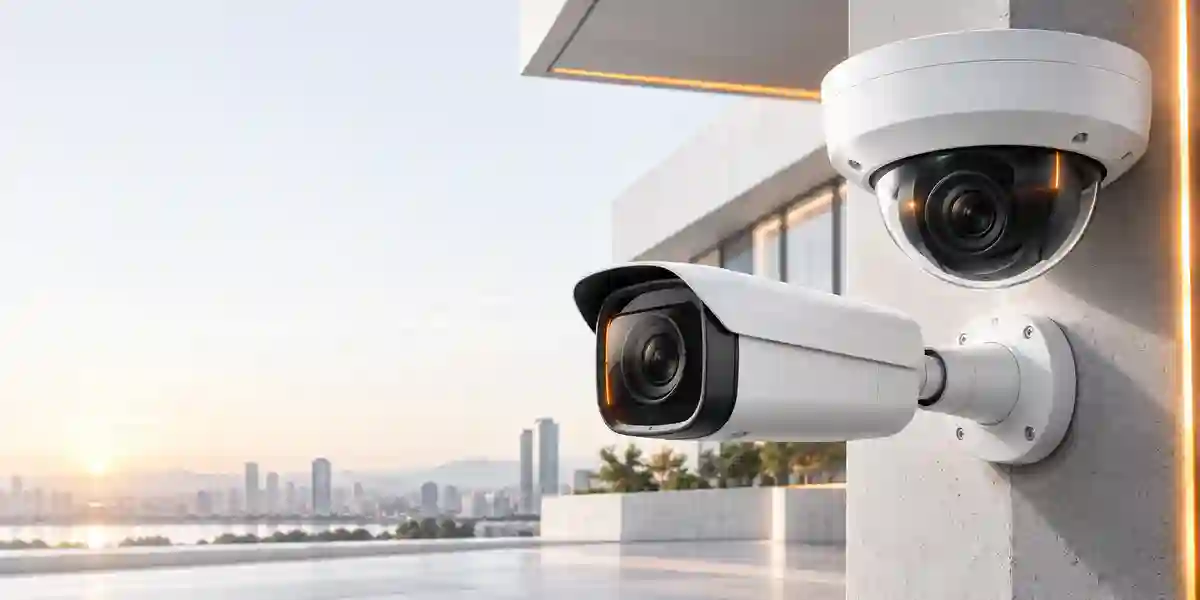
The Hanwha XND-L6080 is a 2MP H.265 indoor network dome camera intended for professional surveillance deployments where a discreet ceiling-mounted form factor, adjustable field of view and dependable IP video performance matter. Its 3.2–10 mm motorized varifocal lens gives installers flexibility to frame wide room views or narrower areas of interest, while up to 60 frames per second can support scenes where smoother motion rendering is desirable. The camera supports H.265, H.264 and MJPEG codecs, 120 dB wide dynamic range, day/night operation, digital image stabilization, defog functions, motion detection, privacy masking, WiseStream II bandwidth optimization and Power over Ethernet.
Quick product summary
Indoor commercial surveillance where a dome camera with flexible optical framing and PoE deployment is preferred.
Maximum 1920×1080 resolution with H.265/H.264 up to 60 fps and MJPEG support.
3.2–10 mm 3.1x motorized varifocal lens for adjustable horizontal viewing from approximately 109° to 33.2°.
10/100 Ethernet with PoE, multiple streaming profiles, ONVIF support and microSD/SDHC/SDXC edge storage.
Overview and buyer-fit guidance
The Hanwha XND-L6080 belongs to a class of professional IP dome cameras used where installers want a compact ceiling-mounted form factor with more optical flexibility than a fixed-lens camera. The 3.2–10 mm motorized varifocal lens is particularly useful during commissioning because the field of view can be tuned for the actual scene rather than relying on a single fixed angle. At the wide end, the camera can cover reception zones, open-plan areas, corridors, retail floors, meeting spaces and general circulation areas. At the telephoto end, it can narrow the scene to emphasize entrances, transaction points, doorways or other defined zones.
The camera records at up to Full HD 1920×1080 and can deliver H.265 or H.264 streams at up to 60 fps. This does not mean every project needs 60 fps. In many commercial installations, lower frame rates are selected to balance bandwidth and retention requirements. The value of the higher frame-rate capability is that the system designer can choose smoother motion capture when the use case warrants it. WiseStream II can also be used to reduce bandwidth while retaining useful visual detail, especially when paired with H.265 encoding.
For scenes with windows, glass doors, lobby entrances or mixed lighting, 120 dB wide dynamic range can help preserve detail across bright and shaded parts of the image. Day/night operation, backlight compensation, highlight compensation, digital noise reduction, defog, image stabilization, motion detection and privacy masking provide practical tools for fine-tuning the camera to the site. Buyers should confirm whether the environment needs built-in infrared illumination because the XND-L6080 model should not be confused with related IR variants in the same family.
Key features and business benefits
2MP image capture
Full HD resolution is suitable for many general monitoring applications, especially where scene coverage, smooth motion and manageable storage requirements are prioritized over very high pixel counts.
Motorized varifocal lens
The 3.2–10 mm range gives the installer meaningful flexibility to adjust the field of view after mounting, reducing the risk of selecting a fixed lens that proves too wide or too narrow for the actual scene.
Up to 60 fps
Higher frame-rate capability can support smoother rendering of movement in entrances, corridors, service areas and other locations where people or objects pass through the scene frequently.
120 dB WDR
Wide dynamic range helps in challenging contrast conditions such as indoor areas facing bright windows or doorways, improving usability of video across mixed lighting zones.
PoE installation
Power over Ethernet allows compatible switches or injectors to supply both data and power over one network cable, simplifying structured deployment and reducing separate power-cabling requirements.
Edge storage
A microSD/SDHC/SDXC slot provides local recording capability that can complement network recording strategies, support event recording or add resilience depending on the final system design.
Verified technical specifications
| Specification | Hanwha XND-L6080 |
|---|---|
| Camera type | 2MP H.265 network dome camera |
| Image sensor | 1/2.8-inch CMOS |
| Maximum resolution | 1920×1080 |
| Maximum frame rate | H.265/H.264 up to 60 fps at 60 Hz; MJPEG up to 30 fps |
| Lens | 3.2–10 mm, 3.1x motorized varifocal, DC auto iris |
| Horizontal field of view | Approx. 109.0° wide to 33.2° tele |
| Wide dynamic range | 120 dB |
| Codecs | H.265, H.264, MJPEG |
| Streaming | Multiple streaming profiles |
| Analytics / events | Motion detection, tampering, defocus detection and related event functions |
| Storage | microSD/SDHC/SDXC edge storage; supported capacity depends on firmware/product specification |
| Network interface | RJ-45 10/100BASE-T |
| Power | PoE IEEE 802.3af |
| Interoperability | ONVIF support; confirm recorder/VMS compatibility for the intended deployment |
Compatibility, configuration and deployment guidance
A network camera should be selected as part of the complete surveillance system rather than as an isolated device. Before specifying the XND-L6080, confirm that the selected NVR or video management platform supports the required video profile, resolution, frame rate, analytics events and retention workflow. ONVIF can help with interoperability, but exact feature support may vary between recorder platforms and firmware versions. Where full camera-side functionality is important, check the integration documentation for the recorder or VMS being used.
PoE simplifies installation, but the switch design still needs attention. Confirm total PoE budget, cable length, structured cabling quality, uplink capacity, VLAN design and network resilience. A single camera has modest bandwidth compared with an entire estate, so larger deployments should calculate aggregate throughput and recording load using the actual codec, frame rate, quality settings and scene complexity. H.265 and WiseStream II may reduce storage and bandwidth compared with less efficient configurations, but retention planning should still use realistic recording assumptions.
The motorized varifocal lens should be adjusted after the final mounting point is known. Wide settings are useful for overview coverage, while tighter focal lengths can focus on a narrower doorway or zone. The correct choice depends on target distance, desired identification detail and mounting height. For low-light areas, carefully evaluate available illumination. If continuous darkness or infrared illumination is required, compare the related IR versions rather than assuming that every XND-L6080 family model includes IR LEDs.
Cybersecurity settings should also be part of commissioning. Use current firmware, unique administrator credentials, HTTPS where supported, appropriate network segmentation, restricted management access and centralized time synchronization. Document the deployed firmware version, IP plan, recording policy and camera naming convention so future maintenance is easier.
Ideal customers and use cases
Offices and commercial buildings
Suitable for reception areas, common corridors, lift lobbies, meeting-zone approaches and controlled-access circulation spaces where a discreet dome format is preferred.
Retail and customer-facing sites
The adjustable field of view can support sales floors, entrances, service counters and general overview coverage, subject to the required pixel density and lighting conditions.
Education and training facilities
Can be considered for indoor corridors, administration areas and shared spaces where PoE network deployment and centralized recording are already part of the security design.
Hospitality and multi-tenant properties
Useful for indoor public zones, back-of-house corridors and access areas where a low-profile dome camera and configurable lens are desirable.
What to confirm before ordering
- Confirm the exact model suffix and whether built-in IR illumination is required.
- Confirm the intended mounting location, height and desired field of view.
- Check whether 2MP resolution provides sufficient detail for the target scene and distance.
- Confirm NVR or VMS compatibility, supported codec and analytics integration requirements.
- Calculate PoE budget, network bandwidth and storage retention needs.
- Confirm whether edge storage will be used and select a suitable surveillance-grade memory card if required.
- Review lighting conditions, WDR needs and low-light performance at the actual site.
- Confirm required accessories, mounting hardware and any project-specific compliance requirements.
- Request current commercial availability and quotation information rather than relying on unverified online stock or pricing.
Related-model guidance and alternatives
The XND-L6080 should be compared with close family variants before purchase. Hanwha offers related L6080 dome and bullet models with different enclosure protection, infrared capability and form factors. For example, an IR dome can be more appropriate where the site must operate in darkness without relying on ambient lighting. A vandal-resistant or weather-rated dome may be preferred for exposed or publicly accessible areas, while a bullet form factor can be easier to aim and visually communicates the direction of surveillance. These differences matter more than model-number similarity.
Projects that require substantially more image detail, advanced AI analytics, longer-range identification or higher environmental ratings should also consider newer or higher-tier Hanwha camera families. The correct alternative depends on scene width, target distance, lighting, analytics requirements, mounting location, storage policy and recorder platform. FourTeck can help compare these factors before the bill of materials is finalized.
Hanwha XND-L6080 Dubai
For Dubai surveillance projects, the Hanwha XND-L6080 is relevant to buyers looking for a professional indoor IP dome camera with flexible lens adjustment and strong video-processing features. Dubai installations frequently span offices, retail environments, hospitality properties, healthcare administration areas, education facilities, mixed-use buildings and commercial fit-outs. In these environments, project teams often need a camera that can be integrated into structured Ethernet networks, powered through PoE and adjusted precisely after the final ceiling position is established. The 3.2–10 mm motorized varifocal lens supports this type of commissioning because it can move from a wide overview toward a tighter view without replacing the lens.
A common Dubai design challenge is strong contrast between interior areas and bright exterior light entering through glass façades, doors and windows. The camera’s 120 dB wide dynamic range can therefore be significant in lobbies, reception areas and entrance approaches. The feature does not replace good lighting design, but it can help preserve useful detail when bright and dark parts of a scene exist together. Buyers should still test expected mounting angles and avoid pointing cameras directly at excessive glare where possible.
Network and storage planning should be addressed early. Rather than setting every camera to the maximum frame rate by default, Dubai integrators typically choose settings according to the operational requirement, available bandwidth and retention policy. H.265 and WiseStream II can help reduce data demands, while PoE can simplify installation when compatible switching infrastructure is available. If microSD edge recording is part of the resilience strategy, the selected memory card and retention expectations should be reviewed as part of the design.
Before ordering the Hanwha XND-L6080 in Dubai, confirm the exact model suffix, indoor environmental suitability, low-light expectations, NVR or VMS interoperability, required mounting accessories and desired field of view. For project assistance, contact FourTeck or use the FourTeck sales contact page to discuss the intended scene and configuration.
Hanwha XND-L6080 UAE
Across the UAE, the Hanwha XND-L6080 can suit multi-site organizations and integrators that need a consistent indoor dome-camera platform for offices, retail branches, schools, clinics, hospitality facilities, logistics administration buildings and shared commercial spaces. UAE projects may involve multiple emirates, centralized security teams and standard specifications that must be repeated across several properties. In that context, the camera’s 2MP resolution, H.265/H.264 support, motorized varifocal lens and PoE connectivity provide a practical combination for standardized IP surveillance designs where Full HD detail is sufficient.
The ability to adjust the field of view from approximately 109° at the wide end to about 33.2° at the tele end is useful when one approved camera model must cover different indoor scene widths. A branch reception might need a wider framing, while a controlled doorway or passage may benefit from a narrower view. This flexibility can reduce the number of fixed-lens variants that project teams need to manage, though the final choice should still be validated through site-specific camera layout planning.
UAE buyers should also examine infrastructure compatibility. If a project uses a third-party NVR or VMS, verify ONVIF and feature-level support, not only basic video connectivity. Confirm whether the platform can use the preferred stream profiles, event notifications and recording modes. Network design should include PoE capacity, switch uplinks, VLANs, cybersecurity controls and reliable time synchronization. Where retention requirements are strict, calculate storage based on real scene conditions rather than theoretical minimum bitrates.
For nationwide procurement, availability, commercial terms and lead time should be requested at the time of purchase because they can change. Do not assume that a listed model is automatically suitable for every environment. Outdoor or exposed locations may require a differently rated enclosure, while unlit areas may be better served by an IR-equipped variant. UAE buyers can review wider technology options through FourTeck UAE and discuss installation or integration requirements through FourTeck IT Services UAE.
Hanwha XND-L6080 Kenya
In Kenya, buyers evaluating the Hanwha XND-L6080 are commonly concerned with dependable IP surveillance, practical recorder integration, manageable storage requirements and flexible deployment across offices, education sites, hospitality properties, retail environments and institutional buildings. The camera’s 2MP Full HD output provides a balanced option for general monitoring where the system does not require the higher pixel density of multi-megapixel specialist cameras. Its motorized 3.2–10 mm lens is particularly useful for projects where mounting points may vary across branches or buildings.
For Nairobi and other urban deployments, local network infrastructure should be considered as carefully as camera specifications. PoE can simplify installation by reducing the need for local power supplies, but installers must confirm switch capacity and cabling quality. In multi-building sites, uplink bandwidth and recorder placement become more important than the consumption of one individual camera. H.265 compression and WiseStream II can help control bandwidth and storage, yet system designers should still calculate expected retention using the selected frame rate, resolution, quality setting and recording schedule.
Lighting conditions vary significantly by site. Office corridors and reception areas may be consistently illuminated, while storage rooms, after-hours entrances or low-traffic spaces may be dark. The XND-L6080 should not be treated as interchangeable with an IR variant, so buyers should verify whether ambient lighting is available during all required recording periods. If darkness is expected, compare an infrared model from the same family or plan suitable external illumination.
Kenyan organizations should also check interoperability with the existing NVR or VMS, especially when extending an installed system rather than building a new one. Confirm ONVIF support, stream profiles, event handling and firmware compatibility. For larger estates, standardize passwords, IP addressing, time synchronization and firmware management. Buyers can use FourTeck Kenya to discuss project requirements, model selection and compatible system components without relying on unverified assumptions about stock or delivery.
Hanwha XND-L6080 Kuwait
For Kuwait projects, the Hanwha XND-L6080 can be evaluated for indoor commercial surveillance in offices, retail sites, hospitality properties, administration facilities and other conditioned interiors where a discreet dome camera is preferred. Its Full HD 2MP imaging, H.265/H.264 codecs, motorized varifocal optics and PoE connectivity make it suitable for structured IP surveillance deployments in which installation simplicity and field-of-view adjustment are important.
Kuwait buyers should carefully distinguish indoor camera requirements from the more demanding environmental conditions of exterior installations. The XND-L6080 is most naturally positioned for protected indoor use. Exposed outdoor areas, parking facilities or locations affected by heat, dust and weather may require a model with appropriate IP and impact ratings. Selecting a related weather-resistant Hanwha dome or bullet camera can be more appropriate than trying to use one model everywhere.
Within air-conditioned buildings, lighting contrast can still be a challenge. Entrances facing strong daylight may create bright backgrounds, and the 120 dB WDR capability helps the camera manage those scenes. The motorized lens can then be adjusted to frame the actual doorway, lobby or service zone. Where lighting is consistently low after closing hours, verify whether infrared illumination is needed and choose the correct family variant.
Procurement teams should request a configuration review that covers NVR compatibility, storage calculations, PoE budget, network topology and mounting accessories. For sites using centralized recording, aggregate traffic from many cameras can be more important than the specification of any single unit. H.265 can improve efficiency, but retention estimates should use realistic bitrates. Firmware and cybersecurity policies should also be included in the handover documentation. Buyers in Kuwait can consult FourTeck Kuwait for current product guidance and assistance selecting the exact Hanwha model required for the project.
Hanwha XND-L6080 Ghana
In Ghana, the Hanwha XND-L6080 is relevant to organizations that want an IP dome camera with flexible optics for indoor business, education, hospitality, financial, institutional and retail environments. Accra-based projects and distributed branch networks often need cameras that can be installed on standard Ethernet infrastructure and integrated with centralized recorders. PoE support can reduce separate electrical work at each camera location, while the motorized varifocal lens allows installers to adjust the framing after mounting.
The 2MP maximum resolution is suitable for many overview and general security tasks, but buyers should define the real objective before selecting it. Monitoring a room, detecting movement and observing activity have different pixel-density requirements from identifying a face at a long distance or reading small text. Camera placement, focal length and distance to the target are therefore as important as the quoted resolution. For demanding identification tasks, a higher-resolution or more specialized model may be a better choice.
Power and network resilience are also important considerations. Where installations use UPS-backed PoE switches, the camera can remain part of a centrally protected power architecture. If recording continuity matters during network interruptions, microSD edge storage may be useful as part of the design, subject to recorder/VMS workflow and memory-card selection. H.265 and WiseStream II can help reduce the bandwidth required over constrained links, but multi-site systems should still be engineered around actual WAN capacity and retention expectations.
Low-light conditions should be reviewed carefully. The XND-L6080 family includes versions with different illumination capabilities, so buyers should verify the exact suffix rather than assuming built-in IR. Existing recorder compatibility and firmware version should also be checked before adding cameras to an established system. For Ghana procurement and project discussion, visit FourTeck Ghana and provide the site type, mounting distance, lighting conditions, recorder platform and expected retention period for a more accurate recommendation.
Hanwha XND-L6080 Uganda
Ugandan buyers considering the Hanwha XND-L6080 can use it as part of an indoor IP surveillance design for commercial premises, schools, healthcare administration areas, hotels, retail sites, offices and institutional facilities. The camera’s combination of 2MP resolution, H.265/H.264 video, motorized varifocal optics and PoE makes it practical for sites that already use or plan to use structured Ethernet networks. The dome shape is also useful where a less visually directional camera is preferred.
Kampala projects frequently include a mix of wide rooms, entrances and corridors. A fixed lens may fit one of those spaces well but not another. The 3.2–10 mm range gives the installer greater flexibility to tune framing after installation. At the wide setting, it can provide broad room coverage; at narrower settings, it can focus more tightly on access points or specific zones. This flexibility should be used alongside proper scene calculations, because optical framing alone cannot compensate for insufficient pixel density at long distances.
Bandwidth and storage are important in both single-site and branch deployments. H.265 can reduce storage consumption compared with older compression settings, and WiseStream II can further optimize data usage. However, the actual bitrate will depend on scene movement, frame rate, quality settings and lighting. Organizations with limited inter-site connectivity should record locally where appropriate and avoid sending unnecessary full-resolution streams across WAN links. If edge storage is required, select a compatible surveillance-grade microSD card and define how recordings will be retrieved.
Before purchase, confirm whether the site needs infrared night vision, whether the camera will be exposed to weather, and whether the existing recorder can use the desired features. A related IR or environmental model may be more appropriate in some locations. Uganda buyers can contact FourTeck Uganda for model-selection help, compatibility review and project-oriented quotation assistance based on current commercial conditions.
Hanwha XND-L6080 Nigeria
In Nigeria, the Hanwha XND-L6080 can be specified for indoor surveillance across offices, banks and financial service environments, retail stores, schools, hospitality sites, clinics, administration buildings and other commercial facilities. Lagos, Abuja and other major business locations often require network cameras that integrate with centralized recording while remaining flexible enough to fit different room shapes and viewing distances. The XND-L6080’s 3.2–10 mm motorized varifocal lens supports that need by allowing the installer to refine the field of view after installation.
The camera’s Full HD 2MP resolution and up-to-60-fps capability provide flexibility, but the final recording profile should be driven by the security objective rather than by maximum settings. A corridor may need a different frame rate and bitrate from a reception desk or transaction area. H.265 compression and WiseStream II can help control bandwidth and storage, which is important in larger Nigerian deployments where many cameras share recorder interfaces, switch uplinks or remote monitoring connections.
Power architecture is another design consideration. PoE allows cameras to be powered from network switches, which can simplify backup planning when switches are connected to UPS systems. This arrangement can be easier to maintain than numerous distributed plug-in power supplies. Buyers should still calculate switch PoE budgets, cable runs and network resilience. Cybersecurity controls, firmware maintenance and strong credential policies are especially important when cameras are accessible across corporate networks.
Lighting and environmental conditions should guide the exact model choice. Indoor air-conditioned spaces may suit this dome format well, while exposed areas, dusty locations or outdoor perimeters may require a more robust enclosure. If nighttime darkness is expected, verify whether an IR-capable related model is required. Nigerian buyers can use FourTeck Nigeria to discuss the intended site, recorder platform, lighting conditions, network design and desired retention before finalizing the camera list.
Hanwha XND-L6080 Seychelles
For Seychelles projects, the Hanwha XND-L6080 can be considered for protected indoor areas in hotels, offices, retail premises, administration buildings, education sites and other commercial facilities. Island environments make careful product selection important because outdoor installations can face humidity, salt exposure and weather conditions that require a properly rated enclosure. The XND-L6080 is better treated as an indoor network dome choice unless the final project documentation confirms suitability for the intended environment.
Within indoor hospitality and commercial spaces, the camera’s motorized 3.2–10 mm lens gives installers flexibility to adapt coverage to reception zones, corridors, entrances and service areas. The 120 dB WDR function can be useful in spaces where bright tropical daylight enters through windows or open doorways. The camera’s H.265/H.264 capability and WiseStream II can also help reduce storage and network demand, which may be valuable in sites where surveillance traffic shares constrained infrastructure.
Seychelles buyers should define whether video is recorded locally on an NVR, centrally across a campus network or partially on edge storage. WAN links should not be assumed to carry every stream continuously. For multi-building properties, a local recording strategy with controlled remote viewing may be more efficient. PoE switching can simplify deployment and centralize backup power, but the overall network design should still account for cable distances, redundancy and switch capacity.
Because procurement may involve imported equipment and varying project timelines, buyers should request current availability and commercial terms directly rather than relying on static web listings. The exact camera suffix, mounting accessory, recorder compatibility and environmental suitability should be confirmed before purchase. For Seychelles and wider regional project assistance, visit FourTeck Africa or contact FourTeck with the intended application and system details.
Related FourTeck product guidance
Verified same-site individual Hanwha product-page URLs were not available through the current public search results, so this page avoids inventing product links. Buyers can instead use the following verified FourTeck regional and specialist resources while the exact related product pages are confirmed.
Use for general product enquiries, configuration assistance and cross-region project discussions.
Useful for UAE business technology projects and local configuration discussions.
Regional route for Kenya product and project enquiries.
Regional route for Kuwait product-selection and project assistance.
Regional support route for Ghana surveillance and IT requirements.
Regional route for Uganda procurement and system discussions.
Regional route for Nigeria CCTV and network project assistance.
Useful for Seychelles and other African-market project discussions.
Why contact FourTeck
Surveillance projects often fail at the boundaries between products: the camera may be suitable, but the lens is wrong for the scene; the recorder accepts video but not the desired events; the PoE switch lacks budget; or the storage estimate does not match the retention target. FourTeck can help buyers review the requested model in the context of the intended deployment. This includes discussing camera type, lens coverage, recorder compatibility, networking, storage and suitable model alternatives. Commercial availability, lead time and pricing should be confirmed at the time of enquiry because these factors can change.
Frequently asked questions
What is the Hanwha XND-L6080?
The Hanwha XND-L6080 is a 2MP H.265 network dome camera designed for indoor IP surveillance. It uses a 3.2–10 mm motorized varifocal lens, supports up to 1920×1080 resolution, H.265/H.264/MJPEG video, up to 60 fps with H.265/H.264, 120 dB WDR, PoE and edge storage. It is intended for professional systems where adjustable framing and network integration are required.
Does the XND-L6080 have a motorized zoom lens?
Yes. The camera uses a 3.2–10 mm motorized varifocal lens with approximately 3.1x optical range. This allows an installer to adjust the viewing angle from a wide scene toward a tighter field of view during commissioning. Exact framing should be chosen according to mounting height, target distance and the level of detail required.
What is the maximum resolution and frame rate?
The XND-L6080 supports a maximum resolution of 1920×1080. With H.265 or H.264, the platform can support up to 60 fps under 60 Hz operation. Projects do not necessarily need to use the maximum frame rate; lower settings can reduce bandwidth and storage while still meeting many security objectives.
Does the Hanwha XND-L6080 support PoE?
Yes. The camera supports Power over Ethernet, allowing compatible network equipment to provide data and power over the same Ethernet cable. When planning a multi-camera system, confirm the total PoE budget of the switch, cable distances, uplink capacity and backup-power requirements rather than looking only at individual camera consumption.
Can the camera record to a microSD card?
The platform supports microSD/SDHC/SDXC edge storage. Edge recording can complement an NVR by supporting event recording or resilience strategies, depending on the system design. Check the current manufacturer specification for supported card capacity and use a suitable surveillance-grade memory card where continuous or frequent recording is required.
Is the XND-L6080 suitable for very dark areas?
The exact low-light requirement should be checked before purchase. The XND-L6080 should not be confused with related XND-L6080R or XND-L6080RV infrared variants. If the scene becomes completely dark, a model with integrated IR or another suitable lighting strategy may be more appropriate. Confirm the exact suffix and illumination requirement with the final bill of materials.
Does it support wide dynamic range?
Yes. The XND-L6080 supports 120 dB WDR. This is useful in scenes that include bright windows, doors or backlit entrances because it can help preserve detail across high-contrast areas. WDR improves difficult lighting, but correct camera positioning and site lighting remain important for reliable image quality.
Will it work with any NVR?
Not every feature is guaranteed on every recorder. The camera supports standard network protocols and ONVIF interoperability, but buyers should verify the exact NVR or VMS model, firmware, supported codec, resolution, event handling and analytics integration. Basic video may work while advanced functions remain unavailable on some third-party systems.
Is 2MP enough for a Dubai office or retail site?
It can be sufficient for many general monitoring tasks, but suitability depends on target distance and the detail required. A wide overview of a room needs less pixel density than identifying a face at distance. The motorized lens helps optimize framing, but projects requiring fine detail across large areas may benefit from a higher-resolution Hanwha model.
How should storage be calculated?
Storage depends on resolution, codec, frame rate, scene complexity, bitrate mode, recording schedule and retention period. H.265 and WiseStream II can improve efficiency, but a realistic calculation should use planned settings and expected motion. For multi-camera projects, include all streams that will be recorded and allow operational headroom.
Discuss your Hanwha XND-L6080 configuration
Share the planned mounting area, target distance, lighting conditions, recorder platform, number of cameras and retention requirement. FourTeck can help review whether the XND-L6080 is the right fit or whether an IR, higher-resolution, outdoor-rated or newer Hanwha model would better match the project.
Reviews
There are no reviews yet.