

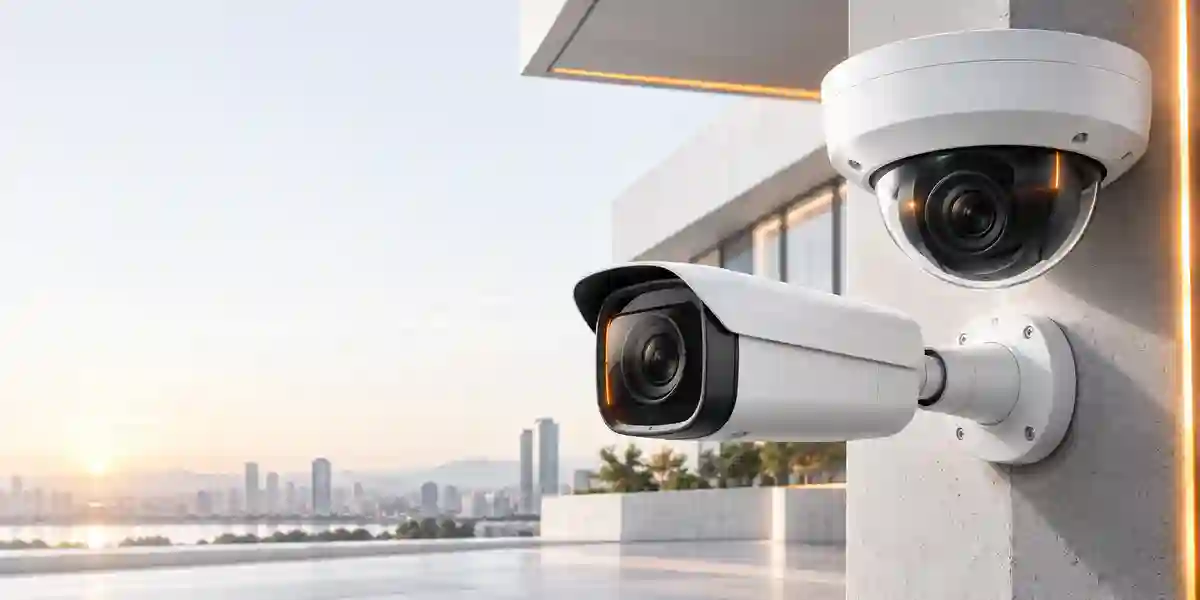
Quick product summary
2MP AI IR vandal dome network camera
2.8–12 mm, 4.3× motorized varifocal
WiseIR up to 50 m
IP66, IP67, IP6K9K, NEMA4X, IK10+
Product overview and buyer fit
The XNV-6083R sits in Hanwha Vision’s professional X Series and is intended for projects where a conventional fixed-view camera may not provide enough flexibility or where security teams want analytic-assisted monitoring. The 4.3× motorized varifocal lens lets installers refine the field of view remotely during commissioning instead of relying on a single fixed focal length. This is useful at entrances, loading areas, perimeter lanes, car parks, logistics zones, building approaches and other locations where the precise viewing angle becomes clear only after the camera is mounted.
AI processing is particularly relevant when operators need to distinguish people, faces, vehicles and licence-plate objects from less useful motion. Supported intelligent video analytics include virtual line and area rules, enter/exit, loitering, direction and intrusion events. The camera also supports events such as defocus, motion, tampering, fog, audio, sound classification, shock and appear/disappear. These capabilities can reduce the amount of irrelevant event traffic presented to a monitoring team, although final alert performance always depends on scene design, camera placement, lighting, rule configuration and the connected VMS or recorder.
For procurement teams, the key question is not simply whether XNV-6083R has a long feature list. The stronger buying process is to confirm coverage distance, mounting height, scene width, lighting, required retention period, network capacity, PoE budget, recorder or VMS compatibility, cybersecurity policy and environmental exposure before ordering. FourTeck can help organize those requirements into a practical camera and infrastructure discussion.
Key features and business benefits
2MP high-frame-rate video
The camera supports 1920×1080 video and up to 120 fps in supported H.265/H.264 modes when WDR is off. Higher frame rates can be useful where motion detail matters, but storage, bandwidth and VMS capability should be sized accordingly.
Motorized varifocal lens
A 2.8–12 mm lens gives a broad adjustment range, helping one model cover wide overview scenes or tighter identification zones. Final focal length should be chosen around the operational target rather than maximum zoom alone.
50 m WiseIR
Integrated infrared illumination supports night viewing up to 50 m under suitable conditions. Real usable distance depends on scene reflectivity, weather, angle, ambient light and the detail level required.
150 dB extremeWDR
Wide dynamic range helps with doors, lobbies, driveways and other scenes where bright and dark areas appear together. The objective is more usable detail in difficult contrast, not merely a brighter image.
AI object analytics
NPU-based detection supports person, face, vehicle categories and licence-plate objects, giving integrators more useful metadata and event logic than simple pixel-motion detection.
Rugged vandal dome design
IP66, IP67, IP6K9K, NEMA4X and IK10+ ratings make the camera suitable for exposed or high-risk locations when installed according to Hanwha Vision guidance and the project environment.
Verified technical specifications
| Specification | Hanwha XNV-6083R |
|---|---|
| Image sensor | 1/2.8-inch CMOS |
| Maximum resolution | 1920×1080 (2MP) |
| Lens | 2.8–12 mm, 4.3× motorized varifocal, F1.4 wide / F3.6 tele |
| Horizontal field of view | Approximately 120°–27° |
| Maximum frame rate | Up to 120 fps/100 fps at 60 Hz/50 Hz with WDR off; up to 60/50 fps with WDR on |
| Minimum illumination | 0.01 lux colour; 0.001 lux B/W under specified test conditions; 0 lux with IR on |
| Infrared | WiseIR, viewable length up to 50 m |
| Wide dynamic range | extremeWDR, 150 dB |
| Video compression | H.265, H.264, MJPEG |
| Network interface | Shielded RJ-45, 10/100/1000BASE-T |
| ONVIF | Profiles S, G, T and M |
| Edge storage | Two microSD/SDHC/SDXC slots; current manufacturer data lists up to 512 GB per slot for standard edge storage |
| Environmental / vandal ratings | IP66, IP67, IP6K9K, NEMA4X, IK10+ |
Compatibility, configuration and deployment guidance
The XNV-6083R is a network camera, so the complete solution normally includes Ethernet cabling, suitable PoE power or supported DC power, switching, recording, viewing and management. The camera supports common IP protocols plus ONVIF profiles S, G, T and M, SUNAPI and the Hanwha Vision Open Platform. ONVIF support improves interoperability, but integrations should still be validated against the exact recorder or VMS version, required analytics metadata and feature set. A system that can display basic video may not necessarily support every analytic event, search function or device-management feature.
Cybersecurity planning should also be part of commissioning. Manufacturer specifications include encrypted and signed firmware, secure boot, IEEE 802.1X options, HTTPS, secure RTP, access control, device certificates, TPM-based security and encrypted SD-card partition capability. In practical deployment, those functions still need to be configured as part of the customer’s network policy. Strong credentials, firmware management, VLAN segmentation, restricted management access, NTP, certificate handling and recorder hardening remain important.
For storage, decide whether the microSD slots will be used for edge recording, failover, event clips or local resilience, and whether primary recording will sit on a Hanwha recorder, third-party NVR or enterprise VMS. Retention calculations should use the selected resolution, frame rate, codec, scene activity, bitrate profile, number of cameras and number of recording days. High frame rate can be valuable, but recording every channel at the maximum setting may increase network and storage requirements significantly.
Ideal customers and use cases
- Commercial buildings: entrances, service corridors, loading areas and external approaches where mixed lighting and vandal resistance matter.
- Logistics and warehousing: vehicle approaches, dispatch bays, high-traffic gates and operational zones that benefit from person/vehicle analytics.
- Retail and mixed-use sites: perimeter and access points where teams want event filtering rather than continuous manual observation.
- Industrial sites: exposed areas requiring a robust enclosure, flexible lens adjustment and integration with a larger IP surveillance network.
- Campuses and institutions: security teams using a central VMS and needing consistent camera metadata, event rules and secure network integration.
What to confirm before ordering
- Required coverage width, distance and identification objective.
- Mounting surface, height, bracket or back-box requirements.
- Day, night, glare, headlight and backlight conditions.
- PoE switch power budget, port availability and cable distance.
- NVR/VMS make, model, version and required analytic integration.
- Recording resolution, frame rate, bitrate and retention days.
- Edge-storage capacity and recording role if microSD is required.
- Cybersecurity, VLAN, certificate and user-access requirements.
- Project quantity, delivery location and installation scope.
Comparison and related-model guidance
Choose the XNV-6083R when a 2MP vandal dome with integrated IR, motorized varifocal framing, high frame-rate capability and AI analytics suits the scene. A bullet camera can be easier to aim visibly on a perimeter, while a dome form factor can provide a more compact appearance and makes the viewing direction less obvious from a distance. Higher-resolution models may be preferable when wider scenes must preserve more pixel detail, but the correct choice depends on target distance, lens, storage and lighting rather than megapixels alone.
Within Hanwha Vision’s wider portfolio, consider related X Series dome, bullet and PTZ models when a project needs a different focal range, form factor, resolution or movement capability. FourTeck can review the project as a camera schedule instead of forcing one model into every location. That approach is especially useful when a site combines gates, corridors, car parks, reception points, perimeter lines and large open areas.
Hanwha XNV-6083R Dubai
Dubai buyers evaluating the Hanwha XNV-6083R are commonly planning surveillance for commercial towers, warehouses, logistics facilities, hospitality environments, schools, compounds, retail projects, industrial sites and mixed-use properties. These projects often have very different camera-placement conditions within the same site. An entrance may need wide dynamic range because of bright daylight beyond a shaded lobby, while a loading yard may need infrared coverage and vehicle-oriented analytics after dark. The XNV-6083R is useful where a rugged dome form factor, motorized varifocal lens and intelligent event processing fit those mixed requirements.
For Dubai installations, lens selection should be tied to the actual scene. At 2.8 mm the camera can provide a wide overview, while the 12 mm end allows a narrower field for more concentrated coverage. Mounting height, camera angle and target distance determine whether the captured subject contains enough pixels for the intended operational purpose. The camera’s 50 m WiseIR rating is helpful for night design, but reflective walls, vehicle plates, glass, dusty conditions and strong nearby lighting can change practical results. A site plan or sample view is therefore more useful than selecting purely from a brochure distance.
Dubai businesses should also confirm network and recording architecture before procurement. With support for H.265/H.264, multiple streams, ONVIF and Hanwha APIs, the camera can fit professional IP systems, but analytics and advanced metadata support should be checked against the recorder or VMS. For larger projects, switching topology, uplink bandwidth, PoE capacity, VLAN policy, UPS backup and recording retention are often just as important as the camera itself. Contact FourTeck UAE or FourTeck to discuss a Dubai camera schedule, quantity, recorder compatibility and installation requirements without relying on unverified public stock or pricing claims.
Hanwha XNV-6083R UAE
Across the UAE, surveillance projects may span offices, branches, warehouses, residential developments, education, healthcare, industrial operations and multi-emirate business locations. The XNV-6083R is suited to projects that value a consistent enterprise camera platform with AI filtering, strong low-light support, high dynamic range and rugged outdoor protection. For organisations standardising cameras across Dubai, Abu Dhabi, Sharjah, Ajman, Ras Al Khaimah, Fujairah or other locations, the buying decision should include not only individual camera specifications but also common firmware policy, VMS compatibility, user permissions, recording standards and long-term operational management.
A multi-site UAE deployment benefits from a repeatable design process. Start with scene objectives: overview, detection, observation, recognition or identification. Then match focal length and mounting position to each objective. The XNV-6083R can cover a useful range because of its 2.8–12 mm motorized lens, but a single camera model will not be optimal for every site. Large open yards may require different lenses or PTZ coverage, narrow corridors may need a different field of view, and locations requiring greater pixel density may justify a higher-resolution model. FourTeck can help organise this model-selection discussion without over-specifying cameras where a simpler device is sufficient.
UAE network teams should also evaluate camera traffic, cyber controls and power design. The XNV-6083R supports Gigabit Ethernet, secure communications, 802.1X options, certificates and other security functions, but implementation needs to align with the customer’s switch configuration and security policy. Recording retention should be calculated from the actual channel profile rather than assumed from camera count. Organisations planning regional standardisation can use FourTeck UAE technology support and FourTeck regional solutions to discuss procurement, deployment planning and compatibility for the required sites.
Hanwha XNV-6083R Kenya
Kenya customers considering the Hanwha XNV-6083R may be planning surveillance for offices, retail, logistics, warehouses, education, hospitality, manufacturing, compounds and institutional projects. A practical camera choice depends on more than brand preference. Buyers should identify which locations require wide scene coverage, which need a tighter view, whether night monitoring is critical and whether the recorder can make use of AI metadata. The XNV-6083R’s motorized 2.8–12 mm lens provides flexibility for commissioning, while integrated WiseIR and a rugged enclosure make it relevant to protected outdoor and semi-exposed positions.
For Kenyan projects, network infrastructure deserves particular attention when cameras are distributed across large sites. PoE switch placement, fibre uplinks between buildings, UPS runtime, surge protection, cabinet environment and remote management can materially affect system reliability. A technically capable camera cannot compensate for overloaded uplinks or unstable power. Where WAN connectivity is limited, local recording on an NVR or VMS should be designed so security operations do not depend entirely on internet connectivity. Edge storage can add resilience for selected scenarios, but it should be treated as part of a recording strategy rather than assumed to replace central storage.
Buyers should also specify how long footage must be retained and whether higher frame rates are required at every camera. The XNV-6083R can reach high frame rates, but many scenes do not need the maximum setting continuously. A balanced design can reduce storage and bandwidth while retaining useful event detail. For Kenya procurement, contact FourTeck Kenya with the camera count, site type, city, recorder platform, retention requirement and installation scope. That information allows the inquiry to be reviewed around actual project requirements instead of an unverified one-size-fits-all price or availability claim.
Hanwha XNV-6083R Kuwait
Kuwait surveillance projects often combine harsh outdoor exposure with demanding indoor monitoring needs. When the Hanwha XNV-6083R is considered for commercial, industrial, logistics, education, retail or compound security, buyers should assess heat exposure, dust, mounting location, night lighting, camera orientation and cable routing. The camera’s environmental ratings and hard-coated vandal dome support challenging deployments, but correct installation practices remain essential. Junction boxes, cable glands, weather sealing and mounting hardware must match the site conditions rather than being treated as generic accessories.
The camera’s 150 dB extremeWDR can be valuable at bright entrances, vehicle access points and shaded areas facing sunlit exteriors. Its AI-assisted detection can help classify people and vehicles and support rule-based events such as intrusion, loitering and directional movement. For real security outcomes, analytic zones should be configured after installation using the actual scene, not copied from another camera. Camera height, angle, object size and background movement influence detection quality, and any alarm workflow should be tested with the monitoring team before handover.
Kuwait buyers integrating the XNV-6083R with an existing recorder should provide the recorder model and software version before purchase. ONVIF helps interoperability, yet third-party platforms may expose only a subset of camera analytics or configuration functions. Storage planning should also account for selected codec, frame rate and retention policy. Organisations can contact FourTeck Kuwait to discuss model suitability, quantities, NVR/VMS compatibility, network design and project-specific accessories. Commercial terms, stock status, delivery and warranty route should be confirmed for the exact quotation rather than assumed from a generic regional page.
Hanwha XNV-6083R Ghana
For Ghana projects, the Hanwha XNV-6083R is relevant where organisations need a professional network dome camera for offices, campuses, warehouses, financial facilities, retail environments, industrial operations, gated sites and other monitored properties. The combination of 2MP video, a 2.8–12 mm motorized varifocal lens, integrated IR and AI analytics gives designers flexibility to use the camera for both broad monitoring and more focused views. The correct focal length should still be selected against the target area, and installers should validate the view after final mounting because small changes in height and angle can materially alter usable detail.
Ghana buyers should plan the camera as part of a complete system that includes PoE switching, uplinks, recording, backup power, secure remote access and maintenance. Sites with multiple buildings may require fibre between distribution points rather than long copper runs. Where utility interruptions are a concern, UPS capacity should be sized for cameras, switches and recorders together. Remote viewing can be useful for managers and security teams, but it should be implemented through approved secure methods and should not become the only way footage is accessed.
AI events can reduce operator workload when they are tuned to the location, especially at vehicle gates, perimeter approaches and restricted areas. However, buyers should define what action follows an alert: live verification, guard dispatch, bookmark, email, VMS event or another workflow. This turns analytics from a marketing feature into an operational control. Contact FourTeck Ghana with your location, quantity, intended coverage, recorder platform and retention requirement. FourTeck can then discuss camera suitability and related infrastructure while current availability, delivery, commercial terms and warranty coverage are confirmed separately for the exact project.
Hanwha XNV-6083R Uganda
Uganda organisations evaluating the XNV-6083R may be securing offices, warehouses, schools, hospitality properties, retail locations, compounds, industrial facilities or distributed business sites. The camera’s vandal-resistant dome construction, environmental protection and integrated IR make it suitable for many exposed positions, while its motorized varifocal lens helps integrators adjust framing during commissioning. For a gate or driveway, a narrower view may provide more useful subject detail; for a forecourt or building approach, a wider view may be appropriate. The design should be based on the security objective for each camera rather than identical settings across a site.
Network planning is especially important on sites where cameras are spread across long distances. A central switch is not always the best topology; local PoE switches with fibre uplinks may be more practical for separate blocks or perimeter locations. Power protection, grounding, cabinet design and cable quality should be reviewed with the camera schedule. Where the customer needs footage during WAN interruptions, local recorder architecture and edge recording options should be considered. Hanwha’s support for H.265 can reduce bitrate compared with less efficient encoding, but actual storage consumption still depends on configured bitrate and scene activity.
For Uganda procurement, it is useful to provide an approximate site plan, target retention period and existing VMS/NVR details. That information helps determine whether XNV-6083R is the right fit at every position or whether a mix of dome, bullet, PTZ or higher-resolution cameras would be more cost-effective. Contact FourTeck Uganda for product and project assistance. Stock, lead time, warranty route and installation scope should be confirmed at quotation stage because these factors can vary by quantity, sourcing route and final configuration.
Hanwha XNV-6083R Nigeria
Nigeria buyers looking at the Hanwha XNV-6083R are often balancing image performance, ruggedness, analytics, network design and long-term system manageability. The model is suitable for professional IP surveillance where a 2MP vandal dome, 50 m IR capability, motorized lens and AI object classification match the scene. Potential applications include corporate campuses, logistics centres, retail estates, industrial sites, warehouses, residential compounds, education and other locations that require monitored entrances, perimeter points or operational zones.
Reliable power and network architecture should be addressed early in the project. Cameras, PoE switches, fibre devices, routers and recorders all need power continuity if footage is expected during outages. The design may require UPS capacity and, for critical systems, additional backup strategy. Large premises should also be divided into logical network segments so camera traffic does not overload unrelated business systems. VLANs, controlled management access, strong credentials, firmware governance and secure remote access help make the surveillance platform easier to manage over time.
AI capabilities should be mapped to a clear operational requirement. Person and vehicle detection can support event filtering; line crossing and intrusion rules can help at restricted zones; loitering logic may be useful around selected areas. These are not automatic guarantees of perfect detection, so configuration and testing are part of deployment. Before ordering, share the required quantities, location, recorder/VMS, coverage distances, retention days and whether installation is required. FourTeck Nigeria can use these details to guide the product discussion. Commercial availability, shipping, warranty and project schedule should be confirmed for the exact quotation rather than inferred from information for another country.
Hanwha XNV-6083R Seychelles
Seychelles surveillance planning often involves hospitality, commercial property, retail, office, infrastructure and institutional environments where outdoor exposure can be an important part of camera selection. The Hanwha XNV-6083R combines a protected vandal dome housing with IP66/IP67/IP6K9K and NEMA4X environmental ratings, making it relevant to exposed locations when installation is carried out correctly. Coastal and humid conditions still require attention to mounting, connectors, cable entries, junction hardware and routine inspection, because the whole installation must be protected rather than the camera body alone.
The 2.8–12 mm motorized lens can be helpful when installers need one model to cover different scene widths across a property. A hotel may use wider views for service approaches and narrower framing at selected access points, while a commercial site may prioritize vehicle approaches or perimeter transitions. Integrated 50 m WiseIR supports night monitoring, but on reflective surfaces or close walls the IR scene should be tested and adjusted. The camera’s WDR capability can also help where strong daylight and shaded areas are visible together.
For island deployments, procurement should include spare strategy, recorder capacity, UPS design and remote support access alongside the cameras. If the system will be maintained by a local team, documentation of IP addressing, camera names, switch ports and credentials becomes important for future service. Where a VMS or third-party NVR is already installed, confirm compatibility before ordering. Seychelles buyers can contact FourTeck Africa with the project location, camera count, recorder platform and installation requirements. Current supply route, delivery timing, warranty handling and commercial terms should be confirmed specifically for the project rather than assumed from UAE or other African market conditions.
Related Hanwha Vision and FourTeck product guidance
FourTeck’s currently indexed website content does not expose seven verifiable Hanwha model-specific product URLs that can safely be linked without guessing. Instead of inventing product-page addresses, use the camera categories and project guidance below while the exact related model links are confirmed in the catalogue.
Best for projects that need professional network video, analytics and dome-format installation. Compare resolution, lens, IR distance and environmental rating.
Useful for perimeter and directional coverage where visible aiming and a bullet form factor better suit the mounting position.
Consider where operators need pan, tilt and optical zoom across large open areas rather than a fixed field of view.
Select recorder capacity and software around camera count, bitrate, analytics support, retention and user requirements.
Regional FourTeck resources
Use the regional site that matches your project so the inquiry can include the correct country, delivery location and deployment context.
Why contact FourTeck
Camera selection often fails when it is treated as a standalone hardware purchase. FourTeck can help buyers organise the surrounding requirements: camera quantities, scene objectives, lens choice, PoE switching, uplinks, NVR or VMS compatibility, retention, edge storage, mounting accessories, secure network design and installation scope. This does not replace manufacturer design rules or local compliance requirements; it helps procurement teams ask the right questions before a quotation is finalised.
For an accurate commercial discussion, provide the country, delivery city, quantity, required installation date, existing recorder or VMS, recording days and whether the requirement is supply-only or includes deployment. Current price, stock, lead time and warranty route should then be confirmed against the exact requested configuration.
Hanwha XNV-6083R FAQs
What resolution does the XNV-6083R support?
The Hanwha XNV-6083R is a 2MP camera with a maximum 1920×1080 resolution. It is designed for professional network surveillance where Full HD video, high frame rates, AI event processing and robust outdoor protection are more important than simply choosing the highest megapixel count.
How far can the infrared illumination reach?
Hanwha Vision specifies WiseIR viewing up to 50 m. Real night performance varies with the scene, target reflectivity, weather, mounting angle, nearby walls and ambient light. A project should therefore treat 50 m as a manufacturer specification, not a guarantee that every target at that distance will provide identification-grade detail.
Does the camera support AI analytics?
Yes. The XNV-6083R uses an NPU-based AI engine for object detection including person, face and vehicle classes, plus licence-plate objects. It also supports intelligent rules such as virtual line and area, enter/exit, loitering, direction and intrusion. Exact integration with recorder or VMS workflows should be checked before purchase.
Can I use the XNV-6083R outdoors in Dubai?
The camera carries IP66, IP67, IP6K9K, NEMA4X and IK10+ ratings, making it suitable for demanding outdoor applications when installed according to manufacturer guidance. Outdoor reliability also depends on appropriate mounting hardware, sealed cable entries, correct power/network design and maintenance for the actual site environment.
What lens does the XNV-6083R have?
It has a 2.8–12 mm 4.3× motorized varifocal lens. This lets installers adjust from a wide horizontal field of view of about 120° toward a narrower view of about 27°. The appropriate setting depends on required subject detail and the distance from camera to target.
Does it work with third-party NVR or VMS platforms?
The camera supports ONVIF profiles S, G, T and M as well as standard network protocols, which can aid third-party integration. However, advanced features such as analytics metadata, event search or configuration may vary by platform and version. Confirm compatibility with the exact NVR/VMS before ordering.
Does the XNV-6083R support edge storage?
Yes. Current manufacturer information lists two microSD/SDHC/SDXC slots, with standard edge storage support up to 512 GB per slot. Edge storage can be used as part of a resilient recording strategy, but capacity and supported functions should be checked against firmware and the intended recording workflow.
What is the benefit of 150 dB extremeWDR?
Wide dynamic range helps preserve useful detail when bright and dark areas appear together, such as a shaded entrance looking toward daylight or a vehicle access point with strong headlights. It is valuable for difficult contrast, although scene setup, lens angle and exposure configuration still affect the final image.
Can the camera run at 120 fps?
Yes, manufacturer specifications list up to 120 fps at 60 Hz in supported H.265/H.264 modes with WDR off, while the maximum is lower when WDR is enabled. Before using very high frame rates, confirm recorder support, network bandwidth and storage capacity because these settings can increase resource requirements.
What information should I send FourTeck for a quote?
Send the country and city, required quantity, site type, target coverage areas, existing NVR or VMS model, desired recording days, whether microSD is required and whether the scope includes installation. These details help FourTeck discuss the correct configuration and confirm current commercial terms for the project.
Need help specifying the Hanwha XNV-6083R?
Share your camera quantity, site layout, recorder platform, retention requirement and installation scope. FourTeck can help you review whether the XNV-6083R fits each camera position and what related network, storage and mounting components should be included in the quotation.
Reviews
There are no reviews yet.