

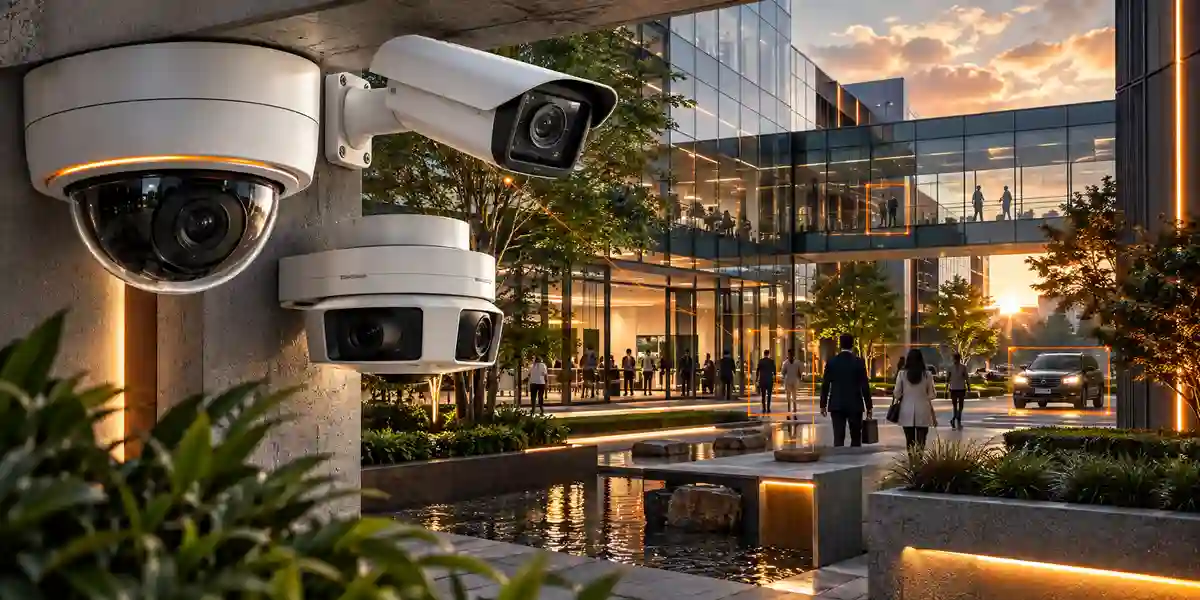
Quick product summary
The XNV-6083RZ sits in Hanwha Vision’s X Series and is specified as a 2MP AI IR vandal dome camera. It uses a 1/2.8-inch CMOS image sensor and supports 1920×1080 video, with H.265/H.264 frame rates reaching 120fps at 60Hz or 100fps at 50Hz when WDR is disabled. When WDR is enabled, maximum H.265/H.264 frame rates are 60fps/50fps. The camera’s motorized 2.8–12mm varifocal lens provides approximately 120° to 27° horizontal field of view, helping designers cover a broad scene or tighten the view toward a doorway, gate, transaction area or monitored lane.
Up to 120fps can be valuable where subject motion is significant and the recording design calls for higher temporal detail.
The 4.3× motorized varifocal lens gives installers flexibility during commissioning without relying on a fixed field of view.
Day/night operation, IR illumination and 150dB extremeWDR help maintain useful images across mixed lighting.
IP66, IP67, IP6K9K, NEMA4X and IK10+ ratings support demanding exposed and vandal-risk locations.
Overview and buyer-fit guidance
A surveillance camera should be selected around the scene, operational risk and recording objective rather than resolution alone. The Hanwha XNV-6083RZ is particularly relevant when a project calls for Full HD detail combined with a high maximum frame rate, intelligent filtering of people and vehicles, remotely adjustable optical framing and a vandal-resistant outdoor form factor. In a Dubai project, those requirements can arise around commercial entrances, vehicle access points, loading areas, building exteriors, covered parking, compounds, industrial facilities, education campuses, hospitality service zones and transport-related spaces.
The camera’s AI engine can classify objects including people, faces, vehicles and license plates and can support intelligent video analytics such as virtual line, area, enter/exit, loitering, direction and intrusion events. These capabilities can reduce the burden of reviewing undifferentiated motion events when the system is configured appropriately. Buyers should still treat analytics as one component of the overall design: mounting height, scene angle, lighting, subject size, lens position, network bandwidth, retention period, recording platform and event rules can materially affect results.
The XNV-6083RZ also supports WiseNR II and WiseStream III, technologies designed around Hanwha’s AI processing to improve image and bandwidth efficiency. For projects with many cameras, this can be useful because network and storage planning are recurring cost and performance considerations. Before ordering, FourTeck recommends confirming required frame rate, WDR mode, camera count, intended field of view, IR expectations, recording retention, VMS/NVR compatibility, network topology, PoE capacity and mounting accessories.
Key features and business benefits
2MP at high frame rates
Full HD resolution with up to 120fps provides a strong fit for monitoring motion-heavy scenes where smoother temporal capture can be more valuable than simply increasing pixel count.
2.8–12mm motorized varifocal
The 4.3× optical range lets the installer move from a wide overview to a narrower view during setup, helping the same model fit multiple scene geometries.
AI object classification
Person, face, vehicle and license-plate object detection can help create more meaningful event rules than basic pixel-motion detection alone.
Extreme WDR
150dB extremeWDR is designed for high-contrast scenes such as entrances, glazed lobbies, loading bays and locations with bright exterior light behind subjects.
Infrared night monitoring
Integrated IR supports scenes with low or no visible illumination, with published viewable distances dependent on scene conditions.
Rugged enclosure
Weather, wash-down and impact ratings make the camera appropriate for many exposed, dusty, wet or vandal-risk locations when installed to specification.
Verified technical specifications
| Specification | Hanwha XNV-6083RZ |
|---|---|
| Camera type | 2MP AI IR vandal dome network camera |
| Imaging device | 1/2.8-inch CMOS |
| Maximum resolution | 1920 × 1080 |
| Maximum H.265/H.264 frame rate | 120fps/100fps (60Hz/50Hz) with WDR off; 60fps/50fps with WDR on |
| Lens | 2.8–12mm, 4.3× motorized varifocal |
| Horizontal field of view | Approx. 120° wide to 27° tele |
| Minimum illumination | Color 0.01 lux at F1.4, 1/30 sec, 30IRE; B/W 0.001 lux; 0 lux with IR LED on |
| WDR | ExtremeWDR, 150dB |
| IR viewable length | Published at 15m / 30m depending on scene conditions |
| AI analytics | Object detection and IVA including virtual line/area, enter/exit, loitering, direction and intrusion |
| Environmental protection | IP66, IP67, IP6K9K, NEMA4X |
| Impact resistance | IK10+ |
Design and specifications can change by manufacturer revision or regional configuration. Confirm the final project specification before procurement.
Compatibility, configuration and deployment guidance
The XNV-6083RZ should be treated as part of a complete IP video system. Buyers need to confirm how the camera will be powered, recorded, monitored and managed. PoE-capable switching can simplify cabling where network design and distance permit, while recorder or VMS selection should be checked against the required streams, codecs, AI metadata and event integration. ONVIF interoperability can support mixed-platform environments, but specific features may depend on the profile and implementation supported by the recording platform. For critical integrations, confirm the exact software version and supported functions rather than assuming every analytic feature will pass through a third-party VMS.
Lens setup also deserves attention. At the wide end, the camera can cover a broad area; at the tele end, it can concentrate available pixels over a narrower field. Neither setting is automatically better. A parking entrance may require a tighter view of a lane, while a lobby or service corridor may require more scene context. Mounting height and angle should be chosen with the intended analytic target in mind. Very steep top-down views, excessive backlight, reflective surfaces, uncontrolled vegetation and subjects that are too small in the frame can reduce analytic usefulness.
For night scenes, published IR distance should not be read as a guarantee of identification quality at the maximum distance. Surface reflectivity, ambient light, scene geometry, lens position, rain, dust and target clothing can affect results. Project design should distinguish between detection, observation, recognition and identification requirements and validate important scenes after installation.
Ideal customers and use cases
- Commercial buildings that need rugged entrance, perimeter and service-area monitoring.
- Warehouses and logistics sites where loading bays, gates and movement corridors require reliable video.
- Education campuses that need vandal-resistant cameras for exterior circulation and controlled entry points.
- Hospitality properties that require discreet dome-format coverage in external or semi-exposed operational zones.
- Industrial facilities that need cameras capable of handling demanding environmental exposure.
- Parking and vehicle-access applications where AI vehicle classification, WDR and adjustable framing are useful.
- Government and enterprise projects requiring professional network-camera functions, analytics and security hardening.
What to confirm before ordering
- Required coverage width, subject distance and identification objective.
- Whether 2MP resolution and the 2.8–12mm lens range match the scene.
- Required recording frame rate and whether WDR will be enabled.
- Expected night conditions and whether built-in IR is sufficient.
- Recorder or VMS compatibility, including AI event and metadata requirements.
- PoE budget, switch uplinks, VLAN design and network bandwidth.
- Storage retention period, stream settings and redundancy expectations.
- Mounting surface, junction box, pendant/wall accessories and cable entry requirements.
- Environmental exposure, cleaning regime and vandal risk.
- Cybersecurity policy, firmware management and credential-management process.
Related-model guidance
The XNV-6083RZ is not the only Hanwha X Series vandal dome option. Projects needing higher pixel resolution can consider other XNV models in the same broader family, while buyers who do not require integrated IR may assess non-IR variants. The right alternative depends on scene width, target distance, low-light design, frame-rate requirements and recorder capacity. A higher-resolution camera can provide additional spatial detail, but it can also increase bandwidth and storage demand, and it does not automatically solve lighting or positioning problems. For this reason, FourTeck recommends selecting the camera after reviewing the full scene objective rather than choosing solely by megapixel count.
For broader Hanwha planning, explore FourTeck resources for network and surveillance solutions, UAE technology procurement and regional support portals listed below. Where a project includes multiple camera types, the design can combine vandal domes, bullets, PTZ cameras and specialist models according to each location’s field-of-view and mounting needs.
Hanwha XNV-6083RZ Dubai
Dubai surveillance projects often combine high-contrast lighting, intense exterior brightness, shaded entrances, reflective glazing and round-the-clock operational activity. The Hanwha XNV-6083RZ is a practical option when a project needs a vandal-resistant dome camera that can handle those transitions while providing a remotely adjustable field of view. The 150dB extremeWDR capability is particularly relevant around building entrances, reception approaches, parking access, service yards and loading areas where subjects may move between sunlight and shade. Its 2.8–12mm motorized varifocal lens gives integrators flexibility to commission the view for a specific doorway, gate lane, façade approach or circulation zone rather than relying on one fixed angle.
Dubai buyers frequently need more than a camera model number; they need to know how the device fits into an existing NVR or VMS, how much bandwidth and storage it may consume, how PoE will be delivered, whether analytics can be used by the recording platform and what accessories are needed for the mounting surface. These decisions should be checked before procurement. For motion-heavy locations such as vehicle entrances or logistics operations, the XNV-6083RZ’s high maximum frame rate can be attractive, but enabling WDR changes the maximum frame-rate ceiling, so the final stream profile should be matched to the operational goal.
Outdoor Dubai installations also require attention to heat, dust, cleaning, cable sealing and physical impact. The camera carries IP66, IP67, IP6K9K, NEMA4X and IK10+ ratings, but those ratings do not replace correct installation practices. Cable entries, junction hardware, mounting surfaces and connector protection must be executed properly. FourTeck can help buyers review camera quantity, view objectives, NVR/VMS compatibility, switching, PoE budget and accessory requirements before a quote is prepared. For UAE project assistance, visit FourTeck UAE or use the sales contact route for configuration guidance.
Hanwha XNV-6083RZ UAE
Across the UAE, surveillance deployments can range from single-site commercial systems to multi-emirate estates with centralized monitoring. The Hanwha XNV-6083RZ fits projects that want a common 2MP AI vandal-dome platform for entrances, external walkways, parking zones, operational yards and other areas where weather protection and impact resistance are important. Standardizing on a defined camera family can simplify spares, documentation and commissioning, but the lens and scene requirements should still be reviewed camera by camera. A wide entrance view and a narrow vehicle-lane view may use the same model at different lens positions, while another location may justify a higher-resolution or PTZ model instead.
For UAE procurement, buyers should ask for a bill of materials that includes more than camera quantity. The camera’s PoE requirement must be supported by the switch budget; uplinks must carry aggregate stream traffic; storage must be sized around codec, frame rate, bitrate and retention; and the NVR or VMS should support the intended integration. AI object classification can improve event filtering, but analytics should be tested against actual scene geometry. For example, a vehicle route with predictable direction and subject size is usually easier to configure than an open plaza with overlapping pedestrian movement.
Regional environmental conditions also make preventive maintenance relevant. Dust accumulation can degrade image quality and IR performance, while direct sun, shade transitions and reflective surfaces can influence exposure. The hard-coated dome bubble, environmental ratings and WDR capabilities provide a strong technical foundation, but commissioning and cleaning remain part of lifecycle management. Organizations purchasing for Abu Dhabi, Sharjah, Ajman, Ras Al Khaimah, Fujairah or Umm Al Quwain should also confirm project-specific compliance, installation standards and site access requirements. FourTeck can assist with configuration review and procurement through FourTeck UAE solutions and FourTeck international project support.
Hanwha XNV-6083RZ Kenya
For Kenya deployments, buyers often need surveillance systems that can serve commercial compounds, offices, education sites, warehouses, hospitality properties, residential estates and transport-related facilities while remaining manageable over the life of the installation. The Hanwha XNV-6083RZ provides a robust outdoor dome option with 2MP resolution, AI-based object detection, built-in IR, 150dB WDR and an adjustable 2.8–12mm lens. That combination is useful where the same camera platform may be used at several different site locations but each view requires a different focal length.
In Nairobi and other urban areas, entrance and perimeter scenes may involve bright daylight, deep shade and vehicle movement. WDR and high-frame-rate capability can help, although the configuration must balance frame rate, WDR and storage. At warehouses and compounds, a narrower focal setting can concentrate detail on a gate or loading zone, while the wide end can provide broader context. Built-in analytics can be configured for intrusion areas, virtual lines, loitering and directional movement, but buyers should define exactly which alerts matter operationally. Too many poorly tuned alerts can reduce confidence in the system.
Kenya projects should also assess network resilience and recording architecture. Where cameras are distributed across larger compounds, switch placement, fiber uplinks, surge protection, grounding and backup power can be as important as the camera itself. If video retention is required for extended periods, storage sizing should reflect real stream settings rather than a generic estimate. The camera’s rugged environmental and impact ratings are helpful for exposed mounting positions, but correct weatherproof installation and maintenance remain essential. FourTeck can assist with bill-of-material review, NVR/VMS compatibility, network planning and camera selection. For regional procurement enquiries, use FourTeck Kenya, and for wider African project coordination see FourTeck Africa.
Hanwha XNV-6083RZ Kuwait
Kuwait surveillance projects commonly need cameras for commercial properties, compounds, logistics locations, hospitality, education, government environments and external building zones where dust, heat, bright sunlight and physical exposure must be considered. The Hanwha XNV-6083RZ brings together a hardened vandal-dome enclosure, 2MP imaging, integrated IR and a motorized 2.8–12mm lens. This makes it useful for locations where installers need to fine-tune the scene after mounting rather than commit to a fixed focal length.
A key design question in Kuwait is often how the camera will handle strong contrast. Doorways, shaded canopies, covered parking exits and service entrances can have bright backgrounds that challenge conventional exposure. The XNV-6083RZ’s 150dB extremeWDR is designed for those conditions. At night, integrated IR can support low-light monitoring, but the effective image depends on the scene, reflectivity and lens setting. Buyers should therefore validate critical views during commissioning and should not treat the published maximum IR distance as an automatic identification distance.
Procurement should include the supporting infrastructure. The camera may be one line item, but switching, PoE capacity, NVR or VMS channels, storage, uplink bandwidth, mounting accessories and protective installation practices determine whether the system performs as intended. For sites with high vehicle movement, buyers may value the high maximum frame rate, while other areas may prioritize WDR and retention efficiency. AI object classification and event rules can help operators focus on people and vehicles instead of general motion, especially when rules are tied to specific operational concerns. FourTeck can support specification review and quotation planning for Kuwait. Visit FourTeck Kuwait for regional enquiries and use FourTeck sales assistance for configuration questions.
Hanwha XNV-6083RZ Ghana
In Ghana, surveillance requirements can vary widely between offices, retail environments, education campuses, hospitality properties, warehouses, industrial sites and gated compounds. The Hanwha XNV-6083RZ is best evaluated where a project needs a professional outdoor dome camera with adjustable optics and intelligent event processing. Its 2.8–12mm motorized varifocal lens allows the commissioning team to choose between a wide contextual view and a narrower target-focused view, while the 2MP sensor and high maximum frame rate can suit locations where movement is important to capture clearly.
Accra and other busy commercial areas can present mixed lighting, including bright outdoor approaches and shaded interior thresholds. The camera’s 150dB extremeWDR helps manage those differences, and built-in IR supports low-light scenes after dark. AI-based detection of people, faces, vehicles and license plates can improve event filtering when compared with basic motion-only alerts. For a warehouse gate, for example, an installer can define a line or area event based on an operational need; for a building perimeter, intrusion or loitering rules may be more appropriate. The analytics should always be tuned to the camera angle and expected subject size.
Ghana deployments should also consider network quality, backup power and storage architecture. Recording design should be based on actual retention requirements and stream settings. Where several cameras share a switch or uplink, bandwidth and PoE capacity need to be calculated with headroom. Exterior installations should use appropriate mounting hardware and cable protection, even though the XNV-6083RZ has strong environmental and impact ratings. FourTeck can help customers review the required camera count, scene goals, recorder compatibility and bill of materials before quotation. For local enquiries, visit FourTeck Ghana, with additional African project resources available through FourTeck Africa.
Hanwha XNV-6083RZ Uganda
Uganda buyers evaluating the Hanwha XNV-6083RZ are typically better served by starting with the required scene outcome rather than the camera specification sheet alone. A camera overlooking an office entrance, a warehouse gate, a campus walkway or a parking access point can have very different needs for field of view, subject detail and event detection. The XNV-6083RZ’s 2.8–12mm motorized varifocal lens is valuable because it gives installers optical flexibility at commissioning, while its 2MP image, integrated IR and AI analytics provide a versatile base for many professional surveillance locations.
Kampala sites may experience strong daylight, shaded building approaches and changing weather. The camera’s 150dB WDR can help around high-contrast entrances, and its IP66/IP67/IP6K9K and NEMA4X enclosure ratings support exposed locations when the unit is installed correctly. IK10+ impact resistance is relevant where the camera could be within reach or exposed to deliberate damage. For low-light operation, IR can illuminate the scene, although usable detail at distance depends on optics, reflectivity, ambient light and target size. Commissioning should include real night testing where the scene is security-critical.
For multi-camera Ugandan projects, infrastructure planning is essential. PoE switches need sufficient power budget, uplinks should support aggregate traffic, and the recorder needs enough channels and storage for the intended retention period. Where power reliability is a concern, backup power for cameras, switches and recording equipment should be designed as one system. AI events can reduce unnecessary operator attention when configured thoughtfully, but event rules should match a real response process. FourTeck can assist with camera selection, recorder compatibility and network planning. Visit FourTeck Uganda for regional project enquiries or FourTeck Africa for broader coordination.
Hanwha XNV-6083RZ Nigeria
Nigeria surveillance projects often span demanding environments: corporate offices, banking and commercial premises, residential estates, logistics hubs, manufacturing sites, schools, hospitality properties and large compounds. The Hanwha XNV-6083RZ is designed for professional IP video deployments where a rugged dome form factor, adjustable lens, AI analytics and strong handling of mixed lighting are priorities. Its motorized 2.8–12mm lens allows the same camera model to serve both wider overview views and tighter target areas, which can simplify standardization while retaining scene flexibility.
In Lagos, Abuja, Port Harcourt and other urban environments, high contrast between bright exteriors and shaded interiors is common. The camera’s 150dB extremeWDR is intended to help preserve information in such scenes. Integrated IR provides additional night capability, while high maximum frame rates can support motion-intensive areas such as vehicle gates and loading zones. The final settings should reflect the actual operational priority, because higher frame rates can increase bandwidth and storage requirements. Similarly, AI object detection is most useful when rules are built around meaningful events such as intrusion, line crossing or loitering rather than enabling every possible alert.
Network and power architecture deserves special attention in Nigerian projects. Cameras, PoE switches, recorders and monitoring workstations should be supported by an appropriate power strategy if continuity is required. Large sites may need fiber backbones or distributed switching, and remote locations may require careful bandwidth planning. Storage calculations should use expected bitrate, recording schedule, camera count and retention days rather than broad assumptions. The XNV-6083RZ’s environmental and impact ratings help in difficult mounting locations, but enclosure ratings still depend on correct installation and cable sealing. For procurement and configuration support, visit FourTeck Nigeria or contact FourTeck for multi-site project planning.
Hanwha XNV-6083RZ Seychelles
Seychelles surveillance projects can place particular importance on outdoor resilience, corrosion awareness, reliable night monitoring and careful network design, especially for hospitality properties, resorts, commercial facilities, warehouses and infrastructure sites. The Hanwha XNV-6083RZ offers a strong technical fit for many exposed applications because it combines a vandal-resistant dome design with IP66, IP67, IP6K9K, NEMA4X and IK10+ ratings. NEMA4X is especially relevant to buyers assessing environmental robustness, although actual suitability for a coastal site must still account for mounting hardware, connectors, cleaning practices and the complete installation environment.
The 2.8–12mm motorized varifocal lens can help island and resort projects where camera positions are constrained by architecture. An installer can start with a broad 120° horizontal view and narrow the scene when more target concentration is needed. Integrated IR supports low-light operation, while 150dB extremeWDR can help with bright tropical daylight and shaded entrances. AI object detection and IVA rules can assist teams in monitoring restricted zones, service areas, access routes and perimeters, but analytics should be validated on-site because vegetation movement, reflections, rain and unusual scene geometry can affect event performance.
Connectivity planning is also important in Seychelles, particularly where sites span multiple buildings or where remote monitoring depends on WAN links. Local recording should be sized around the number of cameras and retention objective, while remote viewing bandwidth should be calculated separately. PoE switching can simplify edge cabling, but switch power budget, environmental placement and backup power need consideration. FourTeck can help customers map camera roles, recorder requirements and infrastructure components before a quotation is finalized. For Seychelles and Indian Ocean project enquiries, use FourTeck Africa, with wider technical procurement support available through FourTeck international solutions.
Regional FourTeck resources
Why contact FourTeck
FourTeck can help convert a camera requirement into a more complete procurement discussion. That can include checking whether the XNV-6083RZ’s lens range suits the scene, identifying the expected camera quantity, reviewing PoE switching, considering NVR or VMS compatibility, estimating storage inputs and discussing mounting or accessory requirements. This does not replace a formal site survey or engineering design where one is required, but it can reduce avoidable mismatches between the selected camera and the rest of the system.
Frequently asked questions
What is the Hanwha XNV-6083RZ?
The XNV-6083RZ is a Hanwha Vision 2MP AI IR vandal dome network camera. It combines Full HD imaging, up to 120fps recording, a motorized 2.8–12mm varifocal lens, built-in infrared illumination, 150dB extremeWDR, AI object classification and rugged environmental and impact protection.
Does the XNV-6083RZ support 120fps?
Yes. Hanwha specifies up to 120fps at 60Hz or 100fps at 50Hz for H.265/H.264 when WDR is off. With WDR enabled, the published maximum is 60fps/50fps. The configured frame rate should be chosen with storage, bandwidth and the scene objective in mind.
What lens does the camera use?
It uses a 2.8–12mm motorized varifocal lens with approximately 4.3× optical zoom. The horizontal field of view runs from about 120° at the wide end to 27° at the tele end, allowing the view to be adjusted during commissioning.
Can the XNV-6083RZ be installed outdoors?
The camera carries IP66, IP67, IP6K9K and NEMA4X environmental ratings plus IK10+ impact resistance, making it designed for demanding outdoor and vandal-risk conditions. Correct mounting, cable entry, connector protection and maintenance are still necessary to preserve system reliability.
How far does the infrared illumination reach?
Hanwha publishes IR viewable lengths of 15m and 30m depending on scene conditions. Actual usable detail depends on the lens setting, target size, reflectivity, ambient light and weather. Critical scenes should be validated at night after final positioning and focusing.
What AI analytics does it support?
The camera can detect people, faces, multiple vehicle classes and license plates and supports intelligent video analytics including virtual line/area, enter/exit, loitering, direction and intrusion. It also includes other events such as motion, tampering, defocus, fog, audio and shock detection.
Is it suitable for entrances with strong backlight?
Yes, that is one of the scenarios where its 150dB extremeWDR can be useful. Entrances with bright outdoor backgrounds, glazed façades or covered parking exits can produce large exposure differences. Final performance still depends on camera angle, lens position and commissioning.
Can I use it with a third-party NVR or VMS?
The XNV-6083RZ is an IP camera and supports industry interoperability standards, but buyers should verify the exact recorder or VMS version and the features they need. Basic video may be widely supported while advanced analytics, metadata or event functions can vary by platform.
What should be included in a quotation?
A useful quote should consider camera quantity, mounting accessories, PoE switching, network uplinks, NVR/VMS licensing or channels, storage, power backup and any installation-specific hardware. The exact bill of materials depends on the site and selected architecture.
How do I request Hanwha XNV-6083RZ pricing in Dubai?
Contact FourTeck with the camera quantity, project location, required recorder or VMS, retention period and any known mounting requirements. Because project pricing, configuration and availability can change, a current quotation is preferable to relying on a fixed web price.
Discuss your Hanwha XNV-6083RZ requirement
Share your camera quantity, project location, coverage objective, recording platform and retention requirement. FourTeck can help review the configuration and prepare a project quotation without making assumptions about stock, price or compatibility.
Reviews
There are no reviews yet.