

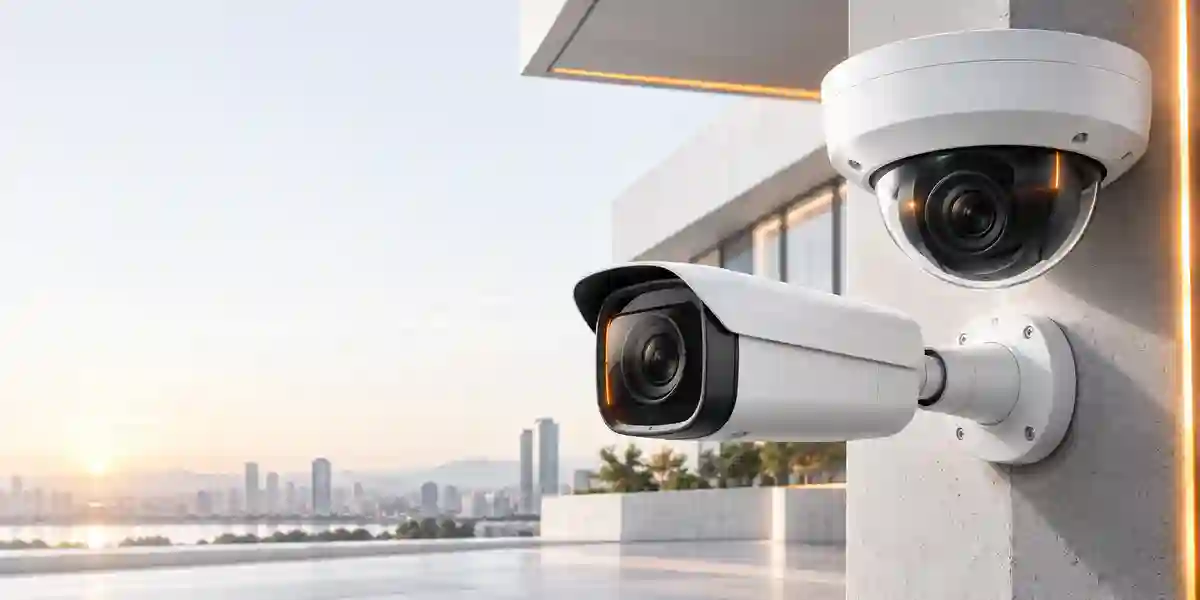
Quick product summary
Outdoor network vandal dome
2MP, 1920 × 1080
5.2–62.4 mm, 12x optical
Up to 60 fps H.265/H.264
IP66, IP67, NEMA 4X, IK10
Discontinued; XNV-6123R listed as replacement
Overview and buyer fit
The XNV-6120 was designed for professional surveillance locations where a conventional wide-angle fixed lens does not provide enough reach. Its 12x optical zoom allows an installer to frame a narrower scene from a greater distance while retaining optical detail rather than relying only on digital enlargement. This makes the model relevant to entrances, vehicle approaches, loading areas, compounds, perimeter views, long corridors and outdoor commercial zones where the camera position may be physically separated from the subject of interest.
The 1/2.8-inch CMOS imaging platform delivers up to 1920 × 1080 video, with H.265 and H.264 streams available up to 60 fps and MJPEG support for compatible workflows. A 150 dB wide dynamic range setting is useful when a scene contains a strong contrast between bright and shaded areas, such as glass-fronted entrances, loading doors facing sunlight or vehicle gates. Day/night switching, defog, digital image stabilization, lens distortion correction, hallway view and multiple video analytics add flexibility for different surveillance layouts.
For procurement teams, the most important current point is lifecycle. Hanwha Vision labels the XNV-6120 discontinued and identifies XNV-6123R as the replacement. A buyer searching for “Hanwha XNV-6120 Dubai price” or “XNV-6120 UAE supplier” therefore needs more than a quotation: the project should first confirm whether the requirement is an exact replacement for a legacy installation, a spare for an existing estate, or a new camera specification that can move to the manufacturer-listed successor. FourTeck can assist with that model-selection discussion without representing discontinued hardware as guaranteed stock.
Key features and business benefits
12x optical zoom
The 5.2–62.4 mm lens gives significantly more framing flexibility than a fixed-lens dome. It is useful where installers need to tighten the field of view on gates, doorways, lanes or distant activity without relocating the camera.
High-frame-rate Full HD
H.265 and H.264 video can run up to 60 fps at supported resolutions, helping capture motion more smoothly in operational areas where movement matters.
150 dB WDR
Wide dynamic range supports difficult lighting conditions where bright backgrounds and darker foreground subjects appear in the same scene, a common issue around entrances and exterior-facing positions.
Rugged exterior housing
IP66/IP67 weather protection, NEMA 4X and IK10 impact resistance make the camera suitable for exposed and public-facing installations when mounted and installed according to project requirements.
Flexible power options
The camera supports IEEE 802.3af PoE as well as 12 VDC and 24 VAC power. PoE can simplify network deployments by carrying power and data over the Ethernet connection.
On-camera analytics
Supported events include motion, tampering, fog and defocus detection, face detection, virtual-area and virtual-line functions, audio detection and digital auto tracking, subject to configuration.
Verified technical specifications
| Specification | Hanwha XNV-6120 |
|---|---|
| Imaging device | 1/2.8-inch CMOS |
| Maximum resolution | 1920 × 1080 (2MP) |
| Lens | 5.2–62.4 mm, 12x optical zoom, DC auto iris |
| Horizontal field of view | 54.58° wide to 5.30° tele |
| Maximum frame rate | 60 fps / 50 fps for H.265/H.264 depending on 60/50 Hz system |
| Codecs | H.265, H.264, MJPEG; multiple streaming |
| Minimum illumination | Color 0.03 lux; B/W 0.003 lux under stated manufacturer test conditions |
| WDR | 150 dB |
| Edge storage | MicroSD/SDHC/SDXC; manufacturer documentation lists two slots with up to 512 GB per slot |
| Power | PoE IEEE 802.3af Class 3, 12 VDC or 24 VAC |
| Protection | IP66, IP67, NEMA 4X, IK10 |
| Operating temperature | -40°C to +55°C; startup above -35°C |
| Dimensions | Ø160 × 128.5 mm |
| Weight | 985 g |
Compatibility, configuration and deployment guidance
The XNV-6120 is a network camera, so deployment should be planned around the complete video path rather than the camera alone. Confirm the recorder or video management system supports the chosen codec, resolution, frame rate, audio, analytics events and required number of streams. Where third-party VMS software is used, confirm current device support and the exact feature set exposed through the integration. Network bandwidth and recording storage should be calculated from the selected stream profiles rather than from resolution alone.
For power, PoE can reduce separate electrical cabling when the switch or injector provides a suitable IEEE 802.3af supply. Alternative 12 VDC and 24 VAC inputs are available for installations designed around those power methods. Outdoor mounting should account for cable entry, weather sealing, physical mounting surface, service access and the selected Hanwha mounting accessory. Use the manufacturer’s supported mount ecosystem when the project requires wall, ceiling, pole or other specialist installation.
The XNV-6120 should not be confused with the XNV-6120R. The “R” model adds integrated IR illumination and is therefore a different choice for scenes requiring built-in infrared lighting. The standard XNV-6120 provides low-light day/night operation but does not have the 70 m integrated IR specification associated with the XNV-6120R. Buyers replacing a legacy camera should confirm the exact suffix printed on the installed unit before ordering a substitute.
Ideal customers and use cases
This model is most relevant today to organizations that already operate Hanwha XNV-6120 cameras and need lifecycle guidance, a like-for-like technical reference, or a migration path. Typical environments include commercial building entrances, warehouses, industrial sites, logistics yards, parking approaches, campus perimeters, hospitality properties and public-facing exterior areas. The 12x optical lens is particularly useful where a single mounting point must observe a more distant or tightly framed subject than a conventional wide-angle dome can comfortably cover.
For a new deployment, the discontinued status changes the buying decision. Instead of designing around an older model simply because its specifications are familiar, procurement and security teams should compare the manufacturer-listed XNV-6123R replacement and any other current Hanwha models against the actual scene. Resolution, infrared needs, lens range, analytics requirements, cybersecurity policies, VMS support, environmental rating and mounting compatibility should all be reviewed before a final model is selected.
What to confirm before ordering
- Whether the requirement is specifically XNV-6120, XNV-6120R, or a current successor.
- Whether the project is replacing an existing camera or designing a new surveillance point.
- Required viewing distance, field of view and optical zoom position.
- Need for built-in infrared illumination; the standard XNV-6120 and XNV-6120R are different models.
- Recorder or VMS compatibility with the selected codec, resolution and analytics.
- PoE switch budget, network bandwidth and recording-storage requirement.
- Mounting surface and compatible Hanwha bracket or housing accessories.
- Outdoor cable sealing, surge protection and site environmental conditions.
- Firmware, cybersecurity and device-management policy for an existing installation.
- Current availability and lifecycle route before issuing a purchase order.
XNV-6120, XNV-6120R and replacement guidance
| Model | Key distinction | Buying guidance |
|---|---|---|
| XNV-6120 | 2MP vandal dome, 12x optical zoom, no integrated IR specification | Discontinued. Best treated as a legacy support or migration requirement. |
| XNV-6120R | Related 2MP 12x model with integrated IR illumination rated by Hanwha up to 70 m | Do not substitute automatically; confirm IR and installed-model requirements. |
| XNV-6123R | Listed by Hanwha Vision as the replacement for XNV-6120 | Preferred starting point for a current-model discussion; verify detailed project compatibility before replacement. |
Hanwha XNV-6120 Dubai
Dubai buyers searching for the Hanwha XNV-6120 are often working with an existing surveillance design, a consultant specification, a maintenance request or a legacy bill of materials. Because the manufacturer now marks this model discontinued, the first procurement question should be whether the project genuinely requires the exact XNV-6120 or whether it can transition to the current replacement. That distinction matters for commercial buildings, warehouses, hotels, industrial units, parking areas and mixed-use properties where camera replacement may need to preserve the old field of view, mounting location, recorder configuration and operational workflow.
Dubai environments also make scene design important. Strong daylight, shaded loading zones, glass entrances and vehicle approaches can produce challenging contrast, so the camera’s 150 dB WDR capability was one of the XNV-6120’s notable strengths. Its 12x optical zoom can help at sites where the mounting position is fixed but the target area is relatively distant. However, a replacement decision should not be based only on matching zoom numbers. The project should confirm actual target distance, desired pixel density, low-light conditions, whether integrated IR is required and how the camera connects to the existing NVR or VMS.
For outdoor Dubai deployment, the IP66/IP67, NEMA 4X and IK10 ratings support demanding installation scenarios, but enclosure ratings do not remove the need for good installation practice. Cable entry, connectors, junction boxes, mounting surfaces, PoE switching, grounding and surge protection should be planned for the site. A shaded location, roof edge, exposed wall and covered parking entrance can each present different environmental and viewing conditions.
FourTeck can help Dubai organizations review a Hanwha XNV-6120 requirement as part of a broader CCTV project. Share the existing camera model, photos of the mounting position where practical, recorder or VMS details, lens/view requirement, camera quantity and whether the site needs an exact legacy replacement or a modern successor. This information allows a more useful comparison than a generic “XNV-6120 price Dubai” request. For broader surveillance planning, visit FourTeck UAE or contact FourTeck sales to discuss the required configuration.
Hanwha XNV-6120 UAE
Across the UAE, an XNV-6120 requirement may come from a Dubai office, an Abu Dhabi facility, a Sharjah warehouse, a Northern Emirates hospitality site or a multi-emirate organization standardizing security equipment. Procurement teams frequently inherit model numbers from old asset registers or tender schedules. When that happens, lifecycle verification is essential. The XNV-6120 is no longer a current Hanwha model, and the manufacturer names the XNV-6123R as its replacement. A replacement project should therefore compare both technical requirements and integration conditions rather than assuming the old part number remains the correct choice.
The original XNV-6120 specification remains useful when documenting an existing installation. It supports 2MP Full HD, a 5.2–62.4 mm 12x optical zoom, H.265/H.264/MJPEG streaming, 150 dB WDR, advanced event analytics, bidirectional audio, edge storage and multiple power choices. These capabilities help teams identify what must be preserved when moving to a successor. For example, a camera viewing a gate may need similar telephoto reach, while a covered loading area may depend more on WDR and low-light behavior. A new model should be chosen around those operational outcomes, not just a single headline specification.
For UAE-wide projects, compatibility with centralized recording can be as important as the camera itself. Check the existing Hanwha NVR, third-party VMS, storage retention policy, network segmentation and user access practices. If the organization maintains multiple branches, it may also be useful to standardize replacement models, firmware processes and mounting accessories instead of sourcing one-off legacy units. This reduces complexity for IT and maintenance teams.
FourTeck can support a UAE review of the XNV-6120 and current Hanwha alternatives without making assumptions about stock, pricing or delivery. Buyers can use FourTeck’s main regional platform and FourTeck UAE to discuss multi-emirate requirements. Provide the number of cameras, existing recorder/VMS, mounting format, target viewing distance and any requirement for built-in IR so the proposed replacement can be evaluated on compatibility rather than model name alone.
Hanwha XNV-6120 Kenya
Kenyan organizations looking for the Hanwha XNV-6120 may be maintaining surveillance installations in offices, hotels, logistics facilities, industrial compounds, schools, healthcare sites or multi-branch commercial operations. Where the camera is already installed, its 12x optical zoom and durable vandal dome housing may have been selected for a specific long-view scene such as a gate, entrance, yard or perimeter. Because the model is now discontinued, replacement planning should document that original purpose before choosing new hardware.
A useful replacement assessment begins with the scene. Record the current camera’s zoom position, required width of view, mounting height, distance to the target, day and night lighting, and any analytics relied on by operators. If the legacy camera is connected to an existing NVR or VMS, record the stream configuration and integration method as well. This avoids selecting a successor that matches the headline 2MP resolution but does not fit the operational requirement. If the site needs integrated infrared illumination, note that the standard XNV-6120 differs from the XNV-6120R, so the suffix of the installed device matters.
Kenyan projects also benefit from practical network and power planning. PoE can simplify structured cabling, but the switch capacity, cable distance and backup-power strategy should be checked. For outdoor installations, ensure the mounting and cable entry preserve weather resistance, and plan for local environmental conditions such as dust, rain exposure and temperature. Edge storage can provide an additional recording option, but centralized retention policies should still be designed around the recorder or VMS where required.
For Kenya enquiries, FourTeck can help procurement and technical teams compare an existing XNV-6120 requirement with a supported current alternative. Use FourTeck Kenya for regional project discussions. Share the legacy model suffix, camera quantity, installation location type, NVR/VMS platform, required night performance and expected viewing distance. This produces a more reliable recommendation than sourcing a discontinued camera solely because the old part number appears in a previous bill of materials.
Hanwha XNV-6120 Kuwait
Kuwait buyers who encounter the XNV-6120 in a surveillance specification should treat the model as a lifecycle and compatibility question. Hanwha Vision has discontinued it and identifies the XNV-6123R as the replacement. For existing commercial, logistics, oil-and-gas support, hospitality or institutional sites, an exact replacement request may come from a maintenance contractor or security team that wants to preserve the same view. In a new project, however, designing around a discontinued camera is usually less useful than evaluating a current model against the actual scene requirement.
The XNV-6120’s long 12x optical range was well suited to views where the subject was farther from the camera than in a typical entrance dome. Its rugged IP66/IP67, NEMA 4X and IK10 housing also supported outdoor and public-facing positions. In Kuwait, exterior cameras can face intense brightness, heat and dust, so placement and environmental planning are important. The 150 dB WDR capability helps in high-contrast scenes, while the manufacturer’s operating range gives a reference point for thermal conditions; actual site exposure and enclosure installation should still be reviewed by the project team.
When migrating, check whether the old surveillance system uses H.264, H.265 or another configured stream profile, whether audio is in use, whether analytics trigger recordings or alarms, and whether edge storage is part of the incident workflow. Mounting compatibility also matters because a replacement camera may require a different bracket or adapter. If the installation relies on a narrow telephoto view, compare optical field of view rather than relying on digital zoom specifications.
FourTeck can support Kuwait enquiries through FourTeck Kuwait. Provide the installed model, camera count, recorder/VMS details, mounting arrangement, viewing distance and whether built-in IR is needed. FourTeck can then help evaluate the manufacturer-listed replacement and other suitable options while keeping current price, availability and delivery as matters to be confirmed for the specific request.
Hanwha XNV-6120 Ghana
Ghanaian organizations may still encounter the Hanwha XNV-6120 in established CCTV systems, consultant documentation or legacy procurement records. The camera combines Full HD imaging with a comparatively long 12x optical zoom and a vandal-resistant outdoor dome body, so it may have been installed where a robust camera needed to observe a specific distant zone. Today, the key purchasing fact is that Hanwha Vision lists the model as discontinued. A replacement exercise should therefore start with documenting what the original camera actually does at the site.
For a warehouse or industrial compound, the priority may be a clear view of a loading gate or a narrow section of perimeter. For a hotel or office property, it may be a vehicle approach or public entrance where WDR is important. For education or healthcare facilities, the key requirement may be a durable exterior housing and manageable integration with centralized recording. The XNV-6120’s specification can act as a benchmark, but a successor should be evaluated against these scene-level needs rather than chosen purely because the old camera was 2MP.
Connectivity also deserves attention. Confirm whether the site uses PoE, the available network-switch power budget, storage retention, recording resolution and remote viewing. Where connectivity to a central operations team is important, review bandwidth and stream profiles. If the installation requires nighttime illumination, verify whether the existing camera is XNV-6120 or XNV-6120R, because the IR-equipped variant is not the same model. A correct model audit prevents the common mistake of replacing a non-IR camera with assumptions based on specifications from the “R” version.
For Ghana project support, use FourTeck Ghana. Share the site type, existing camera and recorder model numbers, quantity, target distance, night-view expectations and any analytics or alarm workflow that must be retained. FourTeck can help compare the legacy XNV-6120 profile with current Hanwha options and prepare the technical conversation required before a quotation or procurement decision.
Hanwha XNV-6120 Uganda
In Uganda, buyers searching for a Hanwha XNV-6120 may be supporting security systems in corporate offices, schools, hotels, warehouses, industrial facilities, retail operations or residential and mixed-use developments. The model’s appeal came from its combination of a rugged vandal dome housing, 12x optical zoom and professional network-video functions. For current procurement, however, it should be treated as a discontinued legacy model rather than a standard new-installation choice. Hanwha Vision identifies XNV-6123R as its replacement.
If an existing XNV-6120 has failed, the quickest technical route is to capture the current scene before removing it. Note the zoom position, camera orientation, approximate target distance and whether operators depend on a specific field of view. Also record the network address plan, PoE source, NVR/VMS, stream settings and any event configuration. This information helps evaluate a current replacement with less risk of changing coverage unintentionally. Where a system has many identical legacy cameras, a phased replacement plan may be more manageable than sourcing isolated discontinued units over time.
Outdoor projects should review mounting, water ingress protection, cable paths and surge or power considerations as part of maintenance. The XNV-6120’s IP66/IP67 and IK10 ratings provide useful protection, but poor cable sealing or unsuitable mounting can still compromise a deployment. In mixed indoor/outdoor estates, it is also worth checking whether every location genuinely needs the same camera type; newer deployments can sometimes standardize fewer models by matching each scene to the correct lens and environmental class.
For Uganda enquiries, visit FourTeck Uganda. FourTeck can help review the XNV-6120 specification, distinguish it from the XNV-6120R, and compare current Hanwha options for the required field of view and recording platform. Provide the number of cameras, site type, installation conditions and recorder details so the discussion can focus on compatibility and operational outcomes rather than an obsolete model number alone.
Hanwha XNV-6120 Nigeria
Nigeria has a wide range of CCTV deployment environments, from banks and corporate offices to logistics hubs, industrial estates, hospitality properties, retail networks and education campuses. An XNV-6120 request may therefore represent very different viewing requirements. Its 12x optical zoom was particularly useful when the camera had to watch a smaller area from a distance, and its 150 dB WDR supported scenes with strong contrast. The correct modern replacement should preserve the functions that matter at the specific site rather than simply matching the old camera’s megapixel count.
Start by confirming the exact installed model. The XNV-6120 is the non-IR version, while the related XNV-6120R includes integrated IR illumination. Mixing the two descriptions can produce the wrong night-view expectation. Next, check the NVR or VMS, codec, frame rate, storage period, PoE switching and analytics workflow. If the system is part of a larger enterprise platform, device licensing and integration support may also influence the replacement choice. Hanwha’s current lifecycle guidance should form the basis for new procurement rather than old reseller listings.
For outdoor installations, practical engineering matters as much as model selection. Weatherproof connections, appropriate mounts, power continuity, network resilience and secure remote access all contribute to a stable surveillance system. A camera with a strong environmental rating can still underperform if the lens angle, mount or cable route is wrong for the site. Where bandwidth between branches is constrained, configure recording and remote-view streams with the network design in mind rather than using maximum settings everywhere.
Nigeria buyers can use FourTeck Nigeria for regional enquiries. Share the legacy camera details, quantity, mounting position, target scene, recording platform and project objectives. FourTeck can then help compare the discontinued XNV-6120 with current Hanwha alternatives and discuss procurement based on the real requirement, with availability, pricing and delivery confirmed only for the specific enquiry.
Hanwha XNV-6120 Seychelles
For Seychelles projects, surveillance equipment selection often needs careful attention to outdoor exposure, maintenance access and long-term support. An existing Hanwha XNV-6120 may be installed at a hotel, commercial property, office, utility facility, marina-related environment or other site where a robust dome and long optical reach were useful. Since Hanwha Vision now lists the XNV-6120 as discontinued, buyers should treat a new request as a migration exercise unless there is a specific maintenance reason to source the legacy model.
The camera’s IP66/IP67 and NEMA 4X protection make its environmental design relevant as a benchmark, but site conditions still need individual assessment. Coastal or exposed locations can create demanding conditions for mounts, connectors and cabling. Maintenance access may also be more important on island projects, because a difficult-to-service camera position can increase operational cost over the life of the system. A replacement should therefore be assessed for mounting practicality, supported accessories, firmware lifecycle and integration with the recording platform as well as imaging performance.
From a video perspective, determine whether the 12x optical zoom is actively used or whether the original camera was simply installed as a standard dome. If the scene genuinely needs a narrow telephoto view, compare the replacement model’s optical focal range and field of view. If a wider lens would now serve the location better, the migration may be an opportunity to redesign coverage. Likewise, if nighttime monitoring needs built-in infrared, verify that the proposed current model provides it; the original XNV-6120 should not be described with the IR specification of the XNV-6120R.
Seychelles enquiries can be routed through FourTeck Africa. Provide the site environment, camera quantity, existing mounting arrangement, recording system, target viewing distance and any need for remote management. FourTeck can help evaluate a current Hanwha alternative with attention to compatibility and maintenance needs while avoiding unsupported claims about local stock, delivery time or warranty arrangements.
Related FourTeck surveillance resources
A complete camera decision normally touches recording, networking, installation and regional support. The following FourTeck resources can help buyers plan the wider project:
CCTV planning in Dubai
Review camera placement, recording, storage, PoE, cabling and deployment considerations for Dubai business sites.
UAE physical security
Consider CCTV and access-control planning together for business buildings and multi-system security projects.
Kenya project enquiries
Discuss camera, recorder, network and project requirements through the Kenya regional route.
Uganda CCTV requirements
Plan surveillance requirements for offices, warehouses, institutions and other business environments.
Ghana regional support
Route Ghana security-camera and network-infrastructure enquiries through the regional FourTeck site.
Nigeria project support
Discuss camera migration, NVR compatibility and deployment requirements for Nigerian sites.
Why contact FourTeck about a legacy Hanwha camera?
A discontinued camera request needs more technical context than a normal current-product enquiry. FourTeck can help organize the information required to compare the XNV-6120 with current options: existing model suffix, lens and scene requirement, NVR or VMS, network design, power method, storage, mounting arrangement and analytics. This helps procurement teams avoid purchasing a technically similar camera that does not fit the installed environment.
FourTeck can also support wider CCTV planning where the requirement includes PoE networking, recording capacity, structured cabling, remote viewing or multi-site deployment. Final compatibility, availability, pricing, warranty route and project scope should be confirmed for the selected products and location before purchase.
Hanwha XNV-6120 FAQs
Is the Hanwha XNV-6120 discontinued?
Yes. Hanwha Vision currently marks the XNV-6120 as discontinued and lists XNV-6123R as the replacement. Buyers should therefore confirm whether they are supporting an existing installation or specifying a new project. For new deployments, compare the replacement model and other current Hanwha options against the required lens range, night performance, analytics, VMS compatibility and mounting arrangement.
What resolution does the XNV-6120 provide?
The XNV-6120 provides up to 2 megapixels at 1920 × 1080 resolution. H.265 and H.264 streams support up to 60 fps in the manufacturer specification, depending on system frequency and configuration. Resolution alone should not determine replacement selection; lens field of view, lighting, recording platform and current model support are equally important.
Does the XNV-6120 have optical zoom?
Yes. It uses a 5.2–62.4 mm DC auto-iris lens with 12x optical zoom. The horizontal field of view ranges from approximately 54.58 degrees at the wide end to 5.30 degrees at telephoto. This makes the camera useful for tighter framing at longer distances than a typical fixed wide-angle dome.
Is XNV-6120 the same as XNV-6120R?
No. They are related models but should not be treated as identical. The XNV-6120R includes integrated infrared illumination with a manufacturer-stated viewable distance up to 70 m, while the standard XNV-6120 does not carry that integrated IR specification. Confirm the exact suffix on the existing camera before planning a replacement.
Can the XNV-6120 use PoE?
Yes. Hanwha specifies IEEE 802.3af Class 3 PoE for the XNV-6120, along with 12 VDC and 24 VAC power options. In a PoE deployment, check the switch power budget, cable distance and network design. For a replacement camera, confirm the successor’s PoE class and consumption rather than assuming it is identical.
Is the XNV-6120 suitable for outdoor use?
Yes. The manufacturer lists IP66, IP67, NEMA 4X and IK10 environmental and impact protection for the camera. Proper outdoor deployment still requires correct mounting, sealed cable entries, suitable connectors and attention to site exposure. Environmental ratings describe the product enclosure under defined conditions and do not compensate for poor installation practice.
What is the XNV-6120 wide dynamic range?
Hanwha specifies 150 dB WDR for the XNV-6120. Wide dynamic range helps a camera handle scenes containing both bright and dark areas, such as a shaded lobby looking toward a sunlit entrance or a loading door with strong exterior light. Actual image results depend on scene conditions and configuration.
What storage options does the XNV-6120 support?
Hanwha’s support documentation lists microSD/SDHC/SDXC edge storage, with two slots and up to 512 GB per slot in current documentation. Edge storage can support local recording strategies, but larger business systems normally also plan NVR, NAS or VMS retention according to recording days, bitrate, camera count and incident-review requirements.
Which analytics are available on XNV-6120?
The manufacturer lists functions including motion, tampering, defocus and fog detection, face detection, audio detection, sound classification, virtual-area events, virtual-line events and digital auto tracking. The exact events used in a project depend on configuration and recorder/VMS integration. Confirm which analytics must be preserved before moving to a replacement model.
Can I buy Hanwha XNV-6120 in Dubai?
Because Hanwha Vision lists the XNV-6120 as discontinued, current availability should be confirmed for each enquiry rather than assumed. If your requirement comes from an existing Dubai installation, share the installed model suffix, camera quantity, recorder or VMS and required field of view. FourTeck can help evaluate whether the legacy model or the manufacturer-listed replacement better fits the project.
What should I send FourTeck for a replacement recommendation?
Provide the exact camera model, quantity, site location, photos or description of the viewing area, approximate target distance, existing NVR/VMS model, power method, mounting type, night-view requirement and any analytics in use. These details allow a replacement to be judged on field of view, compatibility and deployment conditions rather than on model number alone.
Need help replacing or supporting an XNV-6120?
Share your existing model, camera quantity, recorder or VMS, mounting position and required viewing distance. FourTeck can help you compare the discontinued XNV-6120 with current Hanwha options for your project.
Reviews
There are no reviews yet.