

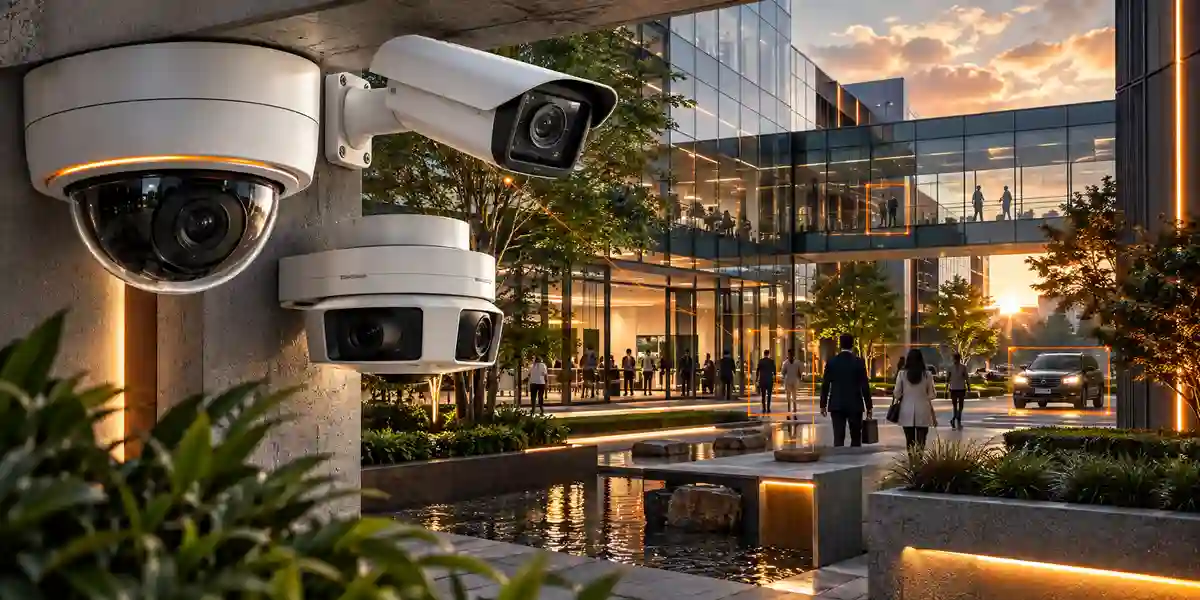
Quick summary of the Hanwha XNV-C9083R
4K resolution up to 3840 × 2160 with H.265/H.264 at up to 30 fps.
4.4–9.3 mm, 2.1× motorized varifocal lens for wide-to-tighter coverage planning.
WiseIR provides an IR viewable length of up to 40 m for low-light and dark scenes.
IP66, IP67, NEMA4X and IK10 enclosure ratings for demanding mounting environments.
Product overview and buyer-fit guidance
For Dubai CCTV projects, the XNV-C9083R is best considered when the brief calls for high-resolution fixed-camera coverage with AI-assisted event detection rather than mechanical pan-tilt-zoom operation. The motorized varifocal lens allows an installer to adjust the field of view during commissioning, which can be valuable for entrances, loading areas, building approaches, car parks, perimeter zones and external circulation spaces where scene composition matters. The hard-coated vandal dome format also suits locations where a compact, impact-resistant camera body is preferable to a visibly projecting bullet design.
The camera’s AI engine can distinguish object classes such as people, faces, vehicles and license plates, while intelligent video analytics can be configured around virtual lines and areas, including enter, exit, loitering, direction and intrusion events. These capabilities are useful when a security team wants to reduce attention on irrelevant motion and focus operators on defined events. The XNV-C9083R also supports conventional events such as motion, tampering, defocus and fog detection, plus audio-related analytics where the required audio hardware and configuration are in place.
Buying the camera should therefore be tied to the complete surveillance design rather than the camera model alone. Confirm mounting height, target distance, lighting, required identification detail, network bandwidth, PoE capacity, recording duration, storage, VMS or NVR compatibility, cybersecurity policy and whether analytics must trigger recording, alerts or operator workflows. Fourteck can help scope these practical requirements before a quote is finalized.
Key features and business benefits
4K evidence detail
The 3840 × 2160 maximum resolution gives security teams more scene detail than lower-resolution fixed cameras, subject to lens selection, target distance, lighting and compression settings.
Motorized varifocal framing
A 4.4–9.3 mm lens provides a practical adjustment range for installers who need to tune coverage around doorways, roads, ramps, loading bays or wider external areas.
AI-assisted event filtering
Object detection and intelligent video analytics can help define more meaningful events, supporting faster review and more focused operator attention than basic motion-only triggering.
Night and contrast handling
40 m WiseIR, Day & Night operation, WiseNR II and 120 dB extremeWDR help address night scenes, bright entrances and mixed-light conditions when the camera is correctly positioned.
Rugged outdoor design
IP66/IP67, NEMA4X and IK10 ratings make the vandal dome suitable for many exposed or physically accessible mounting locations, subject to correct installation.
Efficient network video
H.265/H.264 video and Hanwha’s AI-based WiseStream III can help optimize bandwidth and storage compared with less efficient streaming configurations, while final results depend on the scene and recording profile.
Verified technical specifications
| Specification | Hanwha XNV-C9083R |
|---|---|
| Camera type | 4K AI IR vandal dome network camera |
| Imaging device | 1/1.8-inch CMOS |
| Maximum resolution | 3840 × 2160 |
| Maximum H.265/H.264 frame rate | 30 fps / 25 fps at 60 Hz / 50 Hz |
| Lens | 4.4–9.3 mm, 2.1× motorized varifocal |
| Horizontal field of view | Approximately 113° to 47° |
| IR viewable length | 40 m WiseIR |
| Minimum illumination | Color 0.04 Lux; 0 Lux with IR LED on |
| Wide dynamic range | extremeWDR, 120 dB |
| Video codecs | H.265, H.264 and MJPEG |
| AI object classes | Person, face, vehicle types and license plate detection |
| Environmental / impact ratings | IP66, IP67, NEMA4X, IK10 |
Specifications above are based on current manufacturer documentation. Firmware, regional availability and supported integration features should be rechecked during project design.
Compatibility, configuration and deployment guidance
The XNV-C9083R is an IP camera and should be planned as part of a network video system. The project team should confirm the selected Hanwha NVR, VMS or supported third-party platform, the number of camera streams required, recording profile, retention period and operator workflow before installation. ONVIF support and Hanwha interfaces can assist integration, but feature parity varies across platforms; advanced analytics, metadata search and alarm actions may require a compatible recorder or VMS version.
Power and network design matter as much as image quality. Confirm that the switch, PoE budget, copper distance, surge protection approach and network segmentation are appropriate for the site. At commissioning, adjust the motorized varifocal lens to match the actual target zone rather than choosing a generic angle. In Dubai outdoor locations, direct sun, reflective façades, vehicle headlights and shaded entrances can all affect exposure; the installer should test WDR, shutter, IR behavior and analytics thresholds under real conditions.
If license-plate visibility is a requirement, distinguish between general plate detection and dedicated license-plate recognition or evidential capture requirements. Vehicle speed, camera angle, plate size in pixels, night glare and local plate designs can materially affect performance. Similarly, analytics should be tested with real pedestrian and vehicle movement, not only default settings. Fourteck can help review these deployment dependencies before procurement.
Ideal customers and use cases
Entrances, driveways, loading zones, external circulation areas and building perimeter coverage.
Dock approaches, gate areas, yard movement and defined intrusion or loitering zones.
Exterior entrances, service areas, car parks and high-value access points where detail and analytics matter.
Campus approaches and controlled external areas, subject to the organization’s privacy and retention policies.
What to confirm before ordering
- Required viewing angle and target distance at each camera point.
- Whether 4K recording is required continuously or only for selected profiles/events.
- NVR or VMS model, software version and analytics/metadata compatibility.
- PoE switch capacity, network design and recording bandwidth.
- Retention period and storage capacity.
- Outdoor mounting, cable entry, weather sealing and surge protection.
- IR performance, ambient lighting and possible reflective surfaces.
- Whether audio, alarm I/O or advanced event actions are part of the design.
- Applicable cybersecurity, privacy and retention policies.
- Any project-specific approvals, certifications or client standards.
Comparison and related-model guidance
The XNV-C9083R sits in Hanwha’s X-series family as a 4K AI IR vandal dome. Buyers should compare it with lower-resolution vandal domes when bandwidth or storage is constrained, with non-vandal indoor domes where impact resistance is unnecessary, and with bullet or PTZ cameras when a different mounting profile or active directional control is needed. The right alternative depends on target distance, field of view, expected lighting, physical risk and the recording platform. Do not select solely by megapixel count: lens geometry and pixels on target are often more important to evidential usefulness than nominal resolution.
Hanwha XNV-C9083R Dubai
Dubai surveillance projects commonly combine demanding outdoor conditions with visually complex scenes: glass façades, bright sunlight, shaded entrances, reflective road surfaces, vehicle headlights and 24-hour activity. The Hanwha XNV-C9083R is well suited to projects where the design calls for a fixed vandal dome with 4K detail, adjustable varifocal framing and analytics that can distinguish relevant people and vehicles from general scene movement. Typical buyer questions include whether the camera can cover a building entrance and adjacent driveway, whether 40 m IR is sufficient for a specific lane, whether the lens can be tightened for a gate, and how much recording storage is needed at 4K. Those are design questions rather than simple product-spec questions, so site geometry and recording policy should be reviewed together.
For a Dubai office tower, retail complex, warehouse or villa compound, the 4.4–9.3 mm motorized varifocal lens allows installers to refine coverage after mounting. The wide end can help with broader entrances and circulation zones, while the tele end can narrow the scene toward a gate, ramp or targeted approach. The camera’s 120 dB extremeWDR is relevant at high-contrast thresholds where a subject may move between strong daylight and indoor shade. WiseIR can support night operation, but final night-image quality still depends on distance, subject reflectivity, mounting height, environmental lighting and the presence of nearby reflective surfaces.
Dubai buyers should also plan for system integration. Confirm PoE switching, VLAN or network segmentation, NVR/VMS compatibility, user permissions, recording retention and whether analytics metadata must be searchable later. If a project requires plate capture, face evidence or another high-detail target, define the expected target size and position before finalizing the lens angle. Fourteck can help translate the surveillance objective into a practical camera, recorder and network configuration without making assumptions about stock, fixed pricing or delivery time. For broader Dubai and UAE technology procurement, visit Fourteck UAE solutions or contact Fourteck for a project discussion.
Hanwha XNV-C9083R UAE
UAE projects may span multiple emirates and a wider mix of building types than a single Dubai installation. The XNV-C9083R is relevant where a consistent 4K vandal-dome standard is needed across branches, logistics locations, hospitality facilities, campuses, compounds or commercial properties. Multi-site buyers often need more than matching camera models: they need consistent firmware policy, network addressing, user-role design, recording profiles, time synchronization, cybersecurity hardening and maintenance documentation. A standardized XNV-C9083R deployment can support that approach when the viewing geometry suits each location.
The camera’s AI-based object detection can be useful for defining events around people and vehicles, reducing dependence on generic motion triggers. For example, a UAE facilities team may want a virtual line at a service gate, loitering logic near a restricted access door, or intrusion detection in a defined perimeter area. These functions should be tested on the actual scene, because environmental movement, shadows, headlight glare and camera angle affect results. The XNV-C9083R also includes conventional analytics such as tampering, defocus, fog and motion detection, giving system designers more options for health and event monitoring.
When specifying across the UAE, confirm whether the chosen recorder or VMS supports the analytics and metadata you expect, and whether the available PoE infrastructure can power the intended camera count. Storage planning should use realistic bitrates and retention targets rather than a generic “4K camera” estimate. Outdoor camera locations should also consider heat exposure, mounting surfaces, cable routing, weather sealing and surge protection. Fourteck can support UAE buyers with configuration discussions and related infrastructure planning. For national procurement enquiries use Fourteck and Fourteck UAE, while specialist infrastructure requirements can be discussed through Fourteck IT services in the UAE.
Hanwha XNV-C9083R Kenya
Kenya buyers considering the Hanwha XNV-C9083R typically need to balance image quality, outdoor durability, network availability and recording cost. A 4K camera can provide useful detail for entrances, yards, compounds, warehouses, offices and retail locations, but the system should be engineered around bandwidth and retention from the beginning. Where WAN links connect remote sites to a central monitoring location, it may be better to record high-quality streams locally and use lower-bandwidth streams for remote viewing, depending on the NVR or VMS architecture.
The camera’s 4.4–9.3 mm motorized varifocal lens is useful in Kenyan installations where one project may include wide compound views and tighter gates or loading points. WiseIR up to 40 m can support night surveillance, while the IP66/IP67 and IK10 ratings are important for exposed or physically accessible positions. Even so, installers should use suitable mounting accessories, sealed cable entries, appropriate surge protection and stable PoE infrastructure. Where mains stability is a concern, UPS and network resilience should be considered as part of the surveillance design rather than treating the camera as an isolated device.
AI analytics can help operators focus on person, face, vehicle and license-plate objects, and virtual line or area rules can be configured for site-specific behavior. For a warehouse, that might mean monitoring a restricted gate; for a school or office, it may mean detecting after-hours access into a defined zone. Each rule should be validated using real traffic patterns and local lighting conditions. Kenya procurement teams should also confirm recorder compatibility, storage capacity and any organizational privacy policy governing analytics and video retention. For Kenya-specific assistance, visit Fourteck Kenya or use the Fourteck contact route to discuss a multi-site configuration.
Hanwha XNV-C9083R Kuwait
In Kuwait, outdoor CCTV designs often need to account for strong sun, high daytime temperatures, dust, night lighting contrast and large paved areas around commercial or industrial properties. The Hanwha XNV-C9083R provides a rugged vandal-dome format with IP66/IP67 and NEMA4X environmental protection plus IK10 impact resistance. Those ratings make it a credible choice for exposed mounting positions, but installation quality remains critical: housing seals, cable glands, junction accessories, network surge protection and mounting orientation all influence long-term reliability.
The 4K sensor and 4.4–9.3 mm motorized varifocal lens can be useful for gate approaches, building entrances, service yards, logistics areas and external circulation routes. Rather than selecting the field of view by eye, integrators should calculate the target width and required detail at the expected distance. Where the scene includes strong backlight from entrances or intense sun, the current manufacturer specification lists 120 dB extremeWDR. At night, WiseIR can illuminate up to 40 m, but IR performance should be tested for reflective walls, vehicles, signs and nearby surfaces that can alter exposure.
Kuwait buyers should also confirm how AI events will be used. Object classification can help distinguish people and vehicles, while virtual area and line analytics may support intrusion, loitering or direction-based workflows. If the site requires centralized monitoring across branches, network design and remote-viewing bandwidth should be part of the project scope. Storage should be calculated from the intended frame rate, resolution, codec, scene complexity and retention period. For local procurement and system discussions, visit Fourteck Kuwait. Fourteck can also help align camera selection with switching, recording and broader security-system integration requirements.
Hanwha XNV-C9083R Ghana
Ghana organizations evaluating the Hanwha XNV-C9083R may be looking for a high-resolution network dome that can operate across offices, banks, retail sites, warehouses, compounds, educational facilities or critical infrastructure environments. The model’s combination of 4K detail, 40 m WiseIR, AI object detection and a vandal-resistant outdoor enclosure gives system designers flexibility, but it should be matched to the actual monitoring objective. A camera watching a broad compound needs a different lens position and evidential expectation from one aimed at a doorway or controlled gate.
The motorized varifocal lens is valuable where installers need to adjust coverage during commissioning without replacing the lens. AI analytics can identify people, faces, vehicle types and license plates as object classes and can trigger rules around virtual lines and areas. These features can be used to support security workflows, but they are not a substitute for scene design. Camera height, target angle, night illumination, background movement and distance should be validated before rules are relied upon operationally.
For Ghana projects, network and power resilience deserve particular attention. Confirm PoE capacity, switch uplinks, UPS strategy, recorder location, disk capacity and how users will view footage from remote branches. Where bandwidth between sites is constrained, local recording with optimized remote streams may be preferable. The camera’s H.265 support and WiseStream III can help manage storage and bandwidth, but exact savings depend on scene activity and encoding settings. Procurement teams should also verify the intended VMS/NVR feature set and organizational retention requirements. For Ghana-specific enquiries, use Fourteck Ghana. Fourteck can help discuss the complete architecture around the camera rather than treating the unit as a standalone purchase.
Hanwha XNV-C9083R Uganda
Uganda CCTV projects can range from single-building installations to distributed branch networks, warehouses, schools, hospitality sites, offices and industrial compounds. The Hanwha XNV-C9083R fits projects that need a fixed 4K vandal dome with adjustable optics and intelligent analytics. Its 4.4–9.3 mm motorized varifocal lens gives installers room to fine-tune composition after mounting, while the 40 m IR capability supports night surveillance where ambient light is limited. Correct scene design is still essential: IR distance alone does not guarantee identification quality at that range.
Organizations in Uganda may benefit from the camera’s ability to classify people and vehicles and to apply rules such as crossing, direction, intrusion, enter/exit and loitering within defined areas. A logistics site can use such events to focus attention on restricted loading areas, while a commercial property may apply them around after-hours entrances. The analytics should be tested for false triggers and tuned to real movement patterns. For projects with centralized monitoring, the recorder or VMS should be checked for compatibility with the camera’s metadata and analytics functions.
Infrastructure planning should cover PoE switching, network segmentation, cable distance, weatherproof termination, power backup and storage. A 4K stream can consume substantial capacity depending on bitrate and scene complexity, so retention calculations should use the intended recording profiles. For remote sites, consider whether high-resolution recording should stay local while remote operators receive an optimized stream. Buyers should also confirm privacy, access-control and data-retention policies before deployment. For Uganda project enquiries, visit Fourteck Uganda. Fourteck can help align the XNV-C9083R with appropriate networking, recording and monitoring requirements for each site.
Hanwha XNV-C9083R Nigeria
Nigeria projects often demand surveillance systems that can operate across large compounds, corporate facilities, retail sites, logistics hubs, hotels, educational institutions and branch networks. The Hanwha XNV-C9083R is most useful where the design requires a high-detail fixed dome with rugged outdoor construction and AI-assisted event handling. Its 4K resolution supports detailed review, while the motorized 4.4–9.3 mm lens helps integrators tailor coverage to wide approaches or tighter target zones. For a multi-camera project, standardized lens planning and mounting-height guidelines can make installation more consistent across sites.
The model’s AI capabilities can classify people, faces and vehicles and can apply rules around virtual lines and areas. This may help security operations reduce unnecessary motion alarms and focus on defined behaviors such as intrusion, loitering or directional crossing. However, analytics should always be tested under real lighting and traffic conditions, particularly where headlights, shadows, trees, weather or busy road movement could affect a rule. If license-plate information is important, the camera angle and plate size in the image must be engineered deliberately.
Nigeria buyers should also plan for power and communications resilience. PoE switching, UPS capacity, surge protection, fiber or copper uplinks, recorder redundancy and remote access all affect operational reliability. Where bandwidth is limited between branches and a central control room, stream profiles should be optimized rather than simply sending every camera at its highest bitrate continuously. H.265 and WiseStream III can support efficient transmission and storage, with actual results depending on scene complexity. For Nigeria-specific assistance, visit Fourteck Nigeria. Fourteck can help review recorder compatibility, retention, network design and camera placement before procurement.
Hanwha XNV-C9083R Seychelles
Seychelles surveillance projects can present a different set of priorities, including coastal exposure, humidity, hospitality environments, remote properties, compact commercial sites and distributed islands or facilities where maintenance access may be limited. The Hanwha XNV-C9083R’s IP66/IP67, NEMA4X and IK10 ratings make it a strong candidate for many demanding outdoor camera points, but coastal installations still require careful attention to brackets, fixings, cable terminations and the wider installation environment. Site-specific corrosion risk and maintenance planning should be reviewed during design.
For hotels, resorts, offices, retail sites or logistics areas, the camera’s 4K image, motorized varifocal lens and 40 m WiseIR can support entrances, service roads, parking zones and perimeter approaches. The adjustable focal range is helpful where the installer needs to refine framing after the final mounting position is chosen. AI object detection and virtual line or area rules can help operators focus on people and vehicles within defined zones, but analytics should be tuned to local scene movement and lighting rather than left at generic defaults.
Connectivity is particularly important for remote or distributed sites. Decide whether cameras will record locally to an NVR at each property, to a centralized platform, or through a hybrid design. Remote viewing bandwidth and resilience should be calculated in advance, and power backup should be included where continuity is important. Storage calculations should reflect the selected 4K recording profile, frame rate, codec and retention policy. If centralized security staff need event-based alerts, confirm that the selected VMS supports the required metadata and alarm workflow. Seychelles buyers can use Fourteck Africa for regional guidance and contact Fourteck to discuss configuration and procurement requirements.
Related Fourteck resources
For wider infrastructure and regional planning around the Hanwha XNV-C9083R, the following Fourteck resources may be useful. These links support location-specific or infrastructure discussions and should be used alongside project-specific camera and recorder validation.
UAE technology and project enquiries.
Fourteck Kenya
Kenya-focused procurement and project support.
Fourteck Uganda
Uganda technology project enquiries.
Fourteck Kuwait
Kuwait procurement and system discussions.
Fourteck Ghana
Ghana regional technology assistance.
Fourteck Nigeria
Nigeria regional project assistance.
Fourteck Africa
Regional support for African markets including Seychelles.
UAE IT services
Network and infrastructure services for integrated projects.
Why contact Fourteck for the XNV-C9083R?
A surveillance camera is only one part of a working CCTV system. Fourteck can help buyers discuss camera placement, recorder sizing, network switching, PoE, storage, remote access, analytics objectives and site-specific integration before a final configuration is chosen. This is especially useful when the same model is being considered across multiple entrances or multiple regional sites, because small differences in lens angle, mounting height or retention requirements can materially change the system design.
Fourteck does not need to rely on fixed-price or stock claims to help with a project. A more useful approach is to confirm the bill of materials against the required result, validate compatibility and then prepare a quote for the selected configuration. Use the contact route below to share your site type, camera quantity, target areas, recorder preference and expected retention period.
Frequently asked questions
Is the Hanwha XNV-C9083R a 4K camera?
Yes. The XNV-C9083R supports a maximum resolution of 3840 × 2160, commonly referred to as 4K UHD. Actual recorded detail also depends on lens framing, target distance, lighting, bitrate, compression and recorder settings, so the installation should be designed around the required pixels on target rather than resolution alone.
How far can the XNV-C9083R see at night?
Hanwha specifies a WiseIR viewable length of up to 40 m. That figure describes IR illumination capability, not guaranteed identification distance. Night performance varies with subject reflectivity, camera angle, ambient light, scene contrast, nearby reflective surfaces and the amount of detail required from the image.
What lens does the XNV-C9083R use?
It uses a 4.4–9.3 mm 2.1× motorized varifocal lens. This allows the installer to move from a wider view to a narrower field of view during commissioning. The lens should be set according to the target width and distance rather than simply left at the widest setting.
Does the camera support AI analytics?
Yes. The XNV-C9083R uses an AI engine for object detection including people, faces, vehicle classes and license plates. It also supports intelligent video analytics such as virtual line and area rules for enter, exit, loitering, direction and intrusion. Available metadata workflows depend on the connected NVR or VMS.
Is the XNV-C9083R suitable for outdoor use in Dubai?
The camera carries IP66, IP67, NEMA4X and IK10 ratings, making it suitable for many demanding outdoor and vandal-prone locations when correctly installed. Dubai projects should still consider sun exposure, heat, cable sealing, surge protection, mounting hardware, IR reflections and local site conditions.
Does it support H.265?
Yes. The XNV-C9083R supports H.265 and H.264, along with MJPEG. It also supports Hanwha’s WiseStream III technology, which can help optimize network bandwidth and storage. The practical saving depends on scene activity, image complexity, recording profiles and VMS/NVR settings.
Can it be used with third-party video management software?
The camera supports ONVIF profiles and Hanwha interfaces, which can enable integration with compatible third-party systems. Basic live view and recording may work differently from advanced AI metadata or alarm features, so the exact VMS version and required functions should be validated before purchasing a large quantity.
What does 120 dB extremeWDR help with?
Wide dynamic range helps balance scenes that contain both bright and dark areas, such as a shaded lobby entrance facing strong daylight. The current manufacturer listing specifies 120 dB extremeWDR for the XNV-C9083R. Correct camera placement and exposure settings remain important for the best result.
Can the XNV-C9083R be used for license plates?
The AI engine can detect license plates as an object type, but evidential plate capture or automatic plate recognition requires careful design. Vehicle speed, angle, plate size, shutter settings, headlight glare and software workflow all matter. Discuss the exact plate-capture objective before treating this camera as a dedicated ANPR solution.
What should I provide when asking Fourteck for a quote?
Share the number of cameras, site type, approximate mounting locations, target distances, recording retention, preferred NVR or VMS, remote-access needs and whether analytics are required. This helps Fourteck discuss a configuration that is relevant to the project rather than quoting only an isolated camera model.
Discuss your Hanwha XNV-C9083R configuration
Send Fourteck your camera quantity, locations, viewing distances, recorder or VMS preference and retention requirement. We can help review the practical configuration for a Dubai, UAE or regional deployment before you finalize the order.

Reviews
There are no reviews yet.