
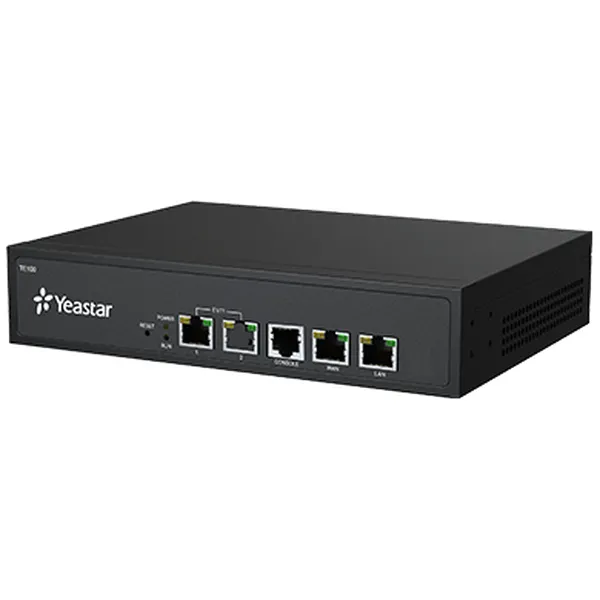
Yeastar TE100 E1 T1 PRI VoIP Gateway in Dubai, UAE
The Yeastar TE100 is built for companies that need a controlled bridge between existing E1/T1/J1 PRI lines and SIP-based voice systems. It helps organizations keep valuable telephony infrastructure active while moving toward IP-PBX, SIP trunking, branch connectivity, or unified communications planning. FourTeck.com supports UAE buyers with model review, compatibility guidance, quote assistance, and delivery coordination for business voice projects.
Quick Product Information
Best Fit
Ideal when a business wants to retain a PRI line or PBX while adding SIP connectivity.
Main Benefit
Supports phased voice migration so the organization does not need a complete replacement immediately.
Check First
Confirm line type, signaling, IP-PBX compatibility, codec preferences, and concurrent call requirement.
FourTeck Help
FourTeck.com can help review project information before preparing a business quotation.
Product Overview
Many businesses still depend on PRI connections, traditional PBX systems, or carrier lines that were installed before the wider adoption of SIP trunks and IP telephony. A sudden full migration can create risk, downtime, user confusion, and unexpected cost. The TE100 provides a practical middle path by linking E1/T1/J1 infrastructure with VoIP networks. This allows companies to protect earlier telecom investments while preparing for a more flexible voice environment.
For an IT manager, the value is not only the hardware. The real value is the ability to integrate voice routes, manage call flow, support existing phone extensions, and test VoIP adoption in a controlled way. A company can continue using existing PBX resources while adding SIP trunk routing, IP-PBX integration, softswitch connectivity, or site-to-site voice planning. This is helpful for organizations that cannot interrupt customer calls, hotel reservations, school administration lines, clinic appointments, or support desk numbers.
FourTeck.com positions this product as a business communication gateway rather than a simple telecom accessory. Buyers in Dubai and the UAE can share their current PBX model, carrier connection, number of voice channels, preferred SIP platform, and installation environment. The FourTeck.com team can then support quote preparation and guide the buyer on related items such as IP phones, PBX systems, network switches, rack planning, and cabling requirements.
Key Business Benefits
◆ Legacy Protection
Businesses can continue using existing PRI and PBX resources while preparing a gradual transition to VoIP. This reduces waste and avoids forcing every department into a sudden telephony change.
◆ Migration Flexibility
The gateway allows IT teams to introduce SIP-based routing, test IP-PBX integration, and manage voice paths in stages rather than rebuilding the full communication system at once.
◆ Call Routing Control
Administrators can plan how calls move between traditional and IP networks, supporting cost control, better routing decisions, and cleaner branch or carrier integration.
◆ Business Continuity
For environments where voice calls are operationally critical, the product helps maintain familiar telephony services during upgrade planning, testing, and phased deployment.
◆ Simple Management
A web-based management approach helps technical teams configure, monitor, and adjust gateway settings without relying only on older PBX maintenance methods.
◆ Procurement Clarity
FourTeck.com can help buyers confirm the correct model, line interface, related accessories, and quote details before committing to a telecom refresh project.
Product Highlights
This gateway is designed around a very practical business requirement: connecting a traditional digital trunk with a VoIP environment. It supports one E1/T1/J1 port and is commonly used where a company wants to bridge ISDN PRI services with an IP-PBX or SIP platform. The model is suitable for up to 30 concurrent calls, depending on deployment and line configuration. That makes it a useful choice for smaller and mid-sized sites where a single PRI interface is enough for daily call volume.
Important highlights include software configurable E1/T1/J1 operation, SIP protocol support, PRI-oriented deployment, routing control, web-based configuration, and compatibility with various PBX, IP-PBX, and softswitch environments. Buyers should confirm signaling requirements, codec preferences, network addressing, firewall rules, and the role the gateway will play in the voice topology. The product should be selected as part of a complete telephony plan, not only by model name.
For teams replacing older voice equipment, it can be used to connect a VoIP-only system to a traditional carrier line. For teams preserving an existing PBX, it can allow VoIP trunks or IP systems to communicate with the legacy environment. FourTeck.com can support the quotation stage by helping procurement teams collect the details required for a more accurate offer.
Technical Specifications
Configuration and Buyer Guidance
Before requesting a quotation, buyers should define how the gateway will be used. Some organizations need PRI-to-SIP bridging because the carrier line remains active. Others need SIP-to-PRI connectivity because a VoIP system must still communicate with an older PBX. A hotel may need to preserve room extension behavior, a school may need stable administration lines, and an office may want to reduce external call cost without changing every handset immediately.
Line Details
Confirm whether the service is E1, T1, J1, PRI, and what signaling settings are required.
Voice Platform
Share the PBX or IP-PBX model, firmware version, SIP trunk provider, and current dial plan.
Call Capacity
Estimate peak concurrent calls, department usage, and whether expansion may be required later.
Deployment Needs
Consider rack placement, power, LAN access, firewall rules, cabling, and installation support.
Ideal Business Use Cases
Office PRI Migration
A company moving from traditional PRI to SIP can use the gateway to keep current voice services while the IP telephony environment is introduced in phases.
Hotel and Hospitality PBX
Hospitality sites often need careful voice continuity for guest services, reception, back office, and operations. A staged bridge can reduce disruption.
School or Clinic Voice Lines
Education and healthcare environments may need to retain familiar numbering while connecting modern IP-based call handling or routing.
Branch Connectivity
Branches with different telecom systems can use gateway planning to link older and newer voice environments more cleanly.
Yeastar TE100 Call Bridging and PRI Integration
The most important role of this product is to bridge two worlds that often exist together inside the same organization: the established PRI environment and the newer VoIP environment. In real projects, this bridge can be the difference between a manageable migration and a disruptive replacement. Instead of asking every team to switch systems on the same day, IT leaders can create a transition path. Existing numbers, carrier lines, and PBX behavior can be evaluated while the organization prepares for SIP trunks, IP phones, call recording, contact center tools, or unified communications workflows.
A buyer should plan the gateway around call direction, routing logic, and the preferred target platform. The device may sit between a carrier line and an IP-PBX, or between a VoIP system and a legacy PBX. FourTeck.com can help the buyer collect the basic details required before a quotation, including carrier type, line handoff, PBX model, site location, and expected usage.
Yeastar TE100 Management and Deployment Simplicity
Telephony gateways should be understandable for the team that maintains them. A practical management interface makes it easier to review settings, adjust routing, and coordinate with an integrator or voice engineer. This is especially important for smaller businesses that may not have a dedicated telecom department. A gateway that can be configured through a web-based interface can make maintenance more accessible to trained IT staff.
Deployment still requires proper planning. Voice networks are sensitive to incorrect signaling, codec mismatch, network address translation, firewall policies, and call routing rules. Buyers should not assume that any PRI gateway will work without checking the surrounding system. FourTeck.com encourages buyers to share the current topology before quotation so the product can be reviewed as part of the overall communication design.
Yeastar TE100 Business Continuity for Voice Projects
Business calls affect sales, support, reservations, appointments, vendor coordination, and internal decision making. When a voice system changes, the risk is not only technical; it is operational. Missed calls can affect customer experience and staff productivity. A PRI VoIP gateway can support continuity by allowing old and new voice systems to coexist while the business decides the right timing for wider migration.
This type of deployment is useful when management wants to control cost, avoid rushed replacement, or preserve special PBX features until a new system is proven. It also helps procurement teams justify a phased project because the gateway supports practical transition instead of unnecessary equipment waste. FourTeck.com can help buyers review related requirements such as IP phones, network readiness, rack space, UPS protection, and compatible PBX options.
What Buyers Should Check Before Purchase
A gateway purchase should begin with the business problem, not only the model number. Buyers should confirm whether the project is meant to connect a carrier PRI line to a modern IP-PBX, connect a VoIP system to an older PBX, maintain a backup path, or reduce calling cost through SIP trunking. The answer affects routing design, installation work, and the accessories needed for the project.
Configuration Fit
Confirm one PRI port is enough and that expected concurrent call volume fits the planned deployment.
Compatibility Check
Review PBX, IP-PBX, softswitch, SIP provider, codecs, signaling, and firewall requirements before ordering.
Availability and Warranty
Ask FourTeck.com to confirm current availability, warranty guidance, and delivery coordination for the UAE.
Quote Preparation
Share site location, carrier details, PBX model, call volume, and deployment timeline for a clearer quotation.
UAE Availability and Service Support
FourTeck.com supports product inquiries across Dubai and the UAE with assistance for product selection, configuration review, quote requests, delivery coordination, and warranty guidance. Availability may vary based on product model, supplier status, selected configuration, and order quantity. For telephony gateways, the most helpful quotation request includes the current PBX model, required interface, number of channels, site details, expected installation timeline, and any related accessories.
Because voice gateway projects are often tied to existing infrastructure, FourTeck.com recommends confirming suitability before purchase. The team can also help buyers consider related telecom products, business networking equipment, UPS protection, rack accessories, and migration-friendly alternatives.
Dubai, Abu Dhabi, Sharjah, and Ajman Coverage
Businesses in Dubai, Abu Dhabi, Sharjah, Ajman, and other UAE locations can contact FourTeck.com for product availability, configuration guidance, and quote assistance. The team can help buyers review whether this PRI gateway fits the existing carrier line, PBX platform, VoIP migration plan, and business communication requirements. This combined UAE coverage approach is useful for procurement teams managing multiple locations because they can discuss model suitability, quantity, delivery coordination, and related project requirements through one clear inquiry process.
GCC and Africa Availability
FourTeck.com also supports business technology inquiries across selected GCC and Africa markets through regional platforms and inquiry channels. Buyers in Saudi Arabia, Qatar, Oman, Kuwait, Bahrain, Kenya, Uganda, and other regional locations may require different availability handling, delivery options, warranty processes, and configuration support depending on country and supplier status. Regional buyers can start from FourTeck.com, FourTeck Kenya, FourTeck Uganda, FourTeck Africa, or FourTeck Kuwait for inquiry direction.
Related Models and Suitable Alternatives
Yeastar TE200 PRI Gateway
Consider when two PRI ports or higher channel capacity may be required.
Yeastar TA FXS Gateways
Useful for connecting analog phones, fax devices, or analog extensions to VoIP.
Yeastar TG GSM Gateways
Suitable where GSM or mobile network integration is part of the voice design.
Yeastar P-Series PBX
Consider for businesses planning a broader communication system refresh.
Why Buyers Choose FourTeck.com
FourTeck.com helps business buyers move from product interest to practical procurement. Telecom gateway selection can be confusing because the same product may be used in different ways depending on carrier lines, PBX type, SIP trunk provider, firewall design, and the migration plan. FourTeck.com focuses on gathering the correct details before quotation so buyers can avoid mismatched hardware, missing accessories, and unclear expectations.
Frequently Asked Questions
What is the Yeastar TE100 used for?
It is used to connect E1/T1/J1 PRI telephony infrastructure with VoIP networks. Businesses commonly use it when they want to keep an existing PBX or carrier line while adding SIP trunking, IP-PBX connectivity, or a phased voice migration plan.
Is it suitable for UAE business phone systems?
Yes, it can be suitable for UAE organizations that use compatible PRI lines and need to connect them with VoIP systems. Buyers should confirm carrier line type, signaling, PBX compatibility, and installation environment before finalizing the quotation.
How many calls can it support?
The TE100 is generally selected for up to 30 concurrent calls, depending on the active line, configuration, and deployment design. If the business expects higher capacity or multiple PRI ports, FourTeck.com can help review alternatives such as a higher model.
Can FourTeck.com help with configuration selection?
FourTeck.com can support the quotation stage by reviewing the intended use, PBX model, IP-PBX platform, current carrier service, site location, and related accessories. This helps buyers request a more accurate offer and avoid selecting the wrong gateway type.
Does availability depend on configuration?
Availability may vary based on supplier status, quantity, region, and related project requirements. FourTeck.com does not need buyers to assume stock status; the best approach is to request a current quote and confirm the exact procurement timeline.
What information should I share before quotation?
Share the current PBX or IP-PBX model, carrier line type, expected call volume, site location, required quantity, preferred deployment date, and whether installation guidance or related networking equipment is required.
Can it be used for SIP trunk migration?
Yes, it can support migration scenarios where PRI and SIP environments must communicate. The exact routing design should be planned with a telecom engineer or integrator, especially when existing numbers, failover, or complex dial plans are involved.
How do I request a quote?
Use the FourTeck.com contact page and provide your business requirement. The team can assist with availability checking, quote preparation, warranty guidance, and related product suggestions for your voice infrastructure project.
Need Help Choosing the Right PRI Gateway?
FourTeck.com can help you review gateway suitability, current availability, warranty guidance, and business deployment requirements before you request a formal quotation.

Reviews
There are no reviews yet.